Current Affairs Ukraine

Status
Not open for further replies.
This lad has served in Afghanistan and has close mates in the Ukrainian Legion.Worth checking out his daily updates. There's a video he posted a few weeks ago,in it his mate is wearing a body cam while clearing trenches of Russian troops.Some really bizzare stuff going on.
 
America’s Stark Choice in Ukraine and the Cost of Letting Russia Win

By Fredrick W. Kagan

April 16, 2024

The current US debate about providing additional military assistance to Ukraine is based in part on the assumption that the war will remain stalemated regardless of US actions. That assumption is false.[1] The Russians are breaking out of positional warfare and beginning to restore maneuver to the battlefield because of the delays in the provision of US military assistance to Ukraine. Ukraine cannot hold the present lines now without the rapid resumption of US assistance, particularly air defense and artillery that only the US can provide rapidly and at scale.[2] Lack of air defense has exposed Ukrainian front-line units to Russian aircraft that are now dropping thousands of bombs on Ukrainian defensive positions for the first time in this war.[3] Ukrainian artillery shortages are letting the Russians use armored columns without suffering prohibitive losses for the first time since 2022.[4] The Russians are pressing their advantage and advancing slowly but steadily on several sectors of the front. Since the beginning of this year, Russian forces have seized over 360 square kilometers - an area the size of Detroit. Russian advances will accelerate absent urgent American action. US policymakers must internalize the reality that further delaying or stopping American military assistance will lead to dramatic Russian gains later in 2024 and in 2025 and, ultimately, to Russian victory.

The United States thus has only two real choices today. It can quickly resume providing military aid to let Ukraine stabilize the front lines near the current locations. Or it can let the Russians defeat the Ukrainian military and drive toward the NATO borders from the Black Sea to central Poland. There is no third option. The risks of a Russian attack against NATO in the near future would rise dramatically if the US allows Russia to defeat Ukraine now, and the challenge of defending the Baltic States in particular could become almost insurmountable. These long-term risks and costs far outweigh the short-term price of resuming assistance to Ukraine.

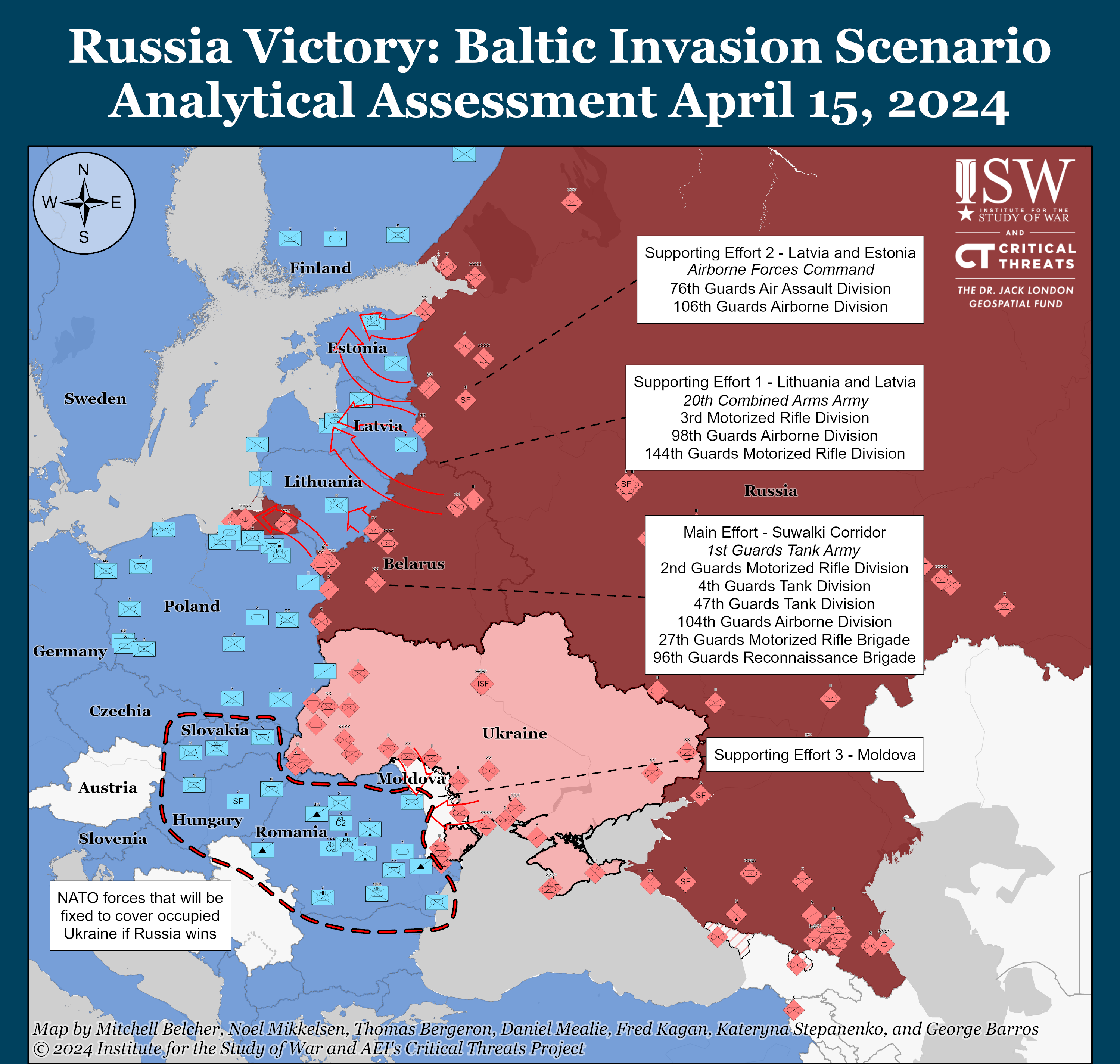
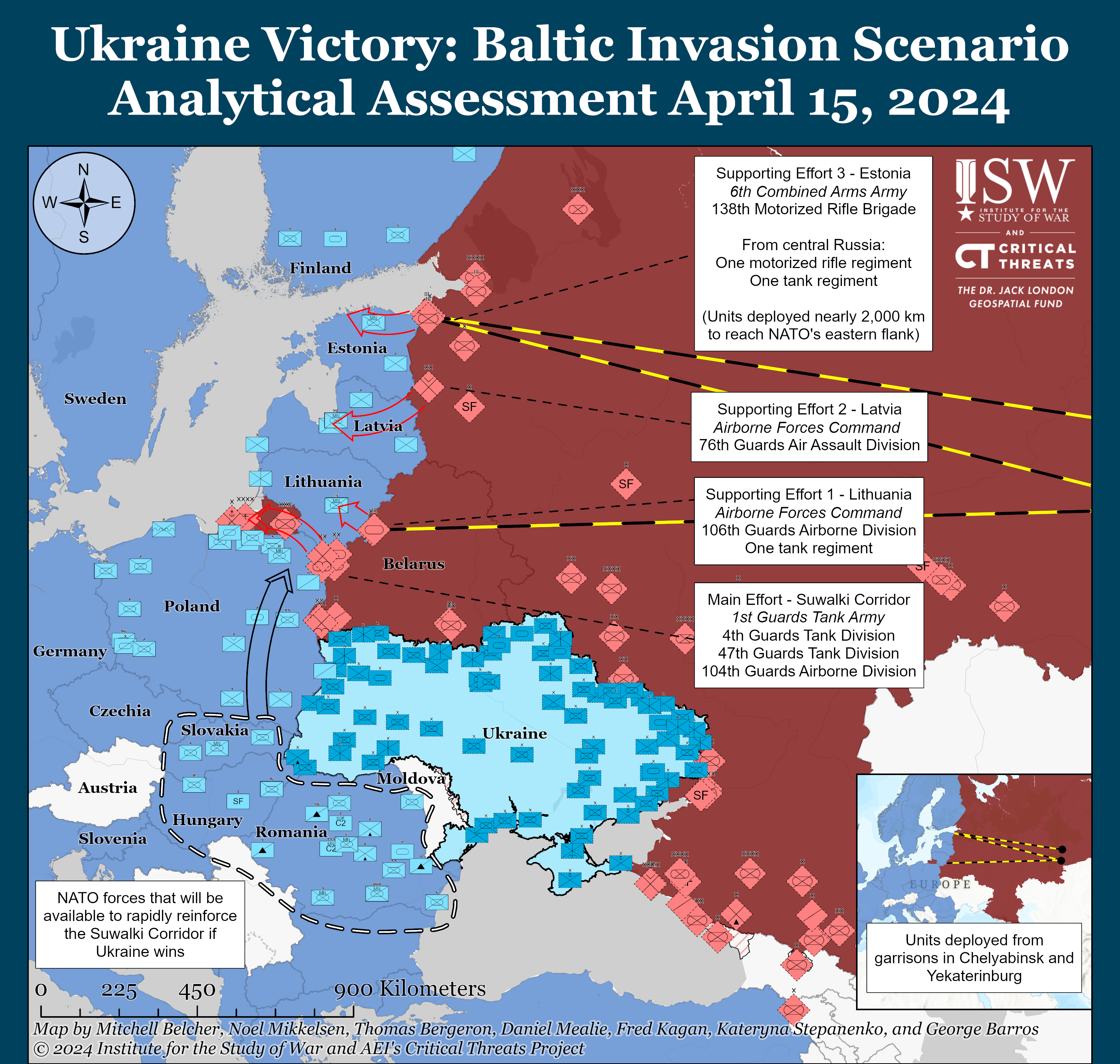
Russian victory in Ukraine would have devastating consequences for the defense of NATO.[5] Ukrainian success, even if Ukraine just holds the frontlines roughly where they now are, on the other hand, would make a successful Russian attack on Poland or the Baltic States much harder and riskier. It would dramatically strengthen NATO’s ability to deter and defend against future Russian aggression. The two maps presented below illustrate the advantages Russia would secure by defeating Ukraine and those that NATO would receive from helping Ukraine hold the line or push the Russians further east and south.

NATO’s Future Is Linked with Ukraine’s Regardless of Ukraine’s Membership Status

A successful Ukrainian military will be the largest and most powerful in Europe after Russia’s—it will be far stronger than that of any European NATO state. Ukraine will deploy its forces along its borders with Russia and Belarus to deter and defend against future Russian aggression. Ukraine will rely on continued assistance at first in the form of equipment but, over time, primarily in the form of money to purchase and maintain its own equipment, from a wide array of European and Asian states that keenly understand the importance of preventing a renewed Russian attack.[6] Ukrainians will recognize that their future is linked with NATO’s survival and deterring Russian attacks on NATO as well as on Ukraine, even if Ukraine is not a member of the alliance.

Russian military leaders planning an invasion of the Baltic States or an attack on Poland will have to assume that Ukraine might enter such a war on NATO’s behalf regardless of Ukraine’s membership status. That planning assumption will have a dramatic impact on Russian campaign plans for a war of aggression against NATO, as we shall see.

If Russia defeats Ukraine, on the other hand, NATO will face tremendous challenges in defending its northeastern members. Ukrainians will not tamely submit to Russian conquest, to be sure, and Russian military victory will very likely be followed by a massive Ukrainian insurgency.[7] But the Russians are already preparing forces distinct from their regular military units to handle such an insurgency, and they will very likely be able to sustain conventional military capabilities to threaten NATO from Ukrainian territory even while addressing Ukrainian insurgents.[8] The Russians will also impress hundreds of thousands or even millions of Ukrainians into military service, along with the defense industrial base Ukrainians are now constructing, significantly increasing Russia’s military and economic potential.

In this dire scenario, therefore, NATO must expect to face large Russian conventional forces along its entire border from the Black Sea to the Arctic, bringing the southern Polish, Hungarian, Slovakian, and Romanian borders under threat of Russian ground attack for the first time since the fall of the Soviet Union. This threat would pin NATO forces in southeastern Europe and would draw additional forces from the US and Western European NATO states to southern and central Europe, depriving NATO of reserves that would otherwise be available to reinforce the Baltic States rapidly in the event of a threatened Russian invasion. These NATO troops, inexperienced in fighting modern mechanized war, would be staring down a battle-hardened Russian military, emboldened from its victory in Ukraine.

The Russian military could prepare campaign plans for an attack on Poland and/or the Baltic States with no concern for its rear areas. That planning assumption would allow Russia to concentrate against the Baltic States forces they would otherwise have to array along the Ukrainian frontier to deter or defend against a Ukrainian effort to help defend NATO. It is almost impossible to overstate how much the success or failure of Ukraine’s current efforts to fight off the Russian attack changes the prospects of a future Russian attack against NATO’s northeastern flank.

Scenarios and Assumptions

The maps below depict current NATO deployments, notional Ukrainian deployments based on pre-war Ukrainian military positions, and notional Russian force concentrations for an invasion of the Baltic States. The underlying scenario assumes that the Russians will prioritize cutting the Suwalki Corridor that runs between northwestern Belarus (around Grodno) and the Russian exclave of Kaliningrad to prevent NATO from reinforcing or supplying the Baltic States while Russian armored and airborne units seize the Baltic States themselves. The scenario also assumes that the Russians will seek to prepare and attack fast enough to avoid giving NATO time to bring large reinforcements from the US, France, Germany, and the UK to the Suwalki Corridor and the Baltic States before they invade. It thus considers a Russian invasion force largely drawn from units in the newly-reestablished Leningrad and Moscow Military Districts, as those forces could move to attack positions and launch an invasion much more rapidly than a larger Russian force drawing on units in the Caucasus, near Central Asia, or in the Far East. The challenge the Russians would face in covering the frontier of a strong and independent Ukraine would likely consume any forces the Russians might choose to make available from further south and east in any event. Generating the Russian combat power necessary to take the Baltic States with the reduced strike force in that scenario would likely require some reinforcement from central Russia as well. That scenario would require a much larger and slower mobilization of Russian forces that NATO would see and be able to respond to.


The deployments and movements depicted on these maps are notional, and the details are open to debate and discussion. The bottom line, however, is very clear. An independent Ukraine with a strong military and a pro-Western government will make a Russian attack on NATO much more difficult, risky, and costly for Moscow. An independent and strong Ukraine will thus help NATO deter such a Russian attack and defeat it if deterrence fails. A victorious Russia that succeeds in its aim of destroying Ukraine entirely, on the other hand, will pose a major conventional military threat to NATO in a relatively short period of time. It will be much harder to deter future Russian aggression and both more difficult and far more costly to defeat it if deterrence fails. The choice before the US today is thus stark, but the answer is clear. American interests now and in the future are served far better by resuming aid to Ukraine now than by allowing Russia to win.

 
America’s Stark Choice in Ukraine and the Cost of Letting Russia Win

By Fredrick W. Kagan

April 16, 2024

The current US debate about providing additional military assistance to Ukraine is based in part on the assumption that the war will remain stalemated regardless of US actions. That assumption is false.[1] The Russians are breaking out of positional warfare and beginning to restore maneuver to the battlefield because of the delays in the provision of US military assistance to Ukraine. Ukraine cannot hold the present lines now without the rapid resumption of US assistance, particularly air defense and artillery that only the US can provide rapidly and at scale.[2] Lack of air defense has exposed Ukrainian front-line units to Russian aircraft that are now dropping thousands of bombs on Ukrainian defensive positions for the first time in this war.[3] Ukrainian artillery shortages are letting the Russians use armored columns without suffering prohibitive losses for the first time since 2022.[4] The Russians are pressing their advantage and advancing slowly but steadily on several sectors of the front. Since the beginning of this year, Russian forces have seized over 360 square kilometers - an area the size of Detroit. Russian advances will accelerate absent urgent American action. US policymakers must internalize the reality that further delaying or stopping American military assistance will lead to dramatic Russian gains later in 2024 and in 2025 and, ultimately, to Russian victory.

The United States thus has only two real choices today. It can quickly resume providing military aid to let Ukraine stabilize the front lines near the current locations. Or it can let the Russians defeat the Ukrainian military and drive toward the NATO borders from the Black Sea to central Poland. There is no third option. The risks of a Russian attack against NATO in the near future would rise dramatically if the US allows Russia to defeat Ukraine now, and the challenge of defending the Baltic States in particular could become almost insurmountable. These long-term risks and costs far outweigh the short-term price of resuming assistance to Ukraine.

Russian victory in Ukraine would have devastating consequences for the defense of NATO.[5] Ukrainian success, even if Ukraine just holds the frontlines roughly where they now are, on the other hand, would make a successful Russian attack on Poland or the Baltic States much harder and riskier. It would dramatically strengthen NATO’s ability to deter and defend against future Russian aggression. The two maps presented below illustrate the advantages Russia would secure by defeating Ukraine and those that NATO would receive from helping Ukraine hold the line or push the Russians further east and south.

NATO’s Future Is Linked with Ukraine’s Regardless of Ukraine’s Membership Status

A successful Ukrainian military will be the largest and most powerful in Europe after Russia’s—it will be far stronger than that of any European NATO state. Ukraine will deploy its forces along its borders with Russia and Belarus to deter and defend against future Russian aggression. Ukraine will rely on continued assistance at first in the form of equipment but, over time, primarily in the form of money to purchase and maintain its own equipment, from a wide array of European and Asian states that keenly understand the importance of preventing a renewed Russian attack.[6] Ukrainians will recognize that their future is linked with NATO’s survival and deterring Russian attacks on NATO as well as on Ukraine, even if Ukraine is not a member of the alliance.

Russian military leaders planning an invasion of the Baltic States or an attack on Poland will have to assume that Ukraine might enter such a war on NATO’s behalf regardless of Ukraine’s membership status. That planning assumption will have a dramatic impact on Russian campaign plans for a war of aggression against NATO, as we shall see.

If Russia defeats Ukraine, on the other hand, NATO will face tremendous challenges in defending its northeastern members. Ukrainians will not tamely submit to Russian conquest, to be sure, and Russian military victory will very likely be followed by a massive Ukrainian insurgency.[7] But the Russians are already preparing forces distinct from their regular military units to handle such an insurgency, and they will very likely be able to sustain conventional military capabilities to threaten NATO from Ukrainian territory even while addressing Ukrainian insurgents.[8] The Russians will also impress hundreds of thousands or even millions of Ukrainians into military service, along with the defense industrial base Ukrainians are now constructing, significantly increasing Russia’s military and economic potential.

In this dire scenario, therefore, NATO must expect to face large Russian conventional forces along its entire border from the Black Sea to the Arctic, bringing the southern Polish, Hungarian, Slovakian, and Romanian borders under threat of Russian ground attack for the first time since the fall of the Soviet Union. This threat would pin NATO forces in southeastern Europe and would draw additional forces from the US and Western European NATO states to southern and central Europe, depriving NATO of reserves that would otherwise be available to reinforce the Baltic States rapidly in the event of a threatened Russian invasion. These NATO troops, inexperienced in fighting modern mechanized war, would be staring down a battle-hardened Russian military, emboldened from its victory in Ukraine.

The Russian military could prepare campaign plans for an attack on Poland and/or the Baltic States with no concern for its rear areas. That planning assumption would allow Russia to concentrate against the Baltic States forces they would otherwise have to array along the Ukrainian frontier to deter or defend against a Ukrainian effort to help defend NATO. It is almost impossible to overstate how much the success or failure of Ukraine’s current efforts to fight off the Russian attack changes the prospects of a future Russian attack against NATO’s northeastern flank.

Scenarios and Assumptions

The maps below depict current NATO deployments, notional Ukrainian deployments based on pre-war Ukrainian military positions, and notional Russian force concentrations for an invasion of the Baltic States. The underlying scenario assumes that the Russians will prioritize cutting the Suwalki Corridor that runs between northwestern Belarus (around Grodno) and the Russian exclave of Kaliningrad to prevent NATO from reinforcing or supplying the Baltic States while Russian armored and airborne units seize the Baltic States themselves. The scenario also assumes that the Russians will seek to prepare and attack fast enough to avoid giving NATO time to bring large reinforcements from the US, France, Germany, and the UK to the Suwalki Corridor and the Baltic States before they invade. It thus considers a Russian invasion force largely drawn from units in the newly-reestablished Leningrad and Moscow Military Districts, as those forces could move to attack positions and launch an invasion much more rapidly than a larger Russian force drawing on units in the Caucasus, near Central Asia, or in the Far East. The challenge the Russians would face in covering the frontier of a strong and independent Ukraine would likely consume any forces the Russians might choose to make available from further south and east in any event. Generating the Russian combat power necessary to take the Baltic States with the reduced strike force in that scenario would likely require some reinforcement from central Russia as well. That scenario would require a much larger and slower mobilization of Russian forces that NATO would see and be able to respond to.


The deployments and movements depicted on these maps are notional, and the details are open to debate and discussion. The bottom line, however, is very clear. An independent Ukraine with a strong military and a pro-Western government will make a Russian attack on NATO much more difficult, risky, and costly for Moscow. An independent and strong Ukraine will thus help NATO deter such a Russian attack and defeat it if deterrence fails. A victorious Russia that succeeds in its aim of destroying Ukraine entirely, on the other hand, will pose a major conventional military threat to NATO in a relatively short period of time. It will be much harder to deter future Russian aggression and both more difficult and far more costly to defeat it if deterrence fails. The choice before the US today is thus stark, but the answer is clear. American interests now and in the future are served far better by resuming aid to Ukraine now than by allowing Russia to win.

Strange concept the Russian army. Schrödinger comes to mind. A rag tag group of untrained press ganged convicts and teenage conscripts. Under fed,armed only with shovels and rusty WW2 era rifles. Yet at the same time a well oiled machine using the latest military technology and poised to roll over Poland and then the Baltic States 🤔
 
Strange concept the Russian army. Schrödinger comes to mind. A rag tag group of untrained press ganged convicts and teenage conscripts. Under fed,armed only with shovels and rusty WW2 era rifles. Yet at the same time a well oiled machine using the latest military technology and poised to roll over Poland and then the Baltic States 🤔
It's not the boots on the ground who decide who they attack. It's the little weasel in the Kremlin, but you know this I'm sure.
 
It's not the boots on the ground who decide who they attack. It's the little weasel in the Kremlin, but you know this I'm sure.
Which army is it? There appears to be two at the same time. Obviously depends on the media you read. Just maybe the ultra efficient army ready to invade NATO countries is the one that justifies continued years of austerity?
 
Strange concept the Russian army. Schrödinger comes to mind. A rag tag group of untrained press ganged convicts and teenage conscripts. Under fed,armed only with shovels and rusty WW2 era rifles. Yet at the same time a well oiled machine using the latest military technology and poised to roll over Poland and then the Baltic States 🤔
Ain't that the case for any enemy army or force? Belittle them publicly for morale and prepare for them being as strong as they could be?

Russian forces are of course strengthened through actual engaging in combat. No doubt their weapons and supply systems have improved immeasurably. A point will of course may come when they are able to go toe to toe with NATO if they wanted to play a game of chicken and see if NATO would respond if a FSU country was attacked. The best way to ensure that this scenario doesn't happen in the short term is arm/ strengthen the eastern most NATO members and put western members' troops in there to make sure they have skin in the game. Best long term is to bring Russia back into the fold and calm stuff down but I don't see that happening until Putin and his cronies are gone from power.

I don't think Russia has any interest in taking on NATO simply due to them being far more calculating over potential outcomes and the consequences would far outweigh the benefits (if any).
 
Ain't that the case for any enemy army or force? Belittle them publicly for morale and prepare for them being as strong as they could be?

Russian forces are of course strengthened through actual engaging in combat. No doubt their weapons and supply systems have improved immeasurably. A point will of course may come when they are able to go toe to toe with NATO if they wanted to play a game of chicken and see if NATO would respond if a FSU country was attacked. The best way to ensure that this scenario doesn't happen in the short term is arm/ strengthen the eastern most NATO members and put western members' troops in there to make sure they have skin in the game. Best long term is to bring Russia back into the fold and calm stuff down but I don't see that happening until Putin and his cronies are gone from power.

I don't think Russia has any interest in taking on NATO simply due to them being far more calculating over potential outcomes and the consequences would far outweigh the benefits (if any).
I totally agree, NATO should always be vigilant,but the problem is it will cost money that just isn't there. The average man on the street wants access to the NHS the buses to run on time etc. Taking the UK as an example, who's finances are in a mess yet have just signed a decade (minimum) promise to support Ukraine. And it appears to be being justified by suggesting that the Russian army that has taken over two years to invade a little more than 17% of Ukraine will in some miraculous way be a threat to Latvia and Lithuania sometime in the near future.
 
I totally agree, NATO should always be vigilant,but the problem is it will cost money that just isn't there. The average man on the street wants access to the NHS the buses to run on time etc. Taking the UK as an example, who's finances are in a mess yet have just signed a decade (minimum) promise to support Ukraine. And it appears to be being justified by suggesting that the Russian army that has taken over two years to invade a little more than 17% of Ukraine will in some miraculous way be a threat to Latvia and Lithuania sometime in the near future.
Good luck to any government in sorting out how to balance of their domestic requirements and obligations against supporting overseas interests.

We've been in a prolonged period of relative peace so it's no wonder we're under invested in arms and military capability. This has been a wake up call.

As for the promise of £3 B per year for as long as it takes to Ukraine, only time will tell how long we will give that much and actually how much gets to Ukraine and in what form?
 
Good luck to any government in sorting out how to balance of their domestic requirements and obligations against supporting overseas interests.

We've been in a prolonged period of relative peace so it's no wonder we're under invested in arms and military capability. This has been a wake up call.

As for the promise of £3 B per year for as long as it takes to Ukraine, only time will tell how long we will give that much and actually how much gets to Ukraine and in what form?
It's a balancing act. Any government needs to be mindful of how much deprivation their population will take. Military security is important but until it happens war is an abstract concept. Although I'm sure that UK citizens have great sympathy for the plight of Ukraine in reality they are more concerned about getting a GP appointment and paying their utility bills
 
Interesting video highlights how warfare is quickly changing into a battle of technology rather than pure manpower.
 
I totally agree, NATO should always be vigilant,but the problem is it will cost money that just isn't there. The average man on the street wants access to the NHS the buses to run on time etc. Taking the UK as an example, who's finances are in a mess yet have just signed a decade (minimum) promise to support Ukraine. And it appears to be being justified by suggesting that the Russian army that has taken over two years to invade a little more than 17% of Ukraine will in some miraculous way be a threat to Latvia and Lithuania sometime in the near future.
Was listening to a deterrence podcast the other day talking about European deterrence, Macron etcetera. They are US folks so probably see things in a slightly more right wing way than we Europeans do but they raised an interesting point that in essence European welfare states have been subsidised by America’s defence spending guaranteeing their safety and providing a nuclear umbrella. I would suggest that it’s probably not quite as simplistic as that but there’s certainly a grain of truth in it.
 
Was listening to a deterrence podcast the other day talking about European deterrence, Macron etcetera. They are US folks so probably see things in a slightly more right wing way than we Europeans do but they raised an interesting point that in essence European welfare states have been subsidised by America’s defence spending guaranteeing their safety and providing a nuclear umbrella. I would suggest that it’s probably not quite as simplistic as that but there’s certainly a grain of truth in it.
If Trump ends up being elected then he's very much on the record as saying that Europe has to up their defence spending and not rely on the US. Can they take that financial strain is the question as they all appear to be in one way or another indebted to each other. Hard to understand how the UK can commit to long term multiple billions of aid to Ukraine while people die on NHS waiting lists.
 
If Trump ends up being elected then he's very much on the record as saying that Europe has to up their defence spending and not rely on the US. Can they take that financial strain is the question as they all appear to be in one way or another indebted to each other. Hard to understand how the UK can commit to long term multiple billions of aid to Ukraine while people die on NHS waiting lists.
30billion of test and trace app money to recover - bosh! 10 years of support for Ukraine straight off the bat!
 
Status
Not open for further replies.

Welcome

Join the Everton conversation today.
Fewer ads, full access, completely free.

🛒 Visit Shop

Support Grand Old Team by checking out our latest Everton gear!
Back
Top