Current Affairs Palestinian Elections

Status
Not open for further replies.
Netanyahu has decided that the flag day March will now be allowed to take place and go through the Muslim quarter of the city, which will be a massive provocation to Palestinian Arabs.

Perhaps he wants violence in order for this fragile coalition to fall apart and thus keeping himself in power which show what a truly vile man he is.

He is willing to spill blood to avoid losing power and face trial for corruption. But why isn’t this widely reported in the media ?

Hamas will no that used this to fire more rockets and Netanyahu will use the violence as a justification to stay in power at the same time telling the Israeli right only he can keep them safe and try and force defections.
You're right about Netanyahu - never underestimate the depths to which he will plunge.

Regarding the march, it's been rescheduled for next Tuesday, two days after the new government is due to be sworn in, so Bibi should be in opposition then. I understand that no decision has been taken yet on the route and whether it will be allowed to pass through the Muslim Quarter - either way it could provide the first of many headaches for the new government.
 
Egypt yesterday informed all Palestinian factions that it will "indefinitely postpone" its scheduled hosting of intra-Palestinian dialogue in Cairo this Saturday-Sunday due to "the lack of a common ground between Fatah and Hamas." Instead, the Egyptians will hold separate talks with Hamas, Islamic Jihad and the PA.
Hamas are represented by, amongst others, leader Ismail Haniyeh and Moussa Abu Marzouk, both of whom flew in from their homes in Qatar, while the PA are represented by Jibril Rajoub, architect of the agreement to hold elections. Islamic Jihad are represented by designated Global Terrorist Ziyad al-Nakhalah. The meeting is meant to pave the way for a unity government (unelected), future elections, and sort out the reconstruction of Gaza.

This is the 15th attempt at reconciliation between Hamas and the PA since 2007 - so far only one has succeeded, the one for the cancelled elections. Since then, Abbas's cancellation of the elections and Hamas's war with Israel has shifted the balance of power.

Haniyeh has announced that he will leave for talks with Hezbollah leaders in Lebanon before heading to Iran to meet their leadership and military chiefs. Other members of Hamas are expected to remain in Cairo awaiting the arrival of an Israeli delegation to discuss (not face to face) strengthening the ceasefire and the long awaited prisoner exchange.
 
While the election of a new Israeli government led by a new prime minister have made the headlines all over the world, the appointment on Sunday of a new prime minister for Gaza has gone almost unnoticed. Issam al-Da’alis succeeded Mohammed Awad, who resigned after two years in the job. It is not clear why Awad submitted his resignation, and it's highly unlikely we'll ever find out.

Meanwhile a predictable row has broken out between the PA and Egypt over the rebuilding of Gaza. The PA have accused Egypt of working directly with Hamas rather than themselves as had been agreed, or so they thought. Egypt, on the other hand, are said to be outraged by the PA's alleged attempt to obstruct Cairo’s effort to contribute to the reconstruction of the strip.

The tensions between Ramallah and Cairo are also related to the PA’s demand to supervise the entry of Qatari cash grants into the Gaza Strip, so as to ensure that the funds do not end up in the hands of Hamas.

While Egypt seem keen to befriend one Islamist party they continue to crack down on their own Islamists after a court in Cairo upheld death sentences for 12 Muslim Brotherhood members, including two senior leaders. The court reduced the sentences of 31 others to life in prison - the rulings were final and cannot be appealed.

Another concern for the PA is Egypt’s continued support for deposed Fatah leader Mohammad Dahlan, an archrival of PA President Mahmoud Abbas. Dahlan has close links with Egyptian President Sisi. The last few weeks have seen the PA arrest more than 150 Dahlan supporters in the West Bank.

The PA is also worried about Hamas’s demand that jailed Fatah leader Marwan Barghouti be included in any prisoner-exchange agreement with Israel. They fear that such a move would further boost Hamas’s popularity among Palestinians, which has already increased after the 11-day fighting with Israel. Hamas political leader Ismail Haniyeh, who visited Cairo last week, met with Barghouti’s wife, Fadwa, and discussed with her the issue of a prisoner swap with Israel.
 
Palestine is in uproar today following the death of political activist Nizar Banat, apparently beaten to death during a raid on his home by PA security officers.

Banat was one of the prominent critics of the PA and had been arrested several times in the past by Palestinian security forces. He was also a candidate for the cancelled legislative elections, after which he and his party appealed to the EU and the Court of Human Rights in Strasbourg to order an immediate cessation of financial aid to the authority. He had recently called on the EU to halt financial aid to the PA and launch an investigation into the “squandering of European taxpayer money.”

His family issued a statement which included, "The occupation (Israel) acts within limits, within rules and laws. The Palestinian Authority does not respect laws- they came to assassinate, not arrest."

This tragedy is the culmination of the recent clampdown on political opponents of the PA in the West Bank. At the last count 195 supporters of Mohammed Dahlan, exiled Fatah chief and arch-critic of Mahmoud Abbas, have been arrested or 'brought in for questioning'. Amongst them have been several candidates for the legislative elections who, if the vote had taken place, would now probably be sitting in the legislature rather than a prison cell.

Several supporters of Hamas have also been rounded up - I have no problem with those who have been attempting to incite an intifada on the West Bank, but if not the PA have no right to arrest them for supporting an organisation that they deemed fit to run in the elections and a suitable partner for the PA in the planned coalition government.

As well as Mr Banat, other political activists have been arrested, including Issa Amro who is so well known that the US Secretary of State, Antony Blinken, held a meeting with him during his recent visit to the region.

Mr Banat had also criticised the PA over last week's vaccine fiasco, an episode which showed just how weak the PA actually are. I know this did receive some coverage in the western media, but for those that missed it, here's what happened.

The PA agreed with Pfizer to buy 4 million doses, but the company said that it would not be able to start delivering the order before October or November of this year. PA Health minister Mai Al-Kaila said, "Under the pressure of the Palestinian government to deliver the vaccines as soon as possible so that we can arrange a normal return to schools and universities, and reopen the economy, Pfizer suggested that we immediately deliver one million doses, surplus to Israel, to be deducted from the Palestinian order scheduled for delivery in the coming months."

Israel duly delivered the first batch of 102,000 vaccines on 18th June, with the PA health ministry announcing that it has the capacity to vaccinate 60,000 people a day.

When the news broke, opponents of the PA, notably Hamas, and some political activists immediately criticised the PA for striking a deal with Israel on the pretext that it was a form of “normalisation with the Israeli occupation.”

In the face of such criticism the PA announced it was cancelling the deal and sending the vaccines back as they were due to expire at the end of June. That doesn't make much sense because even if the PA had only managed to vaccinate around 20,000 people a day, rather than the 60,000 they claimed, all the vaccines would have been used by 23rd June, with more to come from Israel.

The excuse of the expiry date led to accusations that Israel were attempting to poison the Palestinians and using them as a dumping ground for old, unwanted vaccines, despite the fact that the Israelis are currently using the same batches with same expiry date to vaccinate the remainder of their population, notably children. The coordinator of the health sector in the Palestinian NGOs Network, Aid Yaghi, said, "The expired vaccine deal is a political, health and moral scandal for the authority, and this is another indication of the absence of oversight and accountability in the authority, and if this deal had passed, it would have led to a health disaster for the Palestinians.
At a time when our proud people are struggling on all fronts in the face of the occupation and its settlers and the Corona pandemic, the occupation continues in desperate attempts to harm the health of our people, by trying to pass a shipment of expired vaccinations."

Strange how vaccines which were still perfectly usable had gone from being described as 'due to expire' to 'expired'. It appears that 90,000 vaccines have been returned to Israel - presumably the other 12,000 had already been used - and that hush-hush negotiations are taking place to try to resuscitate the deal, but the whole episode is an indictment not just of the weak PA government but also of their opponents who chose to make political capital out of the deal rather than welcoming it in the fight against coronavirus. It's an example of something I wrote on here on 4th June: "Sadly, there are some Palestinian leaders and activists who fear that agreeing to policies that improve the situation in the territories would only serve to legitimise the current situation."

As I write this the death of Mr Banat has not yet made the BBC website and not merited a mention in most of the British media. Even if it eventually does, it is a disgrace that the unprecedented, even by their standards, repression of political freedom by the PA has received no coverage whatsoever, and none of those prominent Palestinian supporting MPs have given it even a passing mention - they are either unaware or don't really care, both equally damning.

 
Nizar Banat's death has sparked a series of protests against the PA, and a few counter-protests as well. The protests began with Banat's funeral when a huge crowd gathered, replete with gunmen and a disconcerting number of Hamas flags. Both Hamas and Abbas rival Mohammed Dahlan have been keen to exploit the discontent, Hamas issuing a statement which is comically hypocritical:

"We condemn the campaign of arrests and intimidation by the Palestinian Authority security forces against journalists, human rights advocates and demonstrators. We call on the Palestinian Authority to resort to the language of reason."

I'll just point out that death sentences issued by Hamas courts increased by 800% in 2020. In the same year they also locked people up for 6 months for the “crime” of talking online to Israeli peace activists.

While the protests against the PA have persisted they aren't yet enough to topple Abbas or the PA. Many people would have been put off attending by the brutal treatment of some of the protesters and journalists, and by the presence of so many gunmen. Fatah's al-Aqsa Martyrs Brigades have been prominent, as they were in the counter-protests in favour of the PA.

The PA have attempted to blame Dahlan activists and Hamas for the trouble, accusing them of working “in favour of an agenda calling for sabotage and chaos,” and doing the work of the Israelis. They haven't fooled anyone, though, and the treatment of protesters and, more particularly, journalists has received international criticism, notably by the US. Even some of the idiots who believed Abbas's excuse for cancelling the elections - Israel - have not been fooled this time, although some have maintained an embarrassed silence rather than saying anything.

The protests seem to have had the effect of embarrassing the US into acknowledging the unpopularity of Abbas, and there are rumours that they want to replace him with former prime minster Salaam Fayyad, who recently completed a three day visit to Gaza. Apparently, Hamas leader Yahya Sinwar refused to meet with Fayyad, although other sources claim Fayyad was only there to confer with his supporters. Prior to visiting Gaza, Fayyad held talks with Abbas - other rumours have him being made head of a unity government or being offered his old role of prime minister, a move opposed by much of the Fatah leadership as Fayyad is not a Fatah member (that was one of the problems he encountered when he was PM).

All of these protests and rumours, not to mention the violence, show how chaotic and uncertain Palestinian politics currently are - and I've not even mentioned what's happening in Gaza!
 
Monday saw another anti-government protest in Ramallah with some of the participants again beaten and arrested, despite the avowal by Prime Minister Mohammed Shtayyeh that peaceful demonstrations would be allowed. After frantic phone calls, Shtayyah succeeded in having the arrestees released around midnight.

Rumours continue regarding the formation of a unity government. It appears that Salaam Fayyad did hold meetings with Hamas officials during his visit to Gaza, but didn't have the 'pleasure' of a meeting with Sinwar.

Nasser al-Qudwa, who formed his own Fatah splinter party for the elections, has issued a similar plan to Fayyad, which has 5 essential points:

1. Restore unity and end division. This involves settling differences in Gaza, and establishing a full partnership between all parties, including the PA and PLO.
2. Rebuild PLO bodies, starting with the formation of a new National Council and convening elections.
3. This would lead to the establishment of a factional government with the participation of independent persons.
4, Form a national legal committee to review and amend some laws, including election law.
5. Form a temporary leadership body to function until the above is accomplished. (6-7 months) Consisting of about 70 leading figures from all factions and independents and including a fair representation of women and youth. Not sure what it means by fair - 10%, 25%, or 50%?

It proposes to maintain the right to armed resistance but only under the auspices of a reinvigorated PLO, of which Hamas would, for the first time, be a member.

As with his election manifesto, it's an impressively detailed document and I would be very surprised if Fayyad hasn't held meetings with him. To succeed, though, it is going to need common sense, concessions, and co-operation from all parties, not least Hamas, the PA, and Mahmoud Abbas.

There is some good news though. The new Israeli Regional Co-operation Minister, Esawi Frej, has announced that the first task of his ministry is to renew co-operation with the Palestinians. Frej has decided to renew the Israeli Palestinian Joint Economic Committee, one of 26 joint committees that was created through the Oslo agreements. The Joint Economic Committee has not met since 2009. This was one of the actions I hoped to see when the new government was formed, and I'm delighted it's been announced so quickly, especially after the vaccine fiasco (since sent to South Korea) and the PA's initial statement that "the Palestinian people were not interested in economic improvements."

Frej said his intention was to "build a foundation of trust and mutual economic, cultural and other relations." It's a good start, but once again it is going to need common sense and co-operation from both sides to succeed, plus goodwill and honesty, qualities that have been in short supply for many years.
 
The Palestinian Authority and Hamas are two sides of the same coin.

After all the global condemnation of Israel retailiating for physical attacks and rocket strikes -- where is the uproar against the PA and Hamas?

Amazing how people can be so brainwashed like sheep for a 'cause'.
 
The Palestinian Authority and Hamas are two sides of the same coin.

After all the global condemnation of Israel retailiating for physical attacks and rocket strikes -- where is the uproar against the PA and Hamas?

Amazing how people can be so brainwashed like sheep for a 'cause'.
Sadly, I have to agree with you Zat - the silence is deafening. Too many self-proclaimed and often prominent Palestinian supporters in the west choose to ignore or make excuses for the lies, brutality and tyranny that have wrecked Palestinian politics - in doing so they provide cover for a political structure and behaviour that they would never accept for themselves. Once again, the losers are the Palestinian people, whether they live under the PA or Hamas.
 
Sadly, I have to agree with you Zat - the silence is deafening. Too many self-proclaimed and often prominent Palestinian supporters in the west choose to ignore or make excuses for the lies, brutality and tyranny that have wrecked Palestinian politics - in doing so they provide cover for a political structure and behaviour that they would never accept for themselves. Once again, the losers are the Palestinian people, whether they live under the PA or Hamas.

Quite incredible really, you'd 'expect' some of those 'celebrities' all 'supporting' the Palesinian people to be illuminating the day to day lives of those they claim to be behind.

It appears now to have been point scoring, band wagon jumping or simply sheep following...all to common place thesedays.
 
US secretary Hady Amr is back in the region and had meetings on Wednesday with Palestinian Civil Society representatives, where he heard their complaints about the massive PA security crackdown on political opponents, journalists and social media users. After that he met PA Prime Minister Mohammad Shtayyeh. A bland statement was released by the PA after the meeting, which seemed to suggest that everything was fine except the PA needed more American money.

Later, Shtayyeh said, "We will remain loyal to democracy and to freedom of expression in our Palestinian society. My brothers in the security establishment are, in addition to being our protectors and the protectors of the homeland, the protectors of freedom."

Meanwhile a list of PA demands for any meetings with the Israelis has been leaked. Some are reasonable, and mirror some of the proposals I listed in an earlier post, some are optimistic, while some impossible for the current Israeli government to meet. Nothing really new in them but I suspect that packaging them all together and including some impossible demands are designed to make the PA look tough to their sceptical domestic audience rather than being a basis for genuine, realistic discussions.

These are the demands:

1- Reopening Orient House and other Palestinian institutions in eastern Jerusalem closed since 2001.

2- Restoring the old status of Al-Aqsa Mosque, which includes limiting the activity of the Israeli occupation police in Al-Aqsa and stopping settlers’ incursions. ('Settlers' means Jews, who are currently only allowed to visit the site (Temple Mount) during limited hours, on a predetermined route and with heavy restrictions — but not allowed to pray or display religious or Israeli national symbols.)

3- Stopping the evacuation of Palestinian homes in Occupied Jerusalem, especially the Sheikh Jarrah neighbourhood.

4- Releasing the fourth batch of pre-Oslo prisoners. (These were people who committed some of the worst terrorist offences - the programme for releasing them began during peace talks but ended when talks broke down and the Palestinians joined various UN agencies.)

5- Stopping the expansion of settlements, including constructions in East Jerusalem, and evacuating all settlement outposts on Palestinian lands.

6- Stop demolishing homes in the Jordan Valley.

7- Stop incursions into Palestinian cities.

8- Returning weapons confiscated by the Israeli occupation authority from the Palestinian security forces.

9- Restoring the process of Palestinian family unification.

10- Increasing the number of work permits in the occupied territories.

11- Returning Palestinian police, officials and customs officers to the Allenby Bridge, as was the case after the Oslo Accords.

12- Allowing the establishment of an international airport in the West Bank, and a free trade zone near Jericho and permission to build railways. (First heard about this in about 2007 when Salaam Fayyad proposed it. Israeli plans for a 293 mile railway network with 30 stations connecting all major cities with Israel and with future links to Gaza and Jordan, serving both Palestinians and Israelis, was turned down by the PA in 2013 and 2019. A PA spokesman said, "We won’t normalise relations with Israel and we won’t take part in economic solutions that perpetuate the occupation.” Instead the PA came up with plans to link Ramallah with Nablus and other northern cities, with a later extension to the south. Funding was sought but not forthcoming from the international community.)

13- Allocating areas in Area C - about 60% of the West Bank - for factories, power stations and tourism projects, and enhancing activities in Areas B.

14- Amending the “Paris Agreement” so that goods destined for the West Bank are released from customs.

15- Allowing 4G cellular network in the West Bank.


Following this it's encouraging that Palestinian Authority Social Affairs Minister Ahmed Majdalani told a Palestinian-Israeli Peace Symposium convened by the Chinese Foreign Ministry. that he hopes to “implement a set of measures to build confidence between peoples, improve the humanitarian situation and open a real window for negotiations to end the conflict.” However, this is the opposite of what he said less than a month ago when he dismissed talk of economic discussions or negotiations with the Israelis - that was for a domestic audience while the one to the Chinese was for an international audience.
 
Spoke with some friends from the West Bank this week - the first time since the Gaza conflict so there was a lot of news to catch up on.

Strong rumours swept through the West Bank last weekend that Mahmoud Abbas was seriously ill - it proved to be false (wishful thinking?). This led to speculation about what would happen if he died and who would replace him. Most of the names were familiar but two who have grown in prominence recently, and are rumoured to have effectively taken over running the PA, are Hussein al-Sheikh, currently head of civil affairs, and Majed Faraj, head of the security services.

The clan war in Hebron is ongoing with the PA unable to restore order, despite sending in a specialist security unit. The war is between the powerful Awiwi clan and the al-Jabari clan.

The PA have begun to fight back against Hamas in the propaganda war, with the main TV channel showing a programme which exposed Hamas's crimes against its own population:

“An explosion occurred in a popular market in the Al-Zeitoun neighbourhood of the Gaza Strip, a place full of Palestinian civilians. A number of human rights committees and organisations, and also eyewitnesses and residents of the area confirmed that this storage area was used by the military wings of a number of factions in the Gaza Strip. This disregards the lives of the civilians, placing bombs, placing explosive devices, and explosives near the homes of the civilians and the homes of the Palestinians. People whose homes survived the recent war with Israel unfortunately were not saved from the bombs of relatives. The human rights organisations too often turn a blind eye on what is happening in Gaza, ignoring crimes against people and against Palestinian civilians, crimes that we hear about every day, including the use of civilian buildings and sites to create explosive materials.”

"This incident brings us back to a similar incident that took place last year, when at least 25 Palestinians were killed and dozens were wounded in a fire that broke out in a popular market in the Nuseirat refugee camp in the central Gaza Strip."

"Hamas is choosing popular markets as a secure place for its live ammunition storehouses, because the occupation forces cannot blow up the markets. This is because a wave of international rage would rise up against them if they targeted essential popular centres such as markets.”

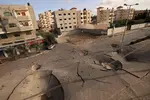
Meanwhile in Gaza, while Egypt have been clearing rubble and rebuilding some of the ruined buildings, Hamas have taken it upon themselves to repair the roads, or at least the ones with tunnels underneath them.

This photo shows a road hit by Israeli missiles, showing three small craters in the asphalt where the missiles struck, and the three large craters where the road collapsed due to the tunnels underneath them.

road1.jpg

This photo shows Hamas workers repairing the road, using much more expensive paving in an attempt to protect the tunnels. This road is close to one of the major hospitals in Gaza.

road2.jpeg

I would have thought this would only cause Israel to use more powerful missiles if war breaks out again, endangering more innocent lives. But then again, the safety of its citizens is not the priority of Hamas.
 
Despite Yahya Sinwar's boast that Hamas didn't need funding from Qatar, the truth is that they are desperate for the funding to resume. Israel and the international community are keen to ensure that the money does not get siphoned off into Hamas's coffers, so the days of suitcases stuffed full of cash being delivered to Gaza appear to be over. In addition, both Israel and the US are keen to bolster the Palestinian Authority by allowing them to be involved in the distribution of the money.

Although it has yet to be officially announced, and is even denied in some quarters, it's believed that the PA and Qatar have reached an agreement on resuming the Qatari grant to the Gaza Strip. The agreement was signed last week in Ramallah, by the Qatari ambassador, Mohammed Al-Emadi, and the PA's Minister of Social Development, Dr. Ahmed Majdalani.

The agreement stipulates that Qatar will pay a monthly grant to 100,000 needy families at a value of $100 per person. The list of beneficiaries from needy families will be determined by the PA, not by Hamas. Qatar will also resume payment of the monthly salaries of 27,000 employees of the Hamas government - as it was before the military operation in May. The list of employees, which was approved by Israel two years ago, remains the same, but the Israelis might not be happy because Hamas government employees will again receive their salaries with them seeming to have less control over the process.

A new development will see each beneficiary issued a magnetic card, with the approval of the PA and upon its request, Qatar will transfer, on a monthly basis, the funds to a bank in the Strip chosen by the PA, and the beneficiaries will then go to the bank to withdraw the amount due to them by card.
As the PA is the official sovereign authority over the Gaza Strip, this arrangement is considered legal.

Hamas will be even more unhappy in being forced to accept this arrangement, which gives the PA a foothold in Gaza, but it probably has no other choice as this is the only method put forward so far to enable the transfer of Qatari funds to the Strip. Hamas will also have concerned that the PA will manipulate the funds, and that the transfer of funds will be used to settle scores or put pressure on Hamas.

One hold up to the deal is the concern among Palestinian banks, which are said to be worried about being slapped with international sanctions should their money go to Hamas. Israel have suggested that the problem be resolved by using post offices. The other issue concerns the 100,000 families, with Israel wishing to maintain scrutiny of the names, while Hamas wants to decide who should be on the list.
 
Hamas, Islamic Jihad, the PFLP and smaller groups issued statements welcoming Hezbollah's missile barrage on Israel on Friday, with Hamas backing up the attack by launching incendiary balloons from Gaza, although they later blamed this on 'rebellious youths'. They also called for the people of the West Bank to 'escalate the resistance', something they've been trying unsuccessfully to incite since before the Gaza conflict in May.

The PFLP's statement included: “We affirm that this is the best solution to confront Zionist arrogance and repeated attacks on Arab land,” and called for “unity to prevent the Zionist enemy from singling out our Lebanese people.”

None of them mentioned the furious Lebanese people from the nearest village who stopped the bombers in their truck, dragged them out and threw them into separate vehicles where they were held at gunpoint until the Lebanese army arrived to arrest them - or so they thought. Two hours later the men were released and given a hero's welcome by Hezbollah supporters.

Neither did they mention the comments of the head of the Maronite Church and leader of more 20% of Lebanon's citizens, who called on the Lebanese Army to deploy in southern Lebanon and prevent Hezbollah rocket fire against Israel: "We are sick of wars, killing, destruction, and displacement." Under UN Resolution 1701, Hezbollah is banned from operating in the country’s south.

Earlier, Hamas’ political leader Ismail Haniyeh and representitives of Islamic Jihad and the PFLP were granted front row seats at the inauguration of Ebrahim Raisi, Iran’s new president, sitting directly in front of senior European Union official Enrique Mora. Next day, the terrorists were joined by Hezbollah’s No. 2, Naim Qassem, as they held a private meeting with Raisi. After the meeting the Palestinian organisations put out statements hailing Iran's role as leader of the 'Axis of Resistance'.

The Palestinian Authority were not represented at the inauguration and were not granted an audience.

All of this confirms the close co-ordination between Hamas, Hezbollah and Iran which took place during the May conflict. The tragedy is that rather than seeing that catastrophe as a watershed, Hamas see it as a triumph - the leadership has chosen to deepen its ties with Iran and the 'axis of resistance' rather than using Egypt's role in bringing about the ceasefire and rebuilding Gaza to forge a closer relationship with them, and through them to the west.


Meanwhile, Hamas has expressed “shock” at the ruling issued by a Saudi court against 69 of its members and supporters who were sentenced on Sunday to prison terms ranging from three to 21 years. The men were arrested three years ago and accused of affiliation with a terrorist organisation and raising funds on its behalf.

“These brothers did not commit what necessitated these harsh and unjustified sentences, as well as trial,” Hamas said in a statement. “All they did was support their cause and the people to which they belong, without any offence to the Kingdom and its people.”

The Saudi authorities prevented the detainees’ relatives from attending the courtroom in which the sentences were pronounced, except for one person from the family of each detainee.


Even terrorist groups have trouble with terrorists! Islamic State (ISIS)-inspired Salafi-Jihadist terrorists detonated a high-explosive device next to the northeastern wall of the popular Bianco Resort, on the northern Gaza seashore. The explosion resulted in the collapse of parts of the wall, and came the day after the resort was accused by Muslim extremists of holding a mixed-gender party on the beach.


The incident first came to light when PA controlled, Ramallah-based media published details.
 
Status
Not open for further replies.

Welcome

Join the Everton conversation today.
Fewer ads, full access, completely free.

🛒 Visit Shop

Support Grand Old Team by checking out our latest Everton gear!
Back
Top