Current Affairs Ukraine

Status
Not open for further replies.
There was no nuanced debate at all. What we had was full on nato / neo-con bible bashing - and anyone who suggested the opposite was shouted down
I think you'll find that there was actually quite a lot of interesting debate about tactics, weaponry and the progress of the war.

But in fairness, some big words were used so it may have been a bit too intellectual for you.
 
Referring to his previous post mainly:

Prigozhin began to be afraid to get acquainted with prostitutes​

Eh! MSM?

About Us​

Polygon is an independent online publication. We write about Russia and the world. We are several Russian media journalists who were forced to close down under pressure from the authorities. We see from our own experience that real honest journalism in our country runs the risk of being included in the list of disappearing professions. And we want to keep this profession, so that Russian journalists are judged not by the products of state pro-government publications.
 
Jesus christ, this thread was bloody decent before the forum was locked - full of interesting nuanced debate. These last few pages make me wish the forum would be locked again.
That's OTT. There's always going to be stuff posted that one doesn't agree with, or propositions stated that have been refuted time and time again, engage in a civilised discussion, or move on, like how about you just read something else?
 
If it were a NATO war though wouldn't we still use the modern warfare route? Gain air superiority, bomb all targets and stop the supply chain to the dug in positions. You can then let them starve/run out of ammunition or bomb the crap out of them from above and/or invade from the rear of those positions.
Yes we probably would. The point was that we've been providing (perhaps expecting) western doctrines to work in Ukraine, when the situation is different.

Ukraine does not have the resources, especially in terms of air power, and they're facing tactics which we would be unlikely to face, hence where we are.

Yet, there are some lights at the end of the tunnel. If evidence is correct, the RA has deep fixed defences in place although without sizeable manpower.

It's also very linear - lack of lateral defences. Their plan will be to use their minefields and trench systems to drop back if there is a singular breakthrough.

If the UA are able to push through the lines in several places, which it appears they're attempting, the lack of lateral defences will mean it could unravel.

You can't drop back to another static line if they've already pushed through and threaten your flanks. This is where the line being spread thin may be their undoing.

Ukraine will hope they make key aspects of the front untenable for the RA to hold, and at that point things may become more fluid once again.
 
No mate, if there is any kind of system or document showing where mines are both sides will quickly know it. Ok Sergei the mines must be placed exactly 2.3 meters between each other, running in a north west direction. Or there is a fairly big piece of land and several hundred miles of front line and hundreds of ill trained soldiers just putting them in while moving backwards….you takes your choice…..
 
According to Medvedev the whole of Ukraine must be crushed :

Time will pass. Western leadership will change, elites will tire, and negotiations might be sought. Any counteroffensive will weaken. They'll mourn their dead and heal their wounds. Yet, we can't halt until the inherently hostile Ukrainian state is dismantled, destroyed utterly. It must never rise again, even from ashes. This process might take years or decades, but we're compelled: it's either dismantle their regime or risk Western aggression against Russia.

Hence, the only solution is to completely control the hostile state's machinery and secure loyalty for the future. Russia's control over the former Bandera state is necessary, and is a goal we will achieve.

This is the thing Medvedev (and the rest) is most wrong about, and as an aside its a failing that he shares with most leaders of "great" countries.

Every action they take against Ukrainian identity will inevitably bolster that identity; indeed it is the actions of first the Russian Empire and then the Soviets that established and then cemented the idea of a separate Ukrainian polity in the first place. If they do over the whole country, they'll treat the population differently - oppression, greater use of force, a lower quality of life and worse economic status, plus lesser status to "Russians". The identity might go underground for a time, but the moment the pressure is reduced it will emerge everywhere and be all the stronger for it.
 
That's OTT. There's always going to be stuff posted that one doesn't agree with, or propositions stated that have been refuted time and time again, engage in a civilised discussion, or move on, like how about you just read something else?
It's not the disagreement - it's the quality. Been plenty of disagreement in this thread for a long time but most of it was well-argued. Lately... not so much.
 
This is the thing Medvedev (and the rest) is most wrong about, and as an aside its a failing that he shares with most leaders of "great" countries.

Every action they take against Ukrainian identity will inevitably bolster that identity; indeed it is the actions of first the Russian Empire and then the Soviets that established and then cemented the idea of a separate Ukrainian polity in the first place. If they do over the whole country, they'll treat the population differently - oppression, greater use of force, a lower quality of life and worse economic status, plus lesser status to "Russians". The identity might go underground for a time, but the moment the pressure is reduced it will emerge everywhere and be all the stronger for it.
You are positing that the Ukraine rump statelet as it presently exists will happily co-exist within its neighbour going forward.

It will not.

It has clearly decided on a course of self destruction ably abetted by the British Imperialists and the neo-con cabal who have have decided for strategic reasons they need to de-fang Russia.

Unfortunately, and in our case specifically we have shot ourselves completely in the foot economically as we can see, while Ukraine has literally committed to a course of suicide.
 
You are positing that the Ukraine rump statelet as it presently exists will happily co-exist within its neighbour going forward.

It will not.

It has clearly decided on a course of self destruction ably abetted by the British Imperialists and the neo-con cabal who have have decided for strategic reasons they need to de-fang Russia.

Unfortunately, and in our case specifically we have shot ourselves completely in the foot economically as we can see, while Ukraine has literally committed to a course of suicide.

No, and you are completely (and probably deliberately) missing all of my point.

Ukraine exists as a distinct identity because of Russian (and Soviet) actions up to this point. Everything Russia is doing right now is cementing and developing that identity. If the Russians took over the whole country, the measures they would bring in would embed that separate, Ukrainian identity even more deeply and effectively.

You talk about Imperialism but this is precisely how new, post-colonial nations are born - the locals are identified as an "other", the rulers discriminate against the "other", and the "others" develop a shared identity with shared goals, shared histories, shared understanding and a common enemy. The rulers notice this and attempt to suppress the movement they started they crack down on it, which occasionally works but in general just improves the opposition by a Darwinian process of removing the lazy, the ineffectual and the corrupt.

Eventually the rulers leave (either voluntarily or are thrown out) and a new country is left behind, where one often did not exist before.
 

Ukraine’s sluggish counter-offensive is souring the public mood​

Aug 20th 2023 | KYIV

The disappointing pace of Ukraine’s counter-offensive has been the focus of international headlines for weeks. For Anastasia Zamula the consequences have been more tangible. Ms Zamula is a co-founder of Cvit (Blossom), an all-women volunteer organisation that supports Ukrainian units on the front line. Her crowdfunding appeals have struggled as hopes of a quick breakthrough have dwindled. Now she says her attention is devoted to counselling exhausted troops whenever she sees them. “The idea of a counter-offensive is bliss when you talk about it from an armchair,” she says. “It’s much harder when you understand that it means darkness, death and despair.”
The public mood is sombre. Criticism of Volodymyr Zelensky, the president, has incr
eased, and the reasons for the dissatisfaction are clear. Having once promised a march to Crimea, occupied and annexed by Russia since 2014, the political leadership in Kyiv now emphasises more realistic expectations. “We have no right to criticise the military sitting here in Kyiv,” says Serhiy Leshchenko, a spokesman in the presidential office. He likened frustration with the speed of the counter-offensive to impatient customers waiting for their iced lattes in the capital’s many hipster cafes. “This isn’t a horse you can whip to go faster. Every metre forward has its price in blood.”

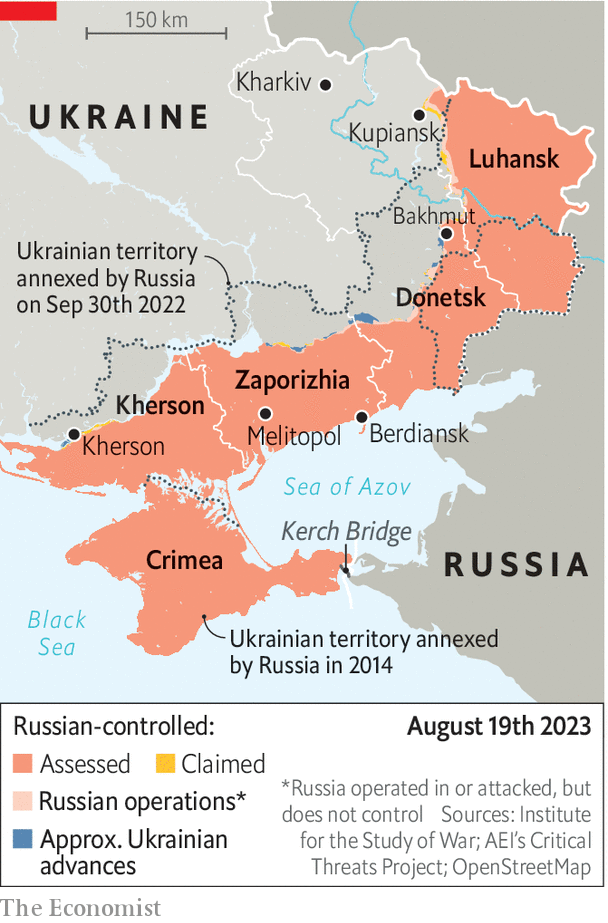
20230826_EPM987.png

Ukraine’s leadership is particularly frustrated that Western equipment has not yet arrived in its promised numbers. It is “upsetting…and demotivating,” Mr Leshchenko says. Equivocation among allies about the supply of newer weapons, and the prospect of America re-electing Donald Trump next year, have added to Ukrainian anxieties. A source in the general staff says that Ukraine has received just 60 Leopard tanks, despite the promise of hundreds. Demining vehicles are particularly scarce. “We simply don’t have the resources to do the frontal attacks that the West is imploring us to do,” says the source.
Lack of air cover is another difficulty. The source adds that Ukraine’s army was never blind to the challenges of breaching Russian minefields and defence lines without air superiority. (On August 20th the Dutch and Danish prime ministers said they would donate up to 61 of the jets, starting in the new year.) For that reason the military leadership delayed the counter-offensive as long as it could. After a disastrous start in early June, when two Western-trained brigades lost an uncomfortable number of men and equipment in minefields, the initial plans were adjusted. Ukraine has since prioritised preserving its army. “We no longer plan operations that presuppose large losses,” says the source. “The emphasis is now on degrading the enemy: artillery, drones, electronic warfare and so on.”
In recent days Ukraine’s armed forces have made important advances in the crucial southern theatre, and may have breached enough minefields to reach the first of three lines of Russian fortifications in several locations. They have also degraded Russia’s operational reserve and logistics. Still, two-and-a-half months in, Ukraine remains a long way off its strategic goal of nearing the Azov sea—and thus cutting Russia’s seized land corridor to Crimea—before the rains of late October, when mud will make for much harder going.
The grim mood is spilling over into Ukraine’s politics, which have been on hold for much of the war. Rumours have circulated all summer that Mr Zelensky’s office may call early parliamentary and presidential elections. The logic is that it is better for him to seek re-election while still a national hero, rather than after being forced into peace talks that might require an unpopular ceasefire or major territorial concessions. “Any election, if it happens, would be a referendum on Zelensky,” says Volodymyr Fesenko, a political analyst. “Apart from [commander-in-chief Valery] Zaluzhny, who is busy running the war, he currently has no obvious competitor. Zelensky’s team understands that could change.”
Conducting an election during a war, with up to 6m Ukrainian citizens living outside the country and hundreds of thousands fighting away from home, would be complex. And martial law precludes elections, meaning parliament would have to approve a change in electoral rules. The talk was initially of holding both elections this autumn, but it is now almost certainly too late for that—indeed, sources close to the presidential office insist the idea has been ruled out. In any case, polling suggests that Mr Zelensky’s team would have trouble persuading citizens of the need for an early vote. “There just isn’t a demand for it,” says Lubomyr Mysyv of Rating, a Kyiv-based sociological group. “The population is confused by the very idea.”

In the absence of a military breakthrough, peace negotiations with Russia would be an even harder sell. True, there have been some signs of a shift in mood, in unexpected quarters. In early August a Ukrainian sniper fighting north-west of Bakhmut made waves by dismissing the prospect of Ukraine ever regaining its full territory. He suggested that many soldiers would now welcome a ceasefire—a notion that would once have been unthinkable. But for now, few would agree. Too much blood has been spilt. “Any peace now is delayed war,” says the general-staff source. “Why hand the problem to the next generation?”

Many of Ukraine’s young are, of course, already bearing the burden of a war that has no end in sight. For young men, in constant danger of being served conscription papers and sent to the front, the pressure is particularly intense. Those keen to fight volunteered long ago; Ukraine is now recruiting mostly among the unwilling. “It makes the air so thick that you can actually feel it,” says Ms Zamula. Everyone knows that the cost of regained territory is dead soldiers. “Even hoping for success in the counter-offensive has become an act of self-destruction.”

 
Status
Not open for further replies.

Welcome

Join the Everton conversation today.
Fewer ads, full access, completely free.

🛒 Visit Shop

Support Grand Old Team by checking out our latest Everton gear!
Back
Top