Current Affairs Irish Border and Brexit

Status
Not open for further replies.
Let's see if the DUP carry through their threat to bring down the Tory government, when this - special status for the north of the island of Ireland - is announced as the UK's only option.

Northern Ireland
Brexit plan drawn up for border checks between NI and rest of UK


Exclusive: Leaked paper reveals backup proposal to avoid hard land border with Ireland

Daniel Boffey in Brussels

Fri 4 May 2018 17.12 BSTLast modified on Fri 4 May 2018 22.01 BST


The proposal is described as ‘infinitely preferable’ to a hard land border on the island of Ireland. Photograph: Peter Morrison/AP
A backup plan to impose border checks on trade between Northern Ireland and the rest of the UK at ports and airports to avoid a hard border with the Republic of Ireland after Brexit has been drafted by senior civil servants.

Despite the Democratic Unionist party (DUP) angrily rejecting any suggestion of a border “in the Irish Sea”, a leaked paper reveals that officials have been working on a blueprint “to be deployed as necessary in the negotiation process”.

The proposal is described as “infinitely preferable” to a hard land border on the island of Ireland and the risk of a return to violence. The European Union has already rejected Theresa May’s two main proposals: maximum facilitation, which would involve some border infrastructure, and a customs partnership, in which the UK would mirror Brussels’ customs rules and collect tariffs for the EU.

The prime minister has insisted the UK will leave the customs union and the single market. She has also adamantly ruled out the return of a hard border on the island of Ireland. The EU, meanwhile, has warned it will not tolerate a solution that undermines the single market and customs union.

While acknowledging these could be seen to be “inherently incompatible positions”, the paper – drawn up by senior officials working on Brexit in the Northern Ireland executive – argues that “ports and airports provide helpful opportunities for surveillance that assist with risk management even when they do not have any of the visible paraphernalia of a border”.

What are the UK government's EU customs proposals?

The DUP leader, Arlene Foster, has claimed that opting for checks on trade between Northern Ireland and the rest of the UK would be constitutionally unacceptable and economically catastrophic.

The document deals with this claim by stating: “Concern that a model without a land border would imply ‘a border in the Irish Sea’ could be addressed by providing a ‘green channel’ for goods moving between Northern Ireland and Great Britain, so that there need be no check or constraint on movement.”

It adds: “The very simple and important practical point is that loading on to a ship or aeroplane always involves both a pause in movement and some checks of ‘entitlement to board’ – obviously neither if these apply at the land border. Pragmatic extension of a present reality, with the lightest possible touch required to manage risk, seems infinitely preferable to ‘a return to the border of the past’.

“As is the case at the English Channel ports, there would still be significant issues if the ‘time to board’ is materially higher than at present, but it is clear that solutions are required in relation to that issue for the UK as a whole.”

A government spokesperson declined to comment on the paper on the grounds that it had not been published, and stipulated that as the document derived from the Northern Ireland executive it was “not a UK government policy document”.

She said: “Our policy is clear – we are committed to ensuring there is no hard border between Northern Ireland and Ireland and to ensuring the same unfettered access for Northern Ireland’s businesses to the whole of the UK’s internal market. We have set out our preferred customs models to enable trade to remain as frictionless as possible.”

The UK is, however, now under growing pressure to come up with a new solution for the border by the next European council summit in June, or risk a breakdown in talks on trade.

The EU’s chief negotiator, Michel Barnier, visited Ireland on Monday. He is understood to have told MEPs on his return to Brussels that the DUP – whose 10 MPs give May a parliamentary majority – had “used, or perhaps abused, its position in the House of Commons” to block a way forward.

Barnier has previously suggested that checks at ports and airports could be a solution.

The leaked document suggests there would need to be a requirement on traders between Northern Ireland and Great Britain to provide information ahead of time for it to work, and “a system of random and intelligence-/data-based checks” on goods going through the “green channel”.

Goods moving from the Republic of Ireland to Great Britain via Northern Ireland would be subject to checks in a “red channel” at the port or airport where they leave the island of Ireland.

Imports from Great Britain and the rest of the world to Northern Ireland that are not permitted to enter the single market would also be subjected to “red channel checks”, with “draconian penalties for noncompliance”.

“The degree to which these protections are needed would depend on the degree of regulatory divergence that would apply sector by sector, and clearly that may evolve over time from the status quo of regulatory uniformity,” the 19-page document says.

Officials concede in the document that a major test of their approach would be whether it was “perceived politically as in effect creating a hard border with the UK (or between Ireland and the rest of the EU)”.

It is also recognised that keeping the border open on the island of Ireland will allow goods not compliant with EU or UK trade policy to move freely around the two jurisdictions. “But the same risk is tolerated to some degree in other contexts (eg between Switzerland and its EU neighbours),” the paper argues. “The commitment to support the all-island economy suggests that some degree of risk can be accepted.”

The paper is believed to have been drafted by Andrew McCormick, Northern Ireland’s director general of international relations for Brexit, with oversight from the head of the Northern Ireland civil service, David Sterling. It was shared with the DUP earlier this year, and the party reiterated its opposition.

The Sinn Féin MEP Martina Anderson said: “This proposal offered a workable solution which would see the north remaining in the customs union and mechanisms put in place to protect trading arrangements between Ireland, north and south, and Britain.”

Brexit negotiators sidestepped any discussions about the Irish border in Brussels this week, instead publishing on Friday an agreed list of subjects to be discussed in the coming trade talks, ranging from financial services to fisheries.

The Brexit secretary, David Davis, said: “Both the United Kingdom and European Union remain committed to reaching agreement on the terms of our future partnership by October, in addition to finalising the withdrawal agreement including the protocol on Northern Ireland.”

 
Let’s see if the ROI threat to stop a U.K./EU deal, over the border issue, stands up to the commercial wellbeing of Germany, France, Italy and Spain.......
 
The party that likes to say no, is upset that the EU are not 'listening to us', even though they boycotted Barnier's visit to the north of the island of Ireland. The DUP only want 'talks' so they can do their usual 'walk out' bluster. The DUP don't even want Stormont to reconvene so that the elected representatives can discuss issues that affect the north of the island of Ireland.


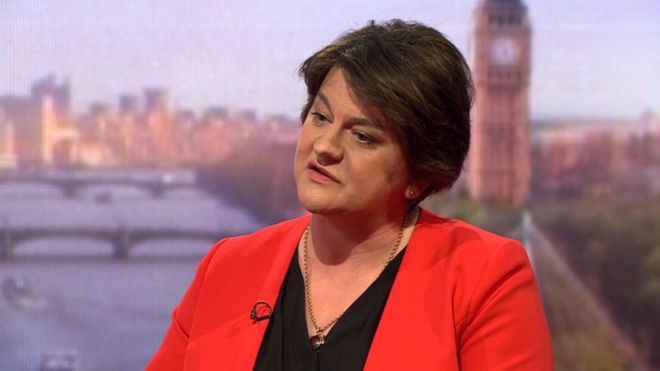
Arlene Foster wants 'less rhetoric' from the EU on Brexit
_101195000_arlenefoster.jpg

Image captionArlene Foster was interviewed on the BBC's Andrew Marr Show
DUP leader Arlene Foster has said she she would like the European Union to take a more sensible approach to the Brexit negotiations.

Mrs Foster said she would like to see less rhetoric and more engagement from the EU on the way forward.

The EU's chief negotiator, Michel Barnier, was in Northern Ireland earlier this week.

Mrs Foster said she regretted the tone of what he had to say.

"What he [Mr Barnier] was saying was that it was up to the UK to come up with a solution and they would wait for that solution to come and that is not the way forward," Mrs Foster told the BBC's Andrew Marr show.

"The way forward is to have a negotiation where both sides are engaged in the negotiation and we look for a solution that will make the difference."

Mrs Foster said the DUP did not believe that the UK needed to stay in the customs union to have "free flow between ourselves and the Republic of Ireland".

"In August of last year, the government put forward various proposals," she said.

"We were disappointed there was not the engagement from the European Union at that time.

"What we would like to see from the European Union is less rhetoric and actually more engagement in relation to the pragmatic way forward."

On his visit to Northern Ireland, Mr Barnier said that the EU would consider "any solution" on Brexit which would allow it to maintain the integrity of the Belfast Agreement.

He said that it was important to maintain relationships in Northern Ireland.

He previously told a press conference on 30 April at the beginning of the all-island Brexit forum that his "door is open" to Arlene Foster and the DUP.

He said he had not approached the negotiations in a "spirit of revenge".

_101181145_brexitgetty.jpg
Image copyrightGETTY IMAGES
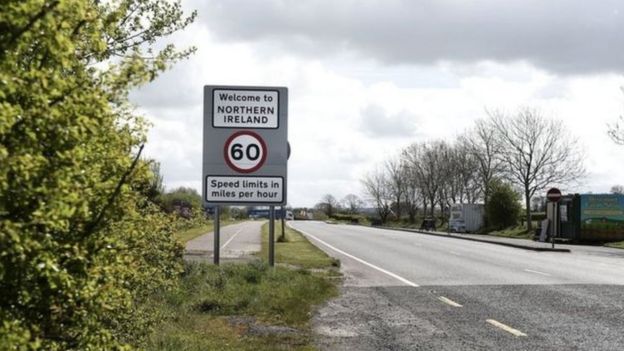
Image captionThe UK and EU have agreed there should be no hardening of the Irish border
The UK government has said it is leaving the customs union but ministers have not yet agreed what will come next.

Prime Minister Theresa May asked officials to draw up "revised proposals" after last week's meeting of her key Brexit committee.

Mrs Foster said she had a telephone conversation with Mrs May on Saturday about customs solutions.

All EU members are part of the customs union, within which there are no internal tariffs (taxes) on goods transported between them. There is also a common tariff agreed on goods entering from outside.

The UK government has said it is leaving the EU customs union so that it can strike its own trade deals around the world, something it cannot do as a member.

This means the UK and the EU will have to agree a new arrangement for what happens at their border post-Brexit.

The UK is under pressure to make progress on the issue before next month's EU summit".
 
Enjoy the large uncontrolled immigration staying in the Custom Union will bring
Immigration has generally worked well for the Irish economy, particularly in my own county with it’s mix of rural and industrial work. There are concerns here that our business may struggle post Brexit re availability of transient labour.

Thanks for your best wishes though mate ;)
 
yea, both north and south are already in the customs union, and both out of the Schengen zone. If there is large increase in uncontrolled immigration, it would suggest that the economy in the north is booming. And if there's a situation where NI is the only part of the UK to remain in the EU common market, they'll do very well.
 
yea, both north and south are already in the customs union, and both out of the Schengen zone. If there is large increase in uncontrolled immigration, it would suggest that the economy in the north is booming. And if there's a situation where NI is the only part of the UK to remain in the EU common market, they'll do very well.

As long as it works out well for everyone that’s what counts.......
 
Haha, Gove is still in denial as per usual for him. There's no technology that can check goods and the movement of people on the island of Ireland without infrastructure. The Tories continue to get themselves into a bind over the north of the island of Ireland.

Gove says development of Irish border technology should not delay Brexit


But Ireland’s foreign minister reiterates Theresa May’s commitment to no border infrastructure

Jessica Elgot Political correspondent

@jessicaelgot
Sun 13 May 2018 12.22 BSTLast modified on Sun 13 May 2018 12.23 BST


The UK government has been urged to consider extending the transition period to allow more time to develop the technological model for the Irish border Photograph: Peter Morrison/AP
Michael Gove has said he would not back any delay to the UK leaving the customs union beyond the transition period to allow new border technology to be developed, as Ireland’s foreign minister said any form of infrastructure or technology on the border would be unworkable.

The government has been urged by some MPs, including former minister Nick Boles, to consider extending the 21-month transition period that will come into force when Britain is due to leave the EU next March to allow more time to develop the technological model.

Gove said: “In delay there lies no plenty ... one of the things that we need to do is to crack on,” he told the BBC’s Andrew Marr show.

However, the environment secretary also expressed scepticism about the merits of an alternative customs proposal, saying the customs partnership model had flaws and needed to be tested.

Theresa May has split members of her warring cabinet into two working groups to thrash out the merits of her two customs proposals.

The prime minister’s favoured new customs partnership model would see the UK collect tariffs on behalf of the EU and would go some way to solving the issue with the Northern Irish border. However, it has been denounced by Brexiters who say it is untested and would force Britain to into copying the EU’s product standards and regulations.

They prefer the “maximum facilitation” model that relies on technology to minimise border checks, which critics say cannot resolve the Irish border issue and would require lengthy development of sophisticated new technology.

“The critical thing is to meet that deadline. My experience in government reinforces my belief that we need to make sure we deliver things at pace,” Gove said.

He told Marr he had some qualms about the customs partnership model, defending Boris Johnson who described the plan as crazy in an interview earlier this week.

Gove said the cabinet agreed that neither of these two models was absolutely perfect. “With NCP [new customs partnership], as Boris pointed out, because it’s novel, because no model like this exists there have to be significant questions about the deliverability of it on time,” he said. “More than that, the NCP requires the British government to in effect act as the tax collector and very possibly the effective deliverer of regulation for the EU.”

Speaking on the same programme, Ireland’s tánaiste and foreign minister, Simon Coveney, said there had been a clear commitment from May that there would be no border infrastructure. He said any backtracking would mean “a very difficult summer for these negotiations if that happens”.

Coveney said: “If we are expecting to get this concluded by the end of October, is it unreasonable for the Irish government to ask for significant progress on a hugely important issue by the end of June, when it is actually factored into the EU negotiating guidelines that there would be a reassessment by the end of June?”

He said the Irish government was seeking a political solution that allowed for regulatory alignment in a way that prevented a need for border infrastructure.

On Sunday, May attempted to calm tensions with a Facebook article setting out three tests that a new customs arrangement would need to meet. She said no hard border in Northern Ireland, nor a border at the Irish sea, were acceptable, and that any deal must “protect our precious union and honour the agreements that were reached in the historic Northern Irish peace process”.

The prime minister said agreements must create as little friction as possible for trade - an acknowledgment that some new obstacles may be created. The agreement also must not constrain Britain’s ability to negotiate trade agreements with other countries around the world, May said, comparing it to Labour’s policy of forging a new customs union with the European Union.

May said she wanted to restate her case “amid all the noisy debate and technical discussions”. Johnson has been excluded from the two working groups examining the merits of both options, as has the chancellor, Philip Hammond, who is most in favour of the customs partnership.

Gove will examine the customs partnership alongside Liam Fox and David Lidington, while David Davis will examine the “max fac” model with Karen Bradley and Greg Clark, who have expressed scepticism about that model’s negative effects on business and on its workability at the Northern Irish border.

Though the majority of cabinet ministers in the working groups have been tasked with examining their least-preferred options, sources earlier this week suggested most ministers’ positions had become more entrenched.

Sir Keir Starmer, the shadow Brexit secretary, called the rift “a farcical situation at the moment. Nearly two years after the referendum the cabinet is fighting over two customs options – neither of which frankly are workable, neither of which are acceptable to the EU.”

He said Labour proposed a combination of a comprehensive customs union and a close relationship with the EU single market. “Nobody credible suggests you can achieve no hard border without it,” he told Marr".
 
Status
Not open for further replies.

Welcome

Join the Everton conversation today.
Fewer ads, full access, completely free.

🛒 Visit Shop

Support Grand Old Team by checking out our latest Everton gear!
Back
Top