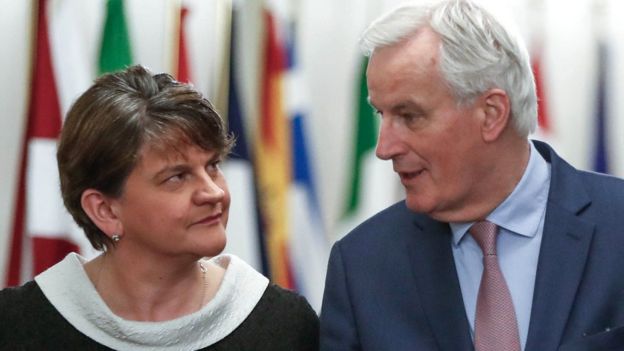
This government, and the civil service, really don't have a clue about the Good Friday Agreement. The Tories, and the civil servants who advise them, are out of their depth.
Home Office withdraws Border Force job ads over discrimination fears ...
Northern Ireland
Home Office withdraws Border Force job ads over discrimination fears
Equality Commission for Northern Ireland says requirement for British passport is potentially unlawful
Lisa O'Carroll Brexit correspondent
@lisaocarroll
Wed 25 Apr 2018 17.17 BSTLast modified on Wed 25 Apr 2018 17.26 BST

The government was attempting to recruit 1,000 Border Force officials. Photograph: Steve Parsons/PA
The government has withdrawn a recruitment campaign for 1,000 Border Force officers after discrimination concerns were raised in
Northern Ireland because the jobs were restricted to British passport holders.
The Equality Commission for Northern Ireland contacted the Home Office to point out the adverts were potentially unlawful under the
Good Friday agreement.
Eileen Lavery, head of advice and compliance at the commission, said the Home Office recruitment “could exclude a large section of the Northern Ireland population who identify as Irish, hold no UK passport and, in many cases, hold an Irish passport”.
Labour’s Northern Ireland spokesman, Tony Lloyd, also raised concerns about the government’s commitment to the Good Friday agreement and to having
no hard border after Brexit.
The jobs are being advertised as part of a drive to have more than
1,300 additional border staff in place for the
end of the transition period in 2020.
Among the posts advertised were 21 in Belfast. The jobs were described as “reserved post”, which are restricted “to UK nationals, ie: British citizens, British subjects under part IV of the British Nationality Act 1981”.
The Equality Commission had discussed legislation in Northern Ireland with the Home Office in January but the passport issue did not arise until the adverts were posted online last week.
The Home Office withdrew the ads immediately and said it would relaunch them with the correct wording.
It said an error had occurred when the roles were advertised and it had incorrectly stated that eligibility was based on having a “full and valid British passport” instead of “full and valid passport”.
Fewer than 900,000 people identify as British in Northern Ireland, with a further 533,000 identifying as Northern Irish and 513,000 identifying as Irish, according to the 2011 census.
The Democratic Unionist party MP for East Belfast, Gavin Robinson, described the row as “noise” and has written to the home secretary, Amber Rudd, for clarification on recruitment policy in Northern Ireland.
“The news that the government plans to recruit Border Force staff in Northern Ireland is a clear admission they share our concerns that they may not to live up to their commitments on the future of the UK-Ireland border post-Brexit,” he told the Irish News.
No legal action is being taken as the Home Office removed the adverts immediately.
It is the second time the Home Office has been caught out by the special arrangements in Northern Ireland for those who identify as Irish. A Derry woman
won a court case in relation to her American husband on the grounds that she was an Irish passport holder and her spouse was not required to go through immigration procedures for third-country nationals'.
Not surprising they haven't a clue about the Good Friday Agreement after this court case in February clearly shows. But they still ploughed on with the Border force ad.
Northern Ireland
Derry woman's US-born husband free to live in UK, court rules
Tribunal finds Emma de Souza can be treated as Irish citizen under Good Friday agreement
Lisa O'Carroll Brexit correspondent
@lisaocarroll
Mon 12 Feb 2018 11.26 GMTLast modified on Mon 12 Feb 2018 22.01 GMT

Jake de Souza and his wife, Emma de Souza. The case could have implications for any Irish passport holder married to an non-EU citizen, lawyers say. Photograph: Emma de Souza
A potential loophole in Britain’s strict immigration laws has been exposed after the Home office lost a case in
Northern Ireland that hinged on the unique peace deal rights that allow citizens to identify as Irish and not British.
A Derry woman at the centre of the case has spoken of her joy after a Belfast court rejected the Home Office’s bid to appeal against a recent ruling that her American husband should be allowed to live in the UK without going through immigration procedures because she carried an Irish passport.
The Home Office has been told that it cannot appeal against the decision on the grounds that “no error in law” was made by the first-tier tribunal in Belfast.
“I feel elated and quite vindicated,” said de Souza.
The extraordinary immigration case hinged on the 1998 Good Friday agreement, which allows citizens to be identified as Irish, British or both and could have implications for any Irish passport holder married to an non-EU citizen, lawyers say.
Emma de Souza found herself at the centre of a legal battle after her application in 2015 for a residence card for her US-born husband, Jake de Souza, was rejected.
The Home Office initially rejected his application on the grounds that his wife was British, even though she never carried a British passport.
They said as she was born in Northern Ireland, under the British Nationality Act 1981 she was automatically deemed British and would have to apply through the normal routes for third country citizens. The Home Office told Mr De Souza the only way they could deal with his case was for his wife to “renounce her status as a British citizen”.
De Souza challenged that decision on the grounds that his wife had the right to be treated as an Irish citizen under the Good Friday agreement and was therefore an EU citizen exercising her freedom of movement rights.
The first-tier tribunal ruled in his favour.
“Under the terms of the Good Friday Agreement, people of Northern Ireland are in a unique position within the United Kingdom. The British and Irish governments recognised the birthright of all the people of Northern Ireland to identify themselves as Irish or British, or both,” said Judge Gillespie in his conclusion at the tribunal.
“Initially I had a lot of people I know say, ‘but the Home Office is right, you are British, just sign the form to denounce being British and make the application,’” said Ms De Souza.
“But I feel very strongly that I am Irish. I grew up in the Troubles and as a child I experienced the sectarian violence and then to be told that you can’t identify as Irish? I felt like even though the Good Friday Agreement upholds my rights, I felt I was being classed as a lesser identity,” she said.
“I wanted to take a stand not just for me, but for others,” added De Souza.
The Home Office appealed against the tribunal’s decision but was told this week that as there was “no error in law” it could not do so in that court.
However it has the right to go direct to the higher court, the upper tribunal to argue that an important point in law needs to be tested.
A spokesman for the Home Office said it was examining the ruling and considering whether to appeal".
I think the UK will not leave the customs union and the single market and May is looking for an 'excuse' not to.