Donald Trump for President Thread

Status
Not open for further replies.
it would be helpful for corporations to start acknowledging what makes their profits possible by paying back the taxes that used to fund education (not the only reason why tuition fees have gone up, i know)

government equity in firms that use government-funded research seems fair, at the very least

what would silicon valley be without NSF grants? it's not just a story of heroic individual entrepreneurs
http://time.com/4089171/mariana-mazzucato/

It annoys Clint no end, but I actually think we already have a tonne of ways of learning for hardly any money. If you think of what a university actually is. You have lectures where you listen to someone speak, well we have a shed load of free video lectures online, whether on YouTube, MOOCs and so on. You also have the free courseware provided by MIT et al so that course materials are freely available.

You might then have books and the knowledge contained within. Now I'm a bookworm, but I'd gladly admit that I could probably get 99% of what I get from books for free online. When you add in that a growing volume of research papers are open access, there is no real shortage of learning material out there for free.

You also get collaborations with colleagues and assignments. This isn't quite so easy to replicate, but I know many MOOCs have local offline study groups where you get together with your peers in the real world, so it's doable.

The assignments, and accreditation, is a trickier thing. I suspect this is doable, but universities can charge high fees in large part due to the exclusivity around accreditation, so I can't see them giving that up any time soon, but whether that is the best signal to say you know stuff I'm not so sure.

The thing is, in my discussions with folks in government, they're not promoting this whatsoever to those who are out of work. Indeed, they didn't even know such things existed, and this despite the fact that the organization behind one such channel was on the envoy to India with Teresa May this week.

I guess that's the frustrating thing. It isn't 'that' hard to do a lot better than we are currently.
 
I have now got CNN on for comedy value...is this a serious American MSM outlet?... it's not a satire, a parody?...no wonder USA represents itself as pretty dumb lol.
Haven't tuned into Fox yet...I imagine the laughs will be similar.

USA...leader of the free world? lol

Cable news is a complete disaster and should be abolished. No matter which channel you watch it makes you dumber and less informed. They chase sensationalist stories with no real substance for ratings and prioritize entertainment over news. They are a huge contributor to our broken media system.
 
It annoys Clint no end, but I actually think we already have a tonne of ways of learning for hardly any money. If you think of what a university actually is. You have lectures where you listen to someone speak, well we have a shed load of free video lectures online, whether on YouTube, MOOCs and so on. You also have the free courseware provided by MIT et al so that course materials are freely available.

You might then have books and the knowledge contained within. Now I'm a bookworm, but I'd gladly admit that I could probably get 99% of what I get from books for free online. When you add in that a growing volume of research papers are open access, there is no real shortage of learning material out there for free.

You also get collaborations with colleagues and assignments. This isn't quite so easy to replicate, but I know many MOOCs have local offline study groups where you get together with your peers in the real world, so it's doable.

The assignments, and accreditation, is a trickier thing. I suspect this is doable, but universities can charge high fees in large part due to the exclusivity around accreditation, so I can't see them giving that up any time soon, but whether that is the best signal to say you know stuff I'm not so sure.

The thing is, in my discussions with folks in government, they're not promoting this whatsoever to those who are out of work. Indeed, they didn't even know such things existed, and this despite the fact that the organization behind one such channel was on the envoy to India with Teresa May this week.

I guess that's the frustrating thing. It isn't 'that' hard to do a lot better than we are currently.
I actually agree 100% with this.
 
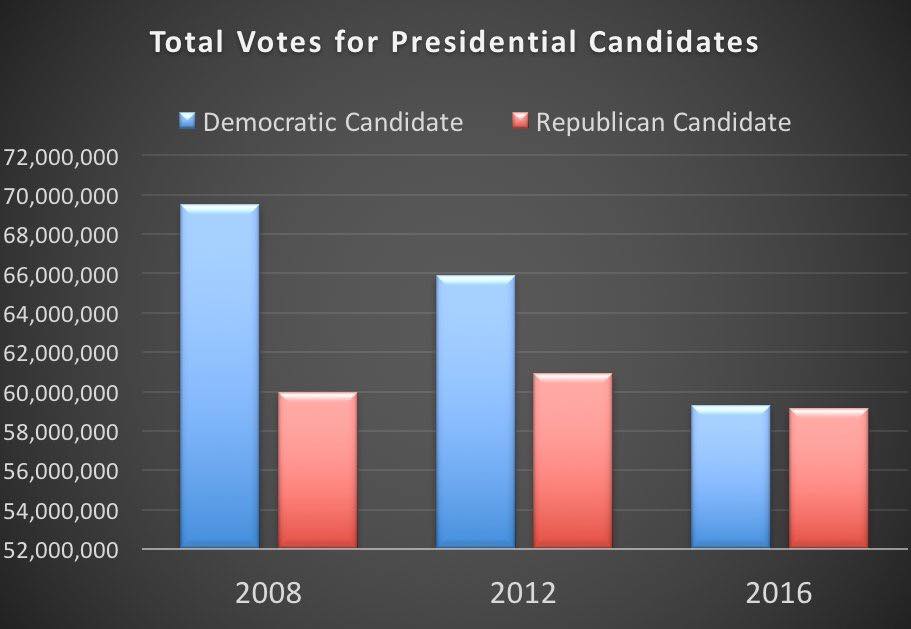
Wtf are you on about. That's a map claiming the whole country loves trump because the low population areas are red. I stated that fact. I'm quite aware he won the electoral college so stop being so defensive.
Layne maybe you mistook my response, the point I am making is that if it was the other way round the same response would have been made by the other camp.
 
It annoys Clint no end, but I actually think we already have a tonne of ways of learning for hardly any money. If you think of what a university actually is. You have lectures where you listen to someone speak, well we have a shed load of free video lectures online, whether on YouTube, MOOCs and so on. You also have the free courseware provided by MIT et al so that course materials are freely available.

You might then have books and the knowledge contained within. Now I'm a bookworm, but I'd gladly admit that I could probably get 99% of what I get from books for free online. When you add in that a growing volume of research papers are open access, there is no real shortage of learning material out there for free.

You also get collaborations with colleagues and assignments. This isn't quite so easy to replicate, but I know many MOOCs have local offline study groups where you get together with your peers in the real world, so it's doable.

The assignments, and accreditation, is a trickier thing. I suspect this is doable, but universities can charge high fees in large part due to the exclusivity around accreditation, so I can't see them giving that up any time soon, but whether that is the best signal to say you know stuff I'm not so sure.

The thing is, in my discussions with folks in government, they're not promoting this whatsoever to those who are out of work. Indeed, they didn't even know such things existed, and this despite the fact that the organization behind one such channel was on the envoy to India with Teresa May this week.

I guess that's the frustrating thing. It isn't 'that' hard to do a lot better than we are currently.

maybe, but MOOCs have had terrible results so far. this is not a new idea, actually... when VHS came out the idea of recording the guy at Harvard, then mailing out the tapes and firing everyone else was floated, but it never really got off the ground. there does some to be some intangible but very real value to interacting the old-fashioned way.

in the US, state education budgets have been one of the biggest casualties of post-financial crash austerity. in the UK, it seems Nick Clegg was also especially ineffective in delivering the one thing many voters wanted from him.

i think part of the problem is that universities have evolved into virtual parallel cities now, with sports leagues, investment managers, nutritionists, marketing directors, public relations and social media coordinators, therapists, security forces and trauma counsellors, and probably a 10-1 administration/faculty ratio, all of whom attend parallel worldwide conferences and seminars. professors now earn less than mid-ranking administrators at many schools. in the past, all you needed were rooms, instructors, and books. it is very affordable, and has none of the "second-class" stigma or over 80% drop-out rates of MOOCs. and there's no reason why this model can't work again.

now though we sacrifice the latter model to fund the former. and when students in the US (and now UK, unfortunately) have to pay literally tens of thousands of dollars a year for tuition, they are going to choose the school that includes a rock-climbing wall, for all they're shelling out for it. in response, universities increasingly target foreign students who can afford the tuition, even though cheating on English exams is systematic, driving down the quality of the degree even as it drives up the price. australia is perhaps the most severe example of this.

but absolutely everything has to be run according to business principles now, which means things not so easily quantified, like "education" are the first to go, and, as elsewhere, we create bubbles to finance ponzi-schemes.

rant over! (see if you can guess where I work, and discount the above as you see fit).

now, back to making America great again!
 
Cw2OIGhXgAAQBUu.jpg


I suppose that's what happens when there's only a choice between a war monger and a proto-fascist.
 
maybe, but MOOCs have had terrible results so far. this is not a new idea, actually... when VHS came out the idea of recording the guy at Harvard, then mailing out the tapes and firing everyone else was floated, but it never really got off the ground. there does some to be some intangible but very real value to interacting the old-fashioned way.

in the US, state education budgets have been one of the biggest casualties of post-financial crash austerity. in the UK, it seems Nick Clegg was also especially ineffective in delivering the one thing many voters wanted from him.

i think part of the problem is that universities have evolved into virtual parallel cities now, with sports leagues, investment managers, nutritionists, marketing directors, public relations and social media coordinators, therapists, security forces and trauma counsellors, and probably a 10-1 administration/faculty ratio, all of whom attend parallel worldwide conferences and seminars. professors now earn less than mid-ranking administrators at many schools. in the past, all you needed were rooms, instructors, and books. it is very affordable, and has none of the "second-class" stigma or over 80% drop-out rates of MOOCs. and there's no reason why this model can't work again.

now though we sacrifice the latter model to fund the former. and when students in the US (and now UK, unfortunately) have to pay literally tens of thousands of dollars a year for tuition, they are going to choose the school that includes a rock-climbing wall, for all they're shelling out for it. in response, universities increasingly target foreign students who can afford the tuition, even though cheating on English exams is systematic, driving down the quality of the degree even as it drives up the price. australia is perhaps the most severe example of this.

but absolutely everything has to be run according to business principles now, which means things not so easily quantified, like "education" are the first to go, and, as elsewhere, we create bubbles to finance ponzi-schemes.

rant over! (see if you can guess where I work, and discount the above as you see fit).

now, back to making America great again!

Aye, the MOOC thing is an interesting one. With regards to the drop out rate, I suppose there are a number of unknowns with that. Firstly, we don't really know what motivated someone to enroll (or indeed leave). It could have been curiosity, it could have been a particular module and so on. Not doing the whole thing needn't mean that value hasn't been gained from it, it's just the only really metric we have from the traditional model as certification = proof that you learned something.

I know there have been a couple of experiments with the model that have had much better success rates in terms of completion. I can't remember the name of the institution, but there's a masters in computer science delivered ala MOOC, and it costs a grand or something as opposed to > 10k, and the completion rate is very high, with those that do 'drop out' tending to return to finish it when the circumstances that caused them to fall behind clear up. What's more, the grades achieved were very comparable with the physical course.

So it's not impossible, but I do agree completely about the fluff that surrounds many universities, although I suspect British institutions are much better at that than American ones. The amount US institutions spend on sports teams is insane, but then the money they make from college sports is equally insane.

Of course, another failing with MOOCs to date. No, failing denotes they've done something to cause it. Another interesting thing with MOOCs to date is that they've mainly attracted college educated people. Despite ostensibly offering free access to college level tuition, few of those who enroll lack a degree already. If you're being optimistic then you could say that folks just aren't aware of what's out there and they'd jump on them if they were. If you're being pessimistic you could say that folks are well aware of what's out there but prefer to shift the blame for their circumstances onto someone else. As with most things, I suspect the answer is somewhere in between.
 
Status
Not open for further replies.

Welcome

Join the Everton conversation today.
Fewer ads, full access, completely free.

🛒 Visit Shop

Support Grand Old Team by checking out our latest Everton gear!
Back
Top