@LinekersLegs
Britain risks becoming virus ‘melting pot’ as mutations spread
Citizens urged to respect curbs to limit transmission of new and dangerous variants
Clive Cookson FEBRUARY 5 2021
The UK risks becoming a “melting pot” for the emergence of new and potentially more dangerous coronavirus variants unless the population respects restrictions put in place to limit transmission, scientists have warned.
Health authorities this week said three different variants of the virus circulating in England had a mutation called E484K, which is believed to undermine the immune protection provided by prior infection and current vaccines.
“Coronaviruses are less prone to mutation than influenza viruses but we have always expected that as the pandemic continues, new variants will begin to become dominant . . . and that eventually a new version of the vaccine . . . would be required to maintain vaccine efficacy at the highest level possible,” said Sarah Gilbert, professor of vaccinology at Oxford university.
Concerns about possible resistance to the first generation of vaccines lies behind Public Health England’s urgent efforts to track people infected with a variant, known as 501.V2, which is thought to have originated in South Africa and carries the E484K mutation.
But the announcement of so-called “surge testing” in parts of England is also aimed at identifying two other variants that have developed the same E484K mutation: the more transmissible B.1.1.7 variant first recorded in Kent in September and an older form of the virus.
Some scientists have expressed concern about the way the government has handled the latest twist in the Covid-19 pandemic, which is caused by the Sars-Cov-2 virus. “Communications from the government about the new variants have not been great,” said Professor Lawrence Young, a virologist at the University of Warwick. “It’s all very confusing and quite frightening to many people.”
Young is one of the experts who criticised Baroness Dido Harding, head of NHS Test and Trace, for telling a parliamentary committee on Wednesday that the mutations had come as a surprise.
“Despite what she said, none of this is at all surprising,” he said. “All viruses mutate and this one has passed between hundreds of millions of people around the world, trying to adapt to us and evade our immune systems.”
Julian Tang, clinical virologist at the University of Leicester, said there had been “a lot of sugar coating” in official statements about the pandemic and urged ministers to be more open with the public about the risk posed by these new mutations.
Without strongly enforced restrictions to control infection, the UK will “become a melting pot for different emerging Sars-Cov-2 variants,” he warned. “We really need to reduce our contact rates to reduce the speed with which these different variants can evolve.”
In the normal course of infecting and passing between people, Sars-Cov-2 undergoes one or two changes per month in the 30,000 biochemical letters that make up its RNA genome. This happens when an error occurs in copying the genetic code during replication.
Most of these random mutations have either no effect or even damage the effectiveness of the virus to spread from host to host. Scientists have identified thousands of genetically slightly different but functionally identical lineages of the virus as they track the spread of Covid-19 around the world.
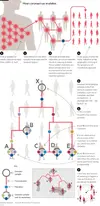
But very occasionally one or several mutations give the virus an advantage, particularly when it becomes more efficient at entering human cells and/or overcoming the host’s immune defences.
The first three variants that caused real concern among scientists were identified late last year in the UK, South Africa and Brazil. The latter has yet to be detected in Britain.
Scientists believe these three variants did not arise through a gradual accumulation of genetic changes as it spread from person to person but instead acquired around 20 mutations each after infecting someone with a weakened immune system. This means the host struggles to fight off the virus, given it more time to replicate over several weeks.
Although none of these super-hosts have been traced, researchers have observed a similar process of multiple mutations in other immunocompromised patients who had the virus for much longer than is normal in Covid-19 patients.
Although the three variants evolved separately, they have a few common features which affect viral behaviour. In particular, they share a mutation called N501Y, nicknamed Nelly by some scientists, that changes the shape of the spike protein, making it easier for the virus to enter human cells and therefore infect people.
Epidemiologists have found that these variants are about 50 per cent more transmissible. As a result they have come to dominate Covid-19 cases not only in their countries of origin but increasingly around the world as travel helps spread them across borders.
But the E484K mutation, dubbed Erik or Eek, is of greater concern. It alters the surface of the virus in a way that helps it to escape the attention of an immune system trained by exposure to older versions of Sars-Cov-2 through vaccination or previous infection.
Initially, E484K was present in the variants detected in South Africa and Brazil but not in the one from the UK. But scientists from Public Health England this week said they had detected 11 cases infected with the B.1.1.7 strain that included the same mutation.
Indirect evidence from clinical trials by Novavax and Johnson & Johnson in South Africa suggests that first generation vaccines work less well against variants with E484K but still achieve useful efficacy of 50 per cent or better.
Vaccine manufacturers are preparing to tweak their products and reintroduce them quickly to protect against more extensive viral mutations if necessary.
Many epidemiologists expect Sars-Cov-2’s long-term future is to become an endemic virus causing mild illness, rather like four other human coronaviruses that cause cold-like symptoms.
But scientists said the new mutations make it hard to predict the course of the pandemic.
Professor John Edmunds of the London School of Hygiene and Tropical Medicine, a leading mathematical modeller of disease, said forecasting even a short time ahead had become much harder since these new variants emerged. “The immune landscape for the virus is changing as more people are infected and vaccinated against it.”



 www.bbc.co.uk


