
Current Affairs The Labour Party

Status
Not open for further replies.
Disturbing news @chicoazul. Presently in John Lennon Airport. My taxi driver was a Tory. He said he didn't vote but slipped over his lies and said he voted Tory.

Joking aside, I thought he was joking. He justified this by saying he lost his job under Labour at the Dunlop factory. Being only adopted Scouse I can't questioned this statement.

Upset now.

There used to be quite a few Dunlop factories in Liverpool.....
 
Beside the airport I believe he said.

There was quite a big Dunlop factory in Speke (they used to have one in Walton as well) and together with British Leyland ended up being closed because the unions were virtually running the factories and the management was crap.......
 
There was quite a big Dunlop factory in Speke (they used to have one in Walton as well) and together with British Leyland ended up being closed because the unions were virtually running the factories and the management was crap.......
He bombarded me with pro Brexit, anti-Labour and anti-Manchester talk the whole journey and I'm still not really sure why.

I just wanted to go home Pete :(
 
He bombarded me with pro Brexit, anti-Labour and anti-Manchester talk the whole journey and I'm still not really sure why.

I just wanted to go home Pete :(

Hahahaha......

The thing is though that numerous factories were closing on Merseyside, before Maggie Thatcher came to power and it sounds like his was one of them....

And interesting entry into Hansard from Eddie Loyden in the march prior to Maggie winning the election.....

http://hansard.millbanksystems.com/commons/1979/mar/26/dunlop-plant-speke-closure
 
There was quite a big Dunlop factory in Speke (they used to have one in Walton as well) and together with British Leyland ended up being closed because the unions were virtually running the factories and the management was crap.......

The site of the Asda in Hunts Cross is also the former site of British Leyland factory Pete.

The Unions ran this one into the ground too, plus the cars were uber crap rust buckets x
 
The site of the Asda in Hunts Cross is also the former site of British Leyland factory Pete.

The Unions ran this one into the ground too, plus the cars were uber crap rust buckets x

Most of the cars were then unfortunately, in fact I think Leyland even produced a car in a rust colour......
 
Marroon, light blue, rust, turd brown or olive.

My old man had quite a few, before he got fed up with breakdowns, rust, leaks and bought a Ford lol
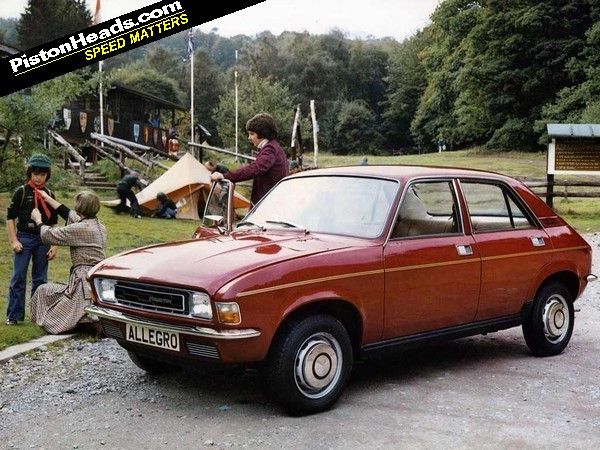
Allegro_01.jpg
 
Most of the cars were then unfortunately, in fact I think Leyland even produced a car in a rust colour......

My dad had an Allegro for a bit without that many problems, then got a lime-green Maestro which was awful in terms of performance but was built like a tank - it wrote off a horse (that ran in front of the car in the middle of town, which is the sort of thing that happens in Wales) and some posh blokes Merc (who ran a red light) without any injuries to the Maestro's occupants or significant damage.
 
My dad had an Allegro for a bit without that many problems, then got a lime-green Maestro which was awful in terms of performance but was built like a tank - it wrote off a horse (that ran in front of the car in the middle of town, which is the sort of thing that happens in Wales) and some posh blokes Merc (who ran a red light) without any injuries to the Maestro's occupants or significant damage.

Shame about the horse though......
 
Dunlop's management had a poor record of investing in their UK plants and it had nothing to do with the unions. The same with Ford's, who would always try and brow beat us to accept any old crap with, 'Germany is more productive'. Yes they were because they invested twice as much in new machinery as they did in for example Halewood.

If it wasn't for the unions, unskilled and semi skilled wages in the 1970s this country would have been no more than in the third world. There are those that would argue that Liverpool docks decline can be traced back to ending the 'tally' system and the recognition of union bargaining.

It was the management that was the 'sick man of Europe' in the 1970s due to poor management and lack of investment.

DUNLOP PLANT, SPEKE (CLOSURE)
HC Deb 26 March 1979 vol 965 cc222-32222
§Motion made, and Question proposed.

§That this House do now adjourn.—[Mr. Jim Marshall.]

§12.42 a.m.

§Mr. Eddie Loyden (Liverpool, Garston)
In this debate I wish to draw attention to a matter that is of great concern on Merseyside, and indeed to the Government, namely, the closure of the Dunlop plant at Speke.

"The Dunlop closure, because of the very nature of that firm and its products, poses a serious problem. It is necessary to go briefly into the history of the events that led to the decision to close. When we met the Dunlop management some weeks ago, the chairman told us that there was 25 per cent. over-capacity in the United Kingdom tyre manufacturing industry. Indeed, he thought that that was a conservative estimate and that the actual figure was likely to be about 30 per cent. It is important to recognise the point made by the chairman of Dunlop about excess capacity, because a common pattern is emerging. It is that whenever there is excess capacity in any 223industry the cut-off point appears to be in areas of high unemployment, and we on Merseyside have had more than our fair share of the cutting off of excess capacity.

"In one year, about 14,000 jobs have gone. I know that Ministers will say that the Government have done all that they can to assist Merseyside with job replacements and with the various measures at their disposal, but my hon. Friends and I must tell the Government that to workers in that area, where massive job losses are still going on, statements by Ministers provide little comfort

There is one other thing about the Dunlop situation that the Government must bear in mind, and that is that in spite of their efforts there appears to be no control over or power of intervention in multinational companies. Dunlop has argued—certainly it did so at the meeting that we had with it—about the poor performance at the Speke factory. I want to make one or two points to the Government on this matter. I am not suggesting that this will provide all the reasons for what has happened at Dunlop, but it will give some indication of the strategy being followed by Dunlop on investment in the United Kingdom
According to the Financial Times, over the past decade Dunlop has invested about £165 million in exporting technology to the Soviet Union. That has resulted in the creation of tyre manufacturing bases in the Soviet Union which must inevitably take a share of the global world market. In addition, Dunlop has invested in other East European countries. In my view, there is strong evidence that the dumping of tyres made in those factories has been partly responsible for the crisis not only in Dunlop but in the whole of the United Kingdom rubber industry, and particularly in the tyre section of it.

Dunlop has invested in 22 countries outside the United Kingdom. I do not disagree with the exchange of technology with the Soviet Union or the Third world. That is essential for the progress of human society. That work should take place in order to benefit other parts of the world, but when it is done in the way that Dunlop has carried out its strategy, it leads to the deindustrialisation of large sections of United Kingdom activity. That enables Dunlop to make investments in other parts of the world where there are no trade unions or no free trade unions or where there is hyper-exploitation of cheap labour which makes it impossible for the United Kingdom to compete".

Those owning industry gave up the ghost of attempting to compete with Germany, France and Italy in the 1960s and 1970s and invested less and less in industry. It was not surprising that all the Bosses unions were very much in favour of joining to EU in the 1970s because they had a protected market with favourable treatment for their products. But it still couldn't stop the decline of UK manufacturing industry.

What happened with Dunlop happened throughout UK industry and Liverpool was always in the firing line when it came to redundancies and closures. Dunlop said they suffered from over-capacity because those working there produced what they were asked to produce and in the quantities they were asked.
 
Last edited:
Status
Not open for further replies.

Welcome

Join the Everton conversation today.
Fewer ads, full access, completely free.

🛒 Visit Shop

Support Grand Old Team by checking out our latest Everton gear!
Back
Top