Current Affairs The Far Right

Status
Not open for further replies.
Oh right it's on Twitter it must be true. What processes have been done on Laura Kuenssberg behalf to identify each and every account of these individual Twitter users and their political affiliations?

This article highlights such issues
An interesting read. The cess-pool levels that Trump's alt-right trolls descend into are bottomless. And Twitter has got it all wrong in dealing with it. Who runs this idiotic company?

https://www.nytimes.com/2017/12/27/opinion/digital-nazi-hunter-trump.html
 
Things like Trump and Brexit have been talked of as a wake up call for a disenfranchised portion of society, but there doesn't seem to be much being done to re-enfranchise them.

Because that would amount to "populism", the greatest evil of them all.

1*oUFh5lZfEJAHF9K_3KAcpg.png


corbyn-speech2.jpg


I think what you're really trying to say might be: "there doesn't seem to be much being done to re-enfranchise them by people who I, aspiring Davos Man, have been conditioned to accept as legitimate". ;)
 
Because that would amount to "populism", the greatest evil of them all.

1*oUFh5lZfEJAHF9K_3KAcpg.png


corbyn-speech2.jpg


I think what you're really trying to say might be: "there doesn't seem to be much being done to re-enfranchise them by people who I, aspiring Davos Man, have been conditioned to accept as legitimate". ;)

There's a sensible approach at change and there's quackery.
 
There's a sensible approach at change and there's quackery.

Quite.

And yet, isn't interesting how seamlessly the former comes to parrot the latter? In the US, for instance, every Democrat in 2020 will at least promise universal healthcare and dramatic increases in the minimum wage, both of which were decried as full communism through late 2016. Similar heresies in the UK - nationalising the railways, for instance - will also inevitably be rendered responsible by politicians who, after years of ineffectual shrieking that the sky was set to tumble, will take one look at the polls and pretend like it'd had been their idea all along.

Almost as though "sensibility" in the eyes of those informed by the financial press is determined solely through performative rites and personnel, rather than through the nature of any specific policies themselves.

So no matter if the "populists" presented it first - anything can be made sensible so long as it's safely processed by people who went to the correct schools, enlisted in the correct professions, attend the correct conferences and dinner parties, speak and dress is the correct manner, and who are recognised as such by the correct publications.

Perhaps this is why they can deliver the Iraq War, the worst financial crisis in eight decades, a nearly ten years of devastating and counterproductive austerity, and fifty years of stagnant wages - and still retain their status as sensible chaperones, responsibly deaf to the baying of the quacks.

Or perhaps this is why people who aren't from the correct schools, professions, and dinner parties feel so disenfranchised?

I expect you'll come around soon enough, but only after responsible politicians extend their permission, and The Economist assures you that they'd been your sensible policy ideas this entire time; )
 
Last edited by a moderator:
Quite.

And yet, isn't interesting how seamlessly the former comes to parrot the latter? In the US, for instance, every Democrat in 2020 will at least promise universal healthcare and dramatic increases in the minimum wage, both of which were decried as full communism through late 2016. Similar heresies in the UK - nationalising the railways, for instance - will also inevitably be rendered responsible by politicians who, after years of ineffectual shrieking that the sky was set to tumble, will take one look at the polls and pretend like it'd had been their idea all along.

Almost as though "sensibility" in the eyes of those informed by the financial press is determined solely through performative rites and personnel, rather than through the nature of any specific policies themselves.

So no matter if the "populists" presented it first - anything can be made sensible so long as it's safely processed by people who went to the correct schools, enlisted in the correct professions, attend the correct conferences and dinner parties, speak and dress is the correct manner, and who are recognised as such by the correct publications.

Perhaps this is why they can deliver the Iraq War, the worst financial crisis in eight decades, a nearly ten years of devastating and counterproductive austerity, and fifty years of stagnant wages - and still retain their status as sensible chaperones, responsibly deaf to the baying of the quacks.

Or perhaps this is why people who aren't from the correct schools, professions, and dinner parties feel so disenfranchised?

I expect you'll come around soon enough, but only after responsible politicians extend their permission, and The Economist assures you that they'd been your sensible policy ideas this entire time; )

Well the government is absorbing many of UKIP's ideas at the moment so presumably that's the natural progression too? Presumably countries where such state largesse is in evidence, such as France, are also devoid of the social challenges we face in Britain and America?

The way things should progress is not based upon ideology but evidence. Corbyn and Sanders have thrived in the back benches for a generation because they've never had to actually do anything. They've never had to expose their ideas to hard reality. It feels almost like trying to compare science with religion, because politics at the moment is almost purely focused around belief. There's just as much actual evidence behind Corbyn as there is behind the Brexiteers blind faith that things will work out.

In the NHS, for instance, we have a pretty wide variety of different models adopted in Europe alone, so there's a degree of actual evidence about how they work, yet the debate around the NHS is pretty much solely down to money, and somehow things will magic themselves better.

The railways are having the same debate that universities had. You've got a sector that requires £x to run. Previously that money would have come from the general public via taxation, thus meaning that those who didn't use it ended up paying for things enjoyed by the (usually) wealthier parts of society. That changed with the introduction of tuition fees, where the middle class were asked to foot the bill for services they enjoyed. It's the same with the railways, the total money spent on railways hasn't changed too much, but the government subsidy has reduced and the people who actually use the trains contribution has increased. Rail travel is, by and large, a middle class pursuit, so again nationalising them would be a sop to the middle classes.

He's a real man of the people though is Corbyn, and certainly not paying lip service to the middle class lefties in his own constituency.
 
Well the government is absorbing many of UKIP's ideas at the moment so presumably that's the natural progression too? Presumably countries where such state largesse is in evidence, such as France, are also devoid of the social challenges we face in Britain and America?

The way things should progress is not based upon ideology but evidence. Corbyn and Sanders have thrived in the back benches for a generation because they've never had to actually do anything. They've never had to expose their ideas to hard reality. It feels almost like trying to compare science with religion, because politics at the moment is almost purely focused around belief. There's just as much actual evidence behind Corbyn as there is behind the Brexiteers blind faith that things will work out.

In the NHS, for instance, we have a pretty wide variety of different models adopted in Europe alone, so there's a degree of actual evidence about how they work, yet the debate around the NHS is pretty much solely down to money, and somehow things will magic themselves better.

The railways are having the same debate that universities had. You've got a sector that requires £x to run. Previously that money would have come from the general public via taxation, thus meaning that those who didn't use it ended up paying for things enjoyed by the (usually) wealthier parts of society. That changed with the introduction of tuition fees, where the middle class were asked to foot the bill for services they enjoyed. It's the same with the railways, the total money spent on railways hasn't changed too much, but the government subsidy has reduced and the people who actually use the trains contribution has increased. Rail travel is, by and large, a middle class pursuit, so again nationalising them would be a sop to the middle classes.

He's a real man of the people though is Corbyn, and certainly not paying lip service to the middle class lefties in his own constituency.

The essence of what Sanders and Corbyn advocate (Sanders in particular), is in policy terms normal, time-tested, and utterly mundane within every part of of the developed world - save the always exceptionally parochial United States and UK. But it is more likely to be the UKIP agenda that prevails, if the self-proclaimed sensible keep childishly pretending that the constructive alternatives to their own constrained set of acceptable responses are tantamount to Chavez and Pol Pot - which of course only compounds the sense of frustration and alienation from mainstream politics.

It is not just about the money - obviously - but that is the the quickest and simplest place for the government to start. The UK spends less on health and education than most countries in Europe; recent NHS spending adjustments have, entirely predictably, resulted in crowding, increased wait times, staff burnout if not exodus, and plummeting general morale - not exactly conducive conditions for carrying out more systemic reforms. University tuition is off the charts anywhere except America (like topping Port Vale in the Football League table), and the trains slower and much more expensive. Perhaps a reason the why university attendance and rail access have become such distinctly middle-class services is because nobody else can afford to spend or borrow the 9k and up to 5k/year, respectively, that it now takes to use them? Perhaps a reason why Boston and other Brexit towns from your rhetorical flourishes have become so disenfranchised is because so many people who live there no longer see a realistic means of going anywhere else?

And which party leadership called for major infrastructure development, at a time when UK productivity has stagnated and central banks are tearing their hair out trying to get governments to invest in exactly this, such that borrowing now costs less than inflation?

Anomie in France is a fair point - as I said, it is obviously more complex than mere spending levels, and the state alone can only do so much. But there are some very easy and obvious things that the UK can be doing immediately; instead, we're clearly hellbent on moving in the opposite direction, all the while insisting that even modest tweaks against our race to the bottom amount to storming the Bastille.

I'm not some doctrinaire Corbynista. His position on Brexit is enormously frustrating, for instance, if not all that surprising given the nature of parliamentary Labour and its constituents.

But to claim to nobody is trying to address the disenfranchised portions of society is self-serving nonsense. It's just that it hasn't yet been transmuted for broadcast via the highly attuned, acutely sensitive media dogwhistles that "sensible" people seem to require before they can hear anything at all.

 
Last edited by a moderator:
The essence of what Sanders and Corbyn advocate (Sanders in particular), is in policy terms normal, time-tested, and utterly mundane within every part of of the developed world - save the always exceptionally parochial United States and UK. But it is more likely to be the UKIP agenda that prevails, if the self-proclaimed sensible keep childishly pretending that the constructive alternatives to their own constrained set of acceptable responses are tantamount to Chavez and Pol Pot - which of course only compounds the sense of frustration and alienation from mainstream politics.

It is not just about the money - obviously - but that is the the quickest and simplest place for the government to start. The UK spends less on health and education than most countries in Europe; recent NHS spending adjustments have, entirely predictably, resulted in crowding, increased wait times, staff burnout if not exodus, and plummeting general morale - not exactly conducive conditions for carrying out more systemic reforms. University tuition is off the charts anywhere except America (like topping Port Vale in the Football League table), and the trains slower and much more expensive. Perhaps a reason the why university attendance and rail access have become such distinctly middle-class services is because nobody else can afford to spend or borrow the 9k and up to 5k/year, respectively, that it now takes to use them? Perhaps a reason why Boston and other Brexit towns from your rhetorical flourishes have become so disenfranchised is because so many people who live there no longer see a realistic means of going anywhere else?

And which party leadership called for major infrastructure development, at a time when UK productivity has stagnated and central banks are tearing their hair out trying to get governments to invest in exactly this, such that borrowing now costs less than inflation?

Anomie in France is a fair point - as I said, it is obviously more complex than mere spending levels, and the state alone can only do so much. But there are some very easy and obvious things that the UK can be doing immediately; instead, we're clearly hellbent on moving in the opposite direction, all the while insisting that even modest tweaks against our race to the bottom amount to storming the Bastille.

I'm not some doctrinaire Corbynista. His position on Brexit is enormously frustrating, for instance, if not all that surprising given the nature of parliamentary Labour and its constituents.

But to claim to nobody is trying to address the disenfranchised portions of society is self-serving nonsense. It's just that it hasn't yet been transmuted for broadcast via the highly attuned, acutely sensitive media dogwhistles that "sensible" people seem to require before they can hear anything at all.

Very good post.
 
The railways are having the same debate that universities had. You've got a sector that requires £x to run. Previously that money would have come from the general public via taxation, thus meaning that those who didn't use it ended up paying for things enjoyed by the (usually) wealthier parts of society. That changed with the introduction of tuition fees, where the middle class were asked to foot the bill for services they enjoyed. It's the same with the railways, the total money spent on railways hasn't changed too much, but the government subsidy has reduced and the people who actually use the trains contribution has increased. Rail travel is, by and large, a middle class pursuit, so again nationalising them would be a sop to the middle classes.

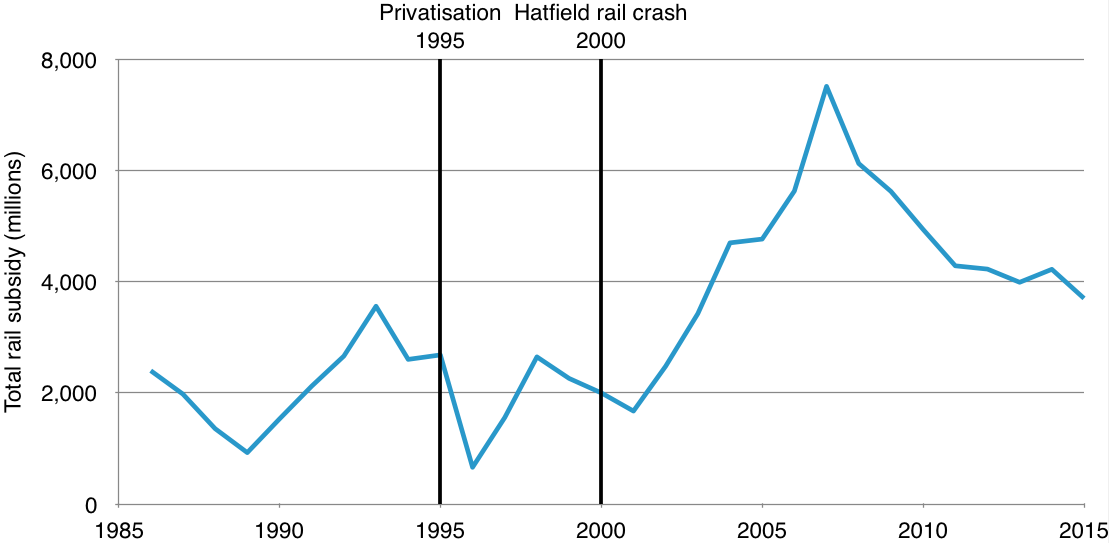
Just as an aside, you have got the railways completely wrong there. The amount of subsidy required is now much more than it was under BR:

UK_total_rail_subsidies_1986-2015.png


Of course there has been an increase in passenger numbers - so the amount of subsidy per passenger mile has gone down, though how much that is down to privatization itself and how much is down to the Government actually investing in the railways (they put nine times as much money in compared to the first years of privatization) is another question.

What Corbyn should really be advocating is some way of combining the advantages that BR had (its size and the fact that it was a unified system) with ensuring that it is kept out of the hands of the Department for Transport, who will try to kill it again.
 
Just as an aside, you have got the railways completely wrong there. The amount of subsidy required is now much more than it was under BR:

UK_total_rail_subsidies_1986-2015.png


Of course there has been an increase in passenger numbers - so the amount of subsidy per passenger mile has gone down, though how much that is down to privatization itself and how much is down to the Government actually investing in the railways (they put nine times as much money in compared to the first years of privatization) is another question.

What Corbyn should really be advocating is some way of combining the advantages that BR had (its size and the fact that it was a unified system) with ensuring that it is kept out of the hands of the Department for Transport, who will try to kill it again.

Quite a good graph, privatised in 95 and the subsidy dropped like a stone. Blair got in in 97 and it went through the roof for the whole of a Labour Government before the tories got back and reduced it...........what was the point again......
 
Status
Not open for further replies.

Welcome

Join the Everton conversation today.
Fewer ads, full access, completely free.

🛒 Visit Shop

Support Grand Old Team by checking out our latest Everton gear!
Back
Top