Remember-the-name
Player Valuation: £6m
It's a vicious terrorist state.


Why isn’t this reported in western media circles ?
Settlers shot Palestinian and mutilated his body as he lay dying
Eyewitnesses say Israeli settlers shot Ismail Tubasi and attacked him with sharp objects while raiding West Bank village. No investigation was opened.www.972mag.com
Settlers shot Palestinian and mutilated his body as he lay dying
Witnesses say Israeli settlers shot Ismail Tubasi and attacked him with sharp objects while raiding his West Bank village. No investigation was opened.
By Basil al-Adraa and Yuval Abraham June 8, 2021
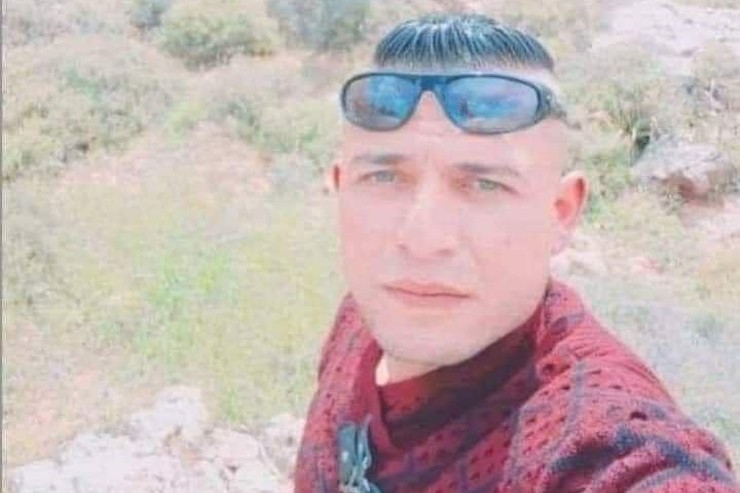
Ismail Tubasi (Courtesy of the Tubasi family)
Ismail Tubasi was shot on Friday, May 14, just south of Hebron in the occupied West Bank. Tubasi, 27, from the Palestinian village of al-Rihiya, was transferred to a local hospital with severe wounds, where he was pronounced dead.
According to evidence gathered by Local Call, it appears Tubasi was shot by Israeli settlers, who may have been accompanied by soldiers, after which he was brutally attacked with sharp objects as he lay incapacitated.
According to two witnesses, settlers shot Tubasi after they began setting fire to Palestinian-owned fields and trees in al-Rihiya. The eyewitnesses said Tubasi and other Palestinians had headed to the fields to try and put out the flames. There, settlers armed with guns, axes, and batons began chasing him, after which the witnesses heard a number of gunshots.
Get Our Weekly Newsletter
Sign up
One of the witnesses, Tubasi’s nephew, said that he saw his uncle laying on the ground after being hit by a bullet, yet did not see any wounds on his face. The nephew then fled the scene out of fear that the settlers, who were approaching the wounded Tubasi, would come after him next.
When Tubasi was evacuated to a hospital half an hour later, however, his face was bloodied by fresh and deep wounds, which were not there when he was shot. According to the testimony, Tubasi was allegedly attacked by a sharp object while incapacitated.
Tubasi was evacuated to Shaheed Abu Hassan al-Qassam Hospital in the West Bank city of Yatta, where he was pronounced dead. According to the hospital report, Tubasi’s body did not have an exit wound from the bullet. The report also said that he was wounded in his forehead by two sharp objects, one of them 20 centimeters long and the other seven centimeters. According to the report, the cause of death was a bullet that struck Tubasi’s head. The report, which included a photo of the deceased body, was viewed by Local Call and +972.
Israeli settlers in the West Bank routinely attack Palestinians, burn their crops and trees, and damage their property. Human rights group Yesh Din say they received 216 complaints of settler violence between January 2020 and June 2021. A recent report by the organization listed 63 cases of severe assaults between 2017 and 2020. In none of these cases was an indictment filed against the attackers.
The Israeli army refused to provide an official response to the incident, but military sources told the Israeli Public Broadcast Corporation (which picked up the story following Local Call’s initial investigation) that the soldiers arrived at the scene after the shooting. According to the same sources, the army reported to the police that a Palestinian had indeed been shot dead, yet the police has yet to open its own investigation.
Although brutal settler violence is pervasive, it is quite rare for such attacks to lead to the killings of victims. According to human rights group B’Tselem, since 2014, Israeli civilians have killed 30 Palestinian residents of the West Bank, many of them during alleged attempts by Palestinians to stab Israelis or throw stones at Israeli vehicles.
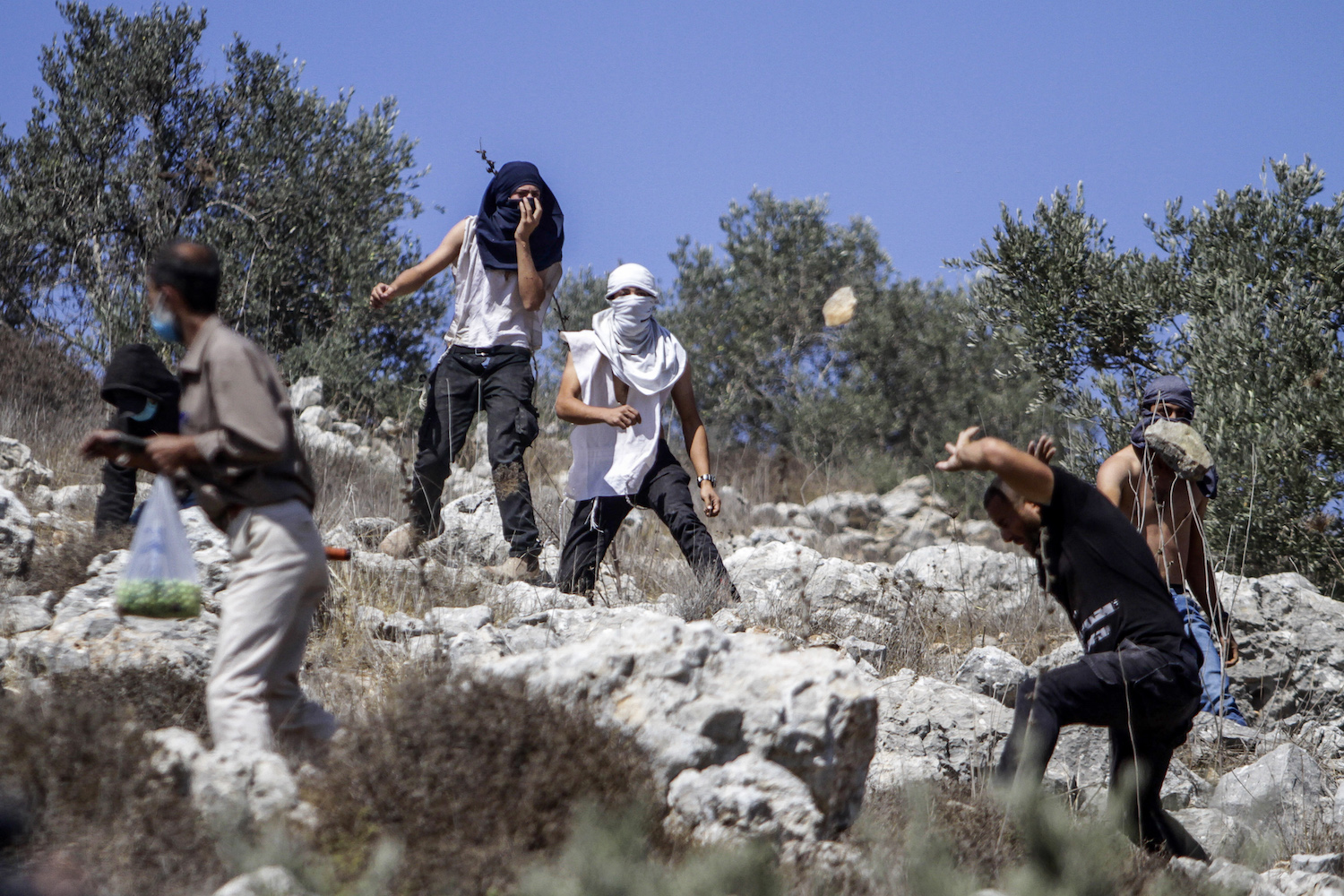
Illustrative photo of Israeli settlers hurling stones at Palestinians during the annual harvest season in the West Bank. (Nasser Ishtayeh/Flash90)
In November 2017, for example, settlers shot dead Mahmoud Za’al Odeh, from the village of Qusra, claiming they were attacked with stones while they were on his land. One of the most infamous cases of deadly settler violence is the murder of members of the Dawabshe family in July 2015, who were burned alive in their homes in the village of Duma as they slept.
Tubasi’s death took place on a day of mass demonstrations across Israel-Palestine, including the West Bank, in protest of Israeli attacks on Gaza and violence against Palestinian citizens inside Israel. According to the Palestinian Health Ministry, Israeli security forces killed 11 Palestinians that day in various locations around the West Bank. According to Palestinian testimonies, besides al-Rihiya, groups of settlers, backed by a small number of soldiers, attacked four villages in the West Bank: Urif, Asira al-Qabliya, Eskaka, and Marda. Tubasi’s death at the hands of settlers refutes to Palestinian Health Ministry’s claim that Israeli soldiers were responsible for the deaths of the 11 Palestinians.
According to the heads of these four localities, the settler attacks led to a massive confrontation and the use of live fire against Palestinians from both settlers and soldiers. Four young Palestinians were reportedly killed in this manner, one in each locality, while dozens of other Palestinians were wounded. “They came to kill,” said Hafez Saleh, the head of Asira al-Qabliya.
‘The army saw everything, but did not intervene’
According to three eyewitnesses Local Call spoke to, on May 14 at 2 p.m., several dozen settlers arrived from the direction of Beit Hagai, an Israeli settlement located 700 meters from al-Rihiya, and began burning the village’s fields and trees, even entering the locality. The villagers identified them as settlers because they were dressed as civilians, wore kippahs, and some had sidelocks. The villagers said that when they tried to put out the fire, they were beaten by the settlers. Israeli soldiers arrived at the scene but did not intervene.
“I woke up at home to people screaming: ‘Fire, they set a fire,'” recalls Kazem al-Hallaq, a 62-year-old resident of Al-Rihiya. “I went outside and saw a large fire in the area of the olive trees, and the wheat and barley fields. The source of the fire was from the north, that is, from the direction of Beit Hagai. Many settlers stood by the fire, about 50 people. They continued to set fire to the fields and made sure it burned and spread.”
Al-Hallaq said that he saw two young men from his family who tried to put out the fire with blankets, but as soon as they started, he saw settlers running toward them and beating them, and at one point knocking them to the ground. “The army stood far away. They saw everything, but did not intervene,” al-Hallaq said.
“When more Palestinians arrived to put out the fire, the army intervened and began throwing gas grenades and firing rubber bullets at them,” al-Hallaq continued. “Most of the people fled to their homes and to the school. The settlers followed them, right in front of the soldiers, entered the village and began throwing stones at the homes.
“Settlers came right up to my house and smashed the car parked at the entrance. It was scary. I locked the door of the home, and went up to the roof with the children to hide them. The settlers stepped onto my car and started dancing and singing while I hid on the roof.
“Suddenly, I saw another group of settlers who were heading to the land that belongs to the Tubasi family. It was difficult to see what was happening there. I saw thick smoke rising from the ground and realized that the settlers had set fire to another field. A few minutes later I heard five gunshots, live fire. I saw residents of the village running there, and heard the sound of an ambulance approaching.
“At one point I also left the house and went to see what had happened,” said al-Hallaq. “There was a lot of confusion. Some people said that someone was dead. Others said someone had been wounded. After an hour I was told that a young man from the Tubasi family was killed. Our fields were completely burned. The settlers and the army disappeared from the area.”
‘The settlers proudly told us they burned our fields’
“At noon on Friday, my uncle Ismail called me,” said Jamal Tubasi, the victim’s nephew. “I was at my aunt’s house because of the Eid al-Fitr holiday. Ismail was stressed and asked me to come quickly. I asked where, and he said: ‘To the olive trees, in the north of the village. The settlers are burning our fields, the fire is strong.’
“I quickly ran there, about a mile from the house,” Jamal continued. “When I arrived I saw a large group, 30 settlers, most of them young, huddled about 200 meters from the burning olive trees. The settlers proudly told us they burned our fields. And not just our fields, but all over.
“Ismail told me that [Palestinian villagers] had been trying to put out the fire for a long time, but settlers were preventing them. I saw other groups of settlers who came to the place, some holding large axes in their hands, some armed with weapons and batons. The soldiers also stood there near the settlers.
“Our young men, and with them Ismail, tried to head to the fire in the olive groves, but the soldiers fired tear gas, rubber bullets, and stun grenades at them. The settlers stood behind the soldiers and tried to advance toward us to attack us. Ismail asked me to stay close to him. But it became very scary once the amount of tear gas and stun grenades increased, and the settlers managed to get very close to us along with the soldiers. We ran away and split into smaller groups.
“I saw that my uncle Ismail had run toward the olive groves. At that moment I got a call, I answered the phone; it was a relative who wanted to check that Ismail and I were okay. When I was done with the call, I could not see where Ismail had gone.
“That’s when I heard gunshots. More than five bullets. Live fire. I didn’t understand what happened. One person came over and yelled ‘Ismail was wounded.’ He pointed over at the direction where Ismail had fled, 300 meters from where I stood.”
Ismail’s brother, Ibrahim, was by his side as they went to put out the fire in the family’s fields. “The soldiers fired gas, stun grenades, and rubber bullets to cause us to split up,” Ibrahim said. “I was standing next to Ismail and I saw him run toward the [olive] trees. I ran in the opposite direction. I saw a group of settlers running in the direction where Ismail fled to, and then I heard about four shots. I did not know or see who opened fire, but the sound came from where Ismail fled. I heard some residents say that Ismail was wounded.”
According to testimonies of Palestinians who asked not to be identified by name, it was the settlers who had opened fire, rather than the soldiers who had been standing closer to the village.
‘They murdered my brother. Our land is burned’
Jamal Tubasi, Ismail’s nephew, says he then ran to where Ismail had been shot. “I saw Ismail lying on the ground between two rocks, on his right side. When he saw me, he called to me in a very weak voice. Almost in a whisper he told me, ‘I’m wounded,’ then he gave me his phone and asked me to take it to the family. ‘Put my head on the ground,’ Ismail murmured, ‘and run away as fast as possible.’ I told him I would not leave him, but he raised his hand with great difficulty, looked at me, and said again, in a very weak voice: ‘Run.’”
“At that moment I saw a group of five settlers carrying large axes, and next to them were two soldiers, all running toward us. They were about 50 meters away from me and approaching quickly. Under pressure, I flipped Ismail on his back and ran away. When I left him, his nose was bleeding and he was also bleeding from his left ear. Apart from that, his face looked fine. I could not understand what the nature of his injury was, and whether he was in serious or mild condition.
“I ran 200 or 300 meters away. From where I was standing I saw people trying to get to the area where Ismail fell. They went back and forth, as if they were looking for something. A long time passed, it’s hard for me to say how much, more than half an hour. Then I saw three or four people, medical workers, carrying Ismail on a stretcher.
“I ran there and asked them to see Ismail to make sure he was alive. They lowered the stretcher and then I saw his face. I could not believe it: his face was completely broken, with deep wounds, covered in blood that was dripping everywhere. I could not bear to look. I screamed in terror, fell to the ground, and fainted.
“All I remember after that is that people poured water on my face, and others lifted my legs up, and slapped me to wake me up. When I woke up, I was told they had taken Ismail to the hospital in Yatta.
“A car took me to the hospital. And when I arrived, I heard two people say that Ismail was dead. I fainted again. I woke up and fainted again. Truthfully, the shock has not left my body and I have a hard time believing what happened.
“The only thing I’m sure about is that when I got to my uncle, after his first injury, his face was clean, there was nothing there, only blood dripping from his nose and ear. And I remember that the group of settlers who ran to Ismail with two soldiers were carrying axes.”
Other residents of al-Rihiya said settlers surrounded Ismail as he lay on the ground, making it difficult for them to gauge exactly how he was attacked.
“My family is devastated,” said Ismail’s brother, Ibrahim. “They murdered my brother. Our land is burned. We are not able to go back there to see it. Usually the settlers come at night and uproot olive trees, but this time the army took advantage of the situation, and the settlers felt they had more power and support than usual to burn everything and murder my brother.”
Ibrahim added, “Today there is no difference between a soldier and a settler. These people destroyed us. Two days after my brother’s murder, the army revoked our work permits in Israel. Five men from my family work in Israel. Now we are all prevented from entering.”
The Tubasi family said they had lodged a complaint with the Palestinian police following Ismail’s death. It is not clear whether the Palestinian police forwarded the complaint to the Israeli police. Yet if the army did in fact inform the Israeli police that Ismail was killed, it is not clear why the police did not open its own investigation regardless of whether a complaint was filed, as per Israeli law in suspected crimes, and especially in cases of unnatural death.
Israeli police offered only the following response to the killing: “No complaint was filed with the police and the details of the incident as stated are not known to us. You can contact the police and file a complaint as is customary.”

Not only the western media. I've seen nothing in Palestinian or Arabic media, other than this article and the same one in Turkish based TRT, while his death was given one line in Middle Eastern Eye. Sad.Why isn’t this reported in western media circles ?
If a Palestinian farts in the wrong direction it’s all over the news so why this media bias ?


I knew it was serious when his Uncle Ben range of tasty sauces got banned…You're always going on about Benjamin netanyahu. Let it go Lynn, you're never going to meet him.


 www.middleeasteye.net

irrefutable facts
Whatever lad

Join the Everton conversation today.
Fewer ads, full access, completely free.