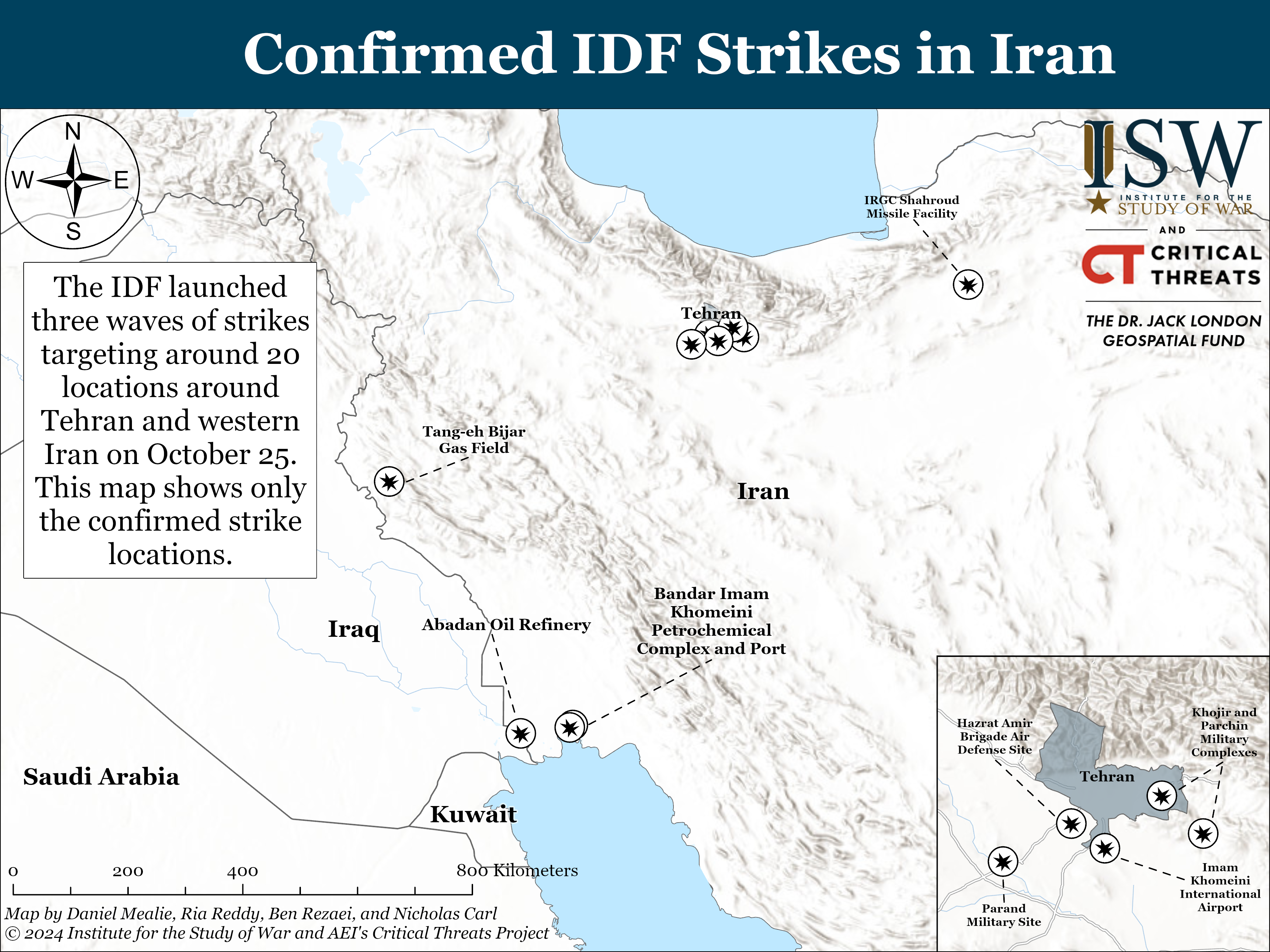
Yup. Hamas, Hez, + various Iraqi militias have all been whacked. The logistics and supply chains to these groups have also been severely compromised.
Also Israel took out their main Long/mid-range AD sites which effectively means they are now wide open to attack.
They look weak, because they now are weak.
Piece on the Hezbollah situation from ISW
.
Hezbollah’s Military Forces Are Failing in Lebanon
By Brian Carter, Middle East Portfolio Manager at the Critical Threats Project (CTP)
October 28, 2024
Lebanese Hezbollah is attempting to obfuscate the reality that its military forces in southern Lebanon are disorganized and conducting ineffective military operations against the Israel Defense Forces (IDF). Hezbollah’s military forces have been badly damaged and disrupted by Israeli military action. Israeli forces entered Lebanon on October 1 to destroy Hezbollah’s ability to threaten northern Israeli communities.[1] The operation has so far successfully destroyed and disrupted many of the capabilities required for Hezbollah to threaten northern Israel.[2] Hezbollah is attempting to present itself as a competent, confident military organization, but it has so far failed to effectively execute any major military campaign at scale. Hezbollah’s degradation and severe disruption is likely temporary, however, and the group can reconstitute if Israeli operations end soon.
The IDF entered Lebanon in force on October 1 after a months-long air and ground campaign that disrupted Hezbollah’s command structure.[3] The entrance of large Israeli forces into Lebanon on October 1 was the culmination of a months-long campaign combining special operations, covert operations, and airpower that disrupted and degraded Hezbollah forces along the border.[4] The five Israeli divisions currently operating in Lebanon have continued to disrupt and destroy Hezbollah forces there.[5] The IDF ground force in Lebanon is supported by a continued air campaign against Hezbollah supplies, finances, and leaders throughout the country.[6] Lebanese social media pages continue to report the deaths of Hezbollah commanders on a near-daily basis, demonstrating the continued IDF pressure against Hezbollah forces.[7]
Hezbollah has so far failed to effectively execute any serious military undertaking at scale. Hezbollah likely planned to execute one of several possible tactical tasks in response to an Israeli ground operation:
- Hezbollah could have decided to defend key infrastructure or Shia towns along the border. A defending force aggressively seeks to hold ground or destroy the attacking force.[8] Hezbollah would presumably decisively engage its combat forces and employ more sophisticated tactics in a defense were it executing a defense effectively. Hezbollah has engaged Israeli forces, but it has not conducted any sophisticated multi-stage ambushes. Hezbollah has instead relied upon rocket and mortar shelling to harass Israeli positions.[9] Rockets and mortars cannot defend ground alone, and would need to be combined with infantry to effectively defend against Israeli attacks. These rocket and mortar attacks also are not limiting the IDF’s ability to maneuver on the battlefield or causing the IDF to change its overall scheme of maneuver.[10] Coordinating between infantry forces and artillery is a difficult command-and-control task that may not be possible given the current state of Hezbollah’s communications and command network.
- Hezbollah, having suffered command-and-control disruption, could have conducted an orderly withdrawal in order to reorganize itself out-of-contact with Israeli ground forces. A withdrawal is when a force in contact with the enemy force moves away from the enemy force.[11] A force conducting an orderly withdrawal evacuates or destroys its supplies to prevent the attacking force from capturing them.[12] Hezbollah did not evacuate even its most prized, high-end supplies, like Kornet anti-tank missile launchers or night-vision goggles, instead allowing these supplies to fall into Israeli hands.[13]
- Hezbollah could also have conducted a delaying operation, trading space for time to force a ceasefire or allow disrupted Hezbollah units to reconstitute. A force “under pressure” executes a delay to trade space for time to slow down an attacking force’s momentum without, in principle, becoming decisively engaged.[14] A delay, like a withdrawal, is one form of a retrograde operation. Hezbollah forces executing a delay would presumably also attempt to evacuate or destroy its supplies to prevent Israeli capture.
Hezbollah forces have executed none of these tasks coherently, instead showing limited resistance in some sectors while abandoning others in a way that shows no clear plan or pattern of operations. Hezbollah’s failure so far demonstrates that its military forces are in disarray.
Hezbollah’s media arms and senior leaders have attempted to obfuscate Hezbollah’s disarray by presenting the group as competent, confident, and successfully defending Lebanon. Hezbollah Deputy Secretary General and public face Naim Qassem said on October 15 that the group was successfully fighting the Israelis and dismissed Israel’s claims about Hezbollah’s losses.[15] Unspecified Lebanese officials, a Lebanese official who “meets regularly with Hezbollah,” and a Lebanese source “close to Hezbollah” spoke to the
Washington Post and attempted to frame the group as highly capable and successful defenders of southern Lebanon.[16] Hezbollah has also routinely claimed it “hits” Merkava tanks with anti-tank missiles but has yet to publish any evidence indicating that these “hits” knocked tanks out of action or slowed Israeli operations.[17] Hezbollah would presumably publish evidence of destroyed vehicles, given that it has a vested interest in portraying its “defensive” operations as effective.
Criticisms directed at the IDF’s slow pace of operations ignore Israeli operational design and lessons learned in the Gaza Strip. Some Lebanese officials implied that the Israeli operation is failing because IDF forces have not penetrated deep into Lebanon.[18] The IDF’s slow movement is a deliberate choice designed to root out and destroy Hezbollah tunnel infrastructure methodically. This approach was presumably derived from a lesson learned in the Gaza Strip, where after a relatively rapid armored assault, the IDF slowed its pace of operations and began methodically reentering areas and ripping out subterranean and above-ground infrastructure.[19]
Israeli forces will need to undertake additional activities to maintain Hezbollah’s degradation and disruption, but current Israeli tactical and operational efforts appear to have routed Hezbollah units at least in the immediate border area. Hezbollah’s degradation and severe disruption is temporary, however, and the group will recover absent sufficient Israeli pressure. If Israeli air operations targeting Hezbollah forces and commanders behind the lines slacken—due either to an IDF decision to prioritize close air support or to a political decision to slow strikes—Hezbollah will be able to reorganize, refit, and become more effective. Persistent IDF airstrikes combined with the IDF’s advances are likely disrupting reorganization efforts, however.

Lebanese Hezbollah is attempting to obfuscate the reality that its military forces in southern Lebanon are disorganized and conducting ineffective military operations against the Israel Defense Forces (IDF). Hezbollah’s military forces have been badly d

www.understandingwar.org