ISW Key Takeaways:
- Hamas published several videos of its operations in the northern Gaza Strip, messaging that it still has a military presence there. The al Qassem Brigades and other Palestinian militias are not destroyed in the northern Gaza Strip and maintain a limited presence there, especially around southern Gaza City.
- A Palestinian journalist reported that Israeli forces “repositioned” themselves in Gaza City after withdrawing from several areas in the city over the past two weeks.
- The Israel Defense Forces continued clearing operations in the Central Governorate of the Gaza Strip. Palestinian militias continued attempting to defend against Israeli clearing operations in the central Gaza Strip.
- The Israel Defense Forces continued clearing operations in Khan Younis in the southern Gaza Strip. The Israel Defense Forces said that it completed operations in Khuzaa, south of Khan Younis.
- US Secretary of State Antony Blinken said in an interview with NBC News that normalization between Saudi Arabia and Israel is still possible.
- Israeli media reported that the latest Qatari proposal for a ceasefire agreement would include exiling Hamas leaders from the Gaza Strip.
- Palestinian fighters attacked Israeli forces conducting raids in five locations in the West Bank. Hamas Political Bureau leaders have in recent days called attention to violence and Israeli raids in the West Bank.
- Iranian-backed militias, including Lebanese Hezbollah, conducted two attacks from southern Lebanon into northern Israel on January 10, compared to the weekly average of around nine attacks.
- Iraqi Prime Minister Mohammad Shia al Sudani is attempting to balance pressure from Iranian-backed Iraqi actors to expel US forces from Iraq with his administration’s reported desire to sustain the US-led coalition presence in Iraq.
- The Islamic Resistance in Iraq—a coalition of Iranian-backed Iraqi militias—claimed responsibility for three attacks targeting US positions in Iraq and Syria.
- The Houthis conducted their largest and most complex attack yet into the Red Sea.
- Iran has reportedly developed a new Shahed drone for Russian forces to use against Ukraine and is “close” to providing Russia with surface-to-surface ballistic missiles and systems.
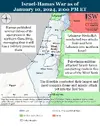 Gaza Strip
Axis of Resistance campaign objectives:
- Erode the will of the Israeli political establishment and public to launch and sustain a major ground operation into the Gaza Strip
- Degrade IDF material and morale around the Gaza Strip.
Hamas published several videos of its operations in the northern Gaza Strip, messaging that it still has a military presence there. Hamas’ military wing—the al Qassem Brigades—published these videos on January 9 and 10.[1] The footage features various al Qassem Brigades operations, including the capture of an Israeli drone in Beit Lahia, rocket-propelled grenade (RPG) attacks on Israeli armor and dismounted infantry in the northwestern Gaza Strip and southern Gaza City, and an ambush on Israeli soldiers in a tunnel in Sheikh Radwan dating to late December 2023.[2] Hamas’ political wing similarly messaged on January 9 that the group retains a strong and cohesive command-and-control network in the Gaza Strip.[3] CTP-ISW has repeatedly assessed, however, that Hamas has lost command-and-control over some units that are engaged with Israeli forces in the Gaza Strip.[4]
The al Qassem Brigades and other Palestinian militias are not destroyed in the northern Gaza Strip and maintain a limited presence there, especially around southern Gaza City.[5] Israeli forces began clearing operations in southern Gaza City in late October 2023 to isolate the northern Gaza Strip from the rest of the territory.[6] The IDF announced on November 18, 2023, that Israeli forces expanded clearing operations to Zaytoun and began targeting fighters and infrastructure belonging to the Hamas’ Zaytoun Battalion.[7] Palestinian militias have continued conducting occasional attacks on Israeli forces in Zaytoun since then, despite the IDF announcing on January 6 that it had “dismantled” the 12 Hamas battalions in the northern Gaza Strip.[8] The commander of the Zaytoun Battalion is one of the three Hamas commanders remaining in the Gaza City Brigade, who held their current positions before the war began, according to IDF reports on December 21, 2023.[9] Palestinian fighters in the Zaytoun Battalion probably have access to a rear area and safe haven in the Gaza Strip’s Central Governorate, given its proximity to where the battalion operates and the fact that the IDF has not completed clearing operations.[10]
A Palestinian journalist reported on January 9 that Israeli forces “repositioned” themselves in Gaza City after withdrawing from several areas in the city over the past two weeks.[11] The journalist said that Israeli forces clashed with Palestinian fighters in Sheikh Radwan and Zaytoun in Gaza City.[12] The IDF confirmed on December 31 that it withdrew five brigades from the northern Gaza Strip and said that it would transition to limited raids in the area.[13] Israeli forces have degraded several Hamas units and rendered others combat ineffective since the beginning of the clearing operations, particularly in the northern Gaza Strip. Hamas’ military forces are neither defeated nor destroyed at this time, however.
Hamas fighters in the northern Gaza Strip may be attempting to fix Israeli forces in the area to prevent any Israeli attempt redeploy forces southward. A fix is a tactical mission task wherein “a commander prevents the enemy from moving any part of that force from a specific location for a specific period.”[14]
The IDF continued clearing operations in the Central Governorate of the Gaza Strip on January 10. The IDF Golani Brigade (assigned to the 36th Division) directed an airstrike targeting fighters in Maghazi and located over 15 militia tunnels in the area.[15] The Golani Brigade also located platforms for launching rockets, missiles, and drones and destroyed an RPG manufacturing system in Maghazi. Palestinian sources said that an Israeli airstrike targeted an ambulance in Deir al Balah and killed four members of the ambulance crew.[16]
Palestinian militias continued attempting to defend against Israeli clearing operations in the central Gaza Strip on January 10. The al Aqsa Martyrs’ Brigades—the self-proclaimed military wing of Fatah—clashed with Israeli forces in central Maghazi.[17] The al Quds Brigades—the military wing of Palestinian Islamic Jihad (PIJ)—fired an RPG at an Israeli Merkava tank north of Nuseirat.[18] The National Resistance Brigades—the militant wing of the Democratic Front for the Liberation of Palestine (DFLP)—fired mortars at Israeli vehicles northwest of Bureij.[19]
The IDF continued clearing operations in Khan Younis in the southern Gaza Strip on January 10. The IDF 55th Brigade (assigned to the 98th Paratroopers Division) has targeted fighters from Hamas’ Khan Younis Brigade in recent days.[20] The IDF located a drone launch site, weapons, and a tunnel shaft in Khan Younis. The IDF also directed airstrikes on four Hamas sites in the area, including a Hamas operational headquarters.[21] The IDF 4th (Kiryati) Brigade Combat Team identified a Palestinian fighter who planted an IED in Khan Younis and directed an airstrike to eliminate the fighter.[22] The IDF Air Force conducted strikes killing over ten Palestinian fighters in Khan Younis.[23] The 98th Paratrooper Division also killed dozens of fighters during clashes in Khan Younis.[24]
The IDF engaged several Palestinian militias in clashes in Khan Younis. The al Qassem Brigades fired mortars at Israeli forces south of Khan Younis.[25] The al Quds Brigades fired mortars at Israeli forces in Khan Younis.[26] The National Resistance Brigades clashed with Israeli soldiers in the Jourat al Lot neighborhood of Khan Younis.[27]
The IDF said that it completed operations in Khuzaa, south of Khan Younis, on January 10.[28] The IDF began combat operations in Khuzaa on December 27, 2023.[29] The IDF said that its 5th Brigade (assigned to the 143rd Division) killed dozens of Hamas fighters and destroyed hundreds of Hamas infrastructure, including weapons depots, rocket launching positions, and tunnels in Khuzaa.[30] The IDF said Hamas’ fighters used the infrastructure in Khuzaa to conduct attacks on Nir Oz, Nirim, and Ein HaSlosha in southern Israel on October 7.[31]
US Secretary of State Antony Blinken said in an interview with NBC News on January 10 that normalization between Saudi Arabia and Israel is still possible.[32] Blinken said that Saudi Crown Prince Mohammad Bin Salman supports advancing the normalization process in a recent meeting.[33] An Israeli journalist reported that Blinken told Israeli Prime Minister Benjamin Netanyahu during their meeting on January 9 that Saudi Arabia intends to continue normalization with Israel only if Israel agrees to a two-state solution after the Israel-Hamas war.[34] Blinken said in a press conference after meeting with Netanyahu that Israeli leaders will have to make ”difficult decisions” if Israel “wants its Arab neighbors to make difficult decisions to ensure its security.”[35]
Israeli media reported on January 10 that the latest Qatari proposal for a ceasefire agreement would include exiling Hamas leaders from the Gaza Strip.[36] The Israeli security cabinet is discussing the proposal, which also involves Hamas releasing all Israeli hostages in stages and Israeli forces withdrawing from the Gaza Strip.[37] The proposal is incompatible with Israel’s stated war aims, which includes the destruction of Hamas, demilitarization of the Gaza Strip, and “deradicalization of Palestinian society.”[38]
Palestinian militias did not claim any indirect fire attacks into Israel from the Gaza Strip on January 10.
West Bank
Axis of Resistance campaign objectives:
- Draw IDF assets and resources toward the West Bank and fix them there
Palestinian fighters attacked Israeli forces conducting raids in five locations in the West Bank on January 10.[39] The al Aqsa Martyrs’ Brigades claimed a series of small arms clashes and IED detonations targeting Israeli armor and dismounted infantry in Jenin, Nablus, and al Dhahiriya.[40] The Nablus Battalion of the al Quds Brigades also participated in the Nablus clashes.[41] Israeli forces uncovered over 180 IEDs during the raids and detained 14 wanted Palestinians.[42]
Hamas Political Bureau leaders have in recent days called attention to violence and Israeli raids in the West Bank. Hamas Political Bureau Chairman Ismail Haniyeh claimed on January 9 that Israeli forces have killed over 350 Palestinians in the West Bank since October 7, describing Israeli actions there as “dangerous and major.”[43] Osama Hamdan—Hamas’ senior representative to Lebanon—similarly condemned on January 10 Israeli raids that destroy homes and infrastructure in the West Bank.[44] Israeli forces uncovered over 80 road buried IEDs intended to target Israeli armor and dismounted infantry in Jenin on January 10.[45]
US Secretary of State Antony Blinken met with Palestinian Authority (PA) President Mahmoud Abbas in Ramallah on January 10. Blinken told Abbas that the United States supports “tangible steps” toward establishing a Palestinian state alongside Israel.[46] The leaders also discussed reforming the PA and improving how it governs.[47] Palestinians demonstrated against Blinken’s visit in Ramallah.[48] A Fatah leader separately called for Abbas to cancel his meeting with Blinken.[49]



