Current Affairs EU In or Out

In or Out

  • In

    Votes: 688 67.9%
  • Out

    Votes: 325 32.1%

  • Total voters
    1,013
Status
Not open for further replies.
Yeah, I just hope (as I'm sure everyone else does) that when the chips fall in the future and things settle down (if that EVER happens), it will be for the betterment and best interests of the UK. We are all urinating into the breeze at present, so to speak...
If your doing that ESK in bold - do not eat yellow snow!
 
I have before me some of the leaflets that were issued in the run-up to voting day.

To quote verbatim from one of them:
FACT: Britain's offical bill for EU membership is £19 billion per year or £350 million every week - the cost of a new hospital. You have to decide whether what we get back from the EU is worth this.
(I have replicated the above exactly as it is. 'Fact' in red bold and part of the sentence in black bold.)

Nothing there that says £350m pw to the NHS. It simply says what we hand over each week is the cost of... I can scan it in and post it if you wish.

From a 'Remain' leaflet:
"Our place in the world
Britain's influence in the world would be undermined if we left the EU. Our leading diplomats warn that outside Europe we would lose influence around the world."
Really??? What influence? And have we seen our influence crash and burn since 23rd June? What a load of tosh!!!

And from Mr. Cameron's £9 million+ leaflet:
"The UK has secured a special status in a reformed EU"
Yeah, the other 27 ignore us most of the time...
The thing is even Lord Farage stated that 350m pledge was so wrong as it did not have our rebate in it we still run a deficit of 8.5 billion a year though also again the hidden cost of uncontrolled immigration with free movement nowhere in the figures is anything worked out on out of work benefits in work benefits collated to say that it is a plus to the economy just tax receipts NI etc which does not collate the cost mainly on low paid workers who do not pay tax and gain tax credits etc - I have seen no data to cross reference this -let alone the stress on certain towns on service overload - we need immigration imo it needs to be controlled like other big economies do outside the EU that's why it was a main feature of the out campaign if those figures had been produced maybe remain would have won?
The figures the present government put out were just too basic imo!
apart from that its the cost of the EU , and how it runs politically and financially imo relies on us!
Brexit will happen in what form is anyone's guess - the TRUMP effect will be a very big gain for us now in negotiations
think back 12 months UKIP forced the Conservatives to give us a referendum. and Trump became the president 2016 is a big milestone in politics all over the western world imo!
 
Newsthump......

Compromise on freedom of movement only impossible when someone else’s job is on the line, insists Merkel.......

Germany chancellor Angela Merkel has indicated a willingness to compromise on free movement a mere six months too late to save David Cameron’s job.

Merkel, who informed David Cameron the free movement within the EU was ‘inviolable’, has realised it is actually perfectly violable after remembering she faces reelection next year.

Free movement and control of borders was a major issue for the British voters during the recent referendum, and Germany has noticed it is a major issue for their voters too, shortly before their forthcoming elections.

“Obviously the right of EU citizens to live and work in Britain could not be undone,” she told reporters.

“But the right to live and work in Germany and France is completely different.

“Especially if I want to win anything or Le Pen is to be kept out of government over the border. That’s the important thing.

“Remember, if you don’t practice the art of compromise, you end up with the art of the deal.”

Critics of David Cameron say he should have negotiated a better deal, apparently unaware that negotiation involves the other party being willing to make concessions – which was ‘impossible’ until it looked like German voters might take matters into their own hands.

Merkel is reported to be disappointed that Britain chose to leave the EU over the matter, but said clearly she couldn’t bend the rules to keep anyone in power, except herself.
 
Interesting piece on INSEAD

History may show that the single biggest casualty of 2016 was the credibility of elites. The one-two punch of Brexit and Trump has left establishment media and politicians reeling, their prestige cast into doubt. Their obliviousness to the right-wing populist surge exposed the bubble that most elites live in. It’s clear that they’ve been speaking and listening to one another within that bubble for far too long.

So what now? Since Donald J. Trump’s victory, we’ve seen a bevy of ostensibly soul-searching think pieces from elites attempting to pinpoint how they got it wrong. But even amid this seeming display of humility, a streak of superiority shows through.

In The Washington Post, for example: “We wanted to believe… America was better than that. I can fault journalists for a lot of things, but I can’t fault us for that.”

A British professor of politics was quoted in The New York Times, “It’s no longer ‘the economy, stupid’, it’s ‘identity, stupid’… Identity and cultural politics are even bigger determinants of people’s politics than we thought possible.”

This hardly qualifies as soul-searching – it’s closer to blame-shifting or rationalised self-righteousness. It neglects patterns of history wherein identity and culture-based grievances flare up at times of increased economic insecurity (Nazi Germany being an extreme example). If this is the best elites can do in terms of learning from their failures, we have cause to worry, considering that upcoming elections in Europe may determine whether the rising populist tide will submerge more of the continent.

The trap of professionalism

To understand the intellectual elite’s current trouble, look no further than Hillary Clinton – widely predicted to win even a few days before the election and overwhelmingly supported by elites. Her campaign website bulged with detailed, rational plans to address issues from substance abuse and education to terrorism and climate change. The trees were all well-groomed, but the forest did not inspire. Her attempts to show voters a softer, more relatable side appeared “forced” and were roundly mocked on television. Still, the Clinton camp believed that carefully calibrated policy fixes would compensate for insufficient inspiration at the core of the candidacy. They’d succumbed to what I call the trap of professionalism, an epidemic among elites in which analytical thinking – focus on intellectual details – is exalted, while emotion – more intuitive, holistic consideration of human social-psychological needs – is automatically disdained.

Trump’s mind-set was the polar opposite: holistic rather than analytical, focused on the forest instead of the trees. To use President Obama’s words, Trump may not be a “plans guy” or a “facts guy”, but he was much better at reading the emotional undercurrent of the times. Moreover, unlike the elites, he correctly diagnosed the holistic root cause: perceived increasing income inequality – and made good use of it. Trump’s antics on the campaign trail were very effective at projecting sympathy for Americans who (rightly or wrongly) felt shut out of the halting economic recovery. His raucous rallies gave financially insecure Americans an outlet for their anger as well as a gallery of scapegoats (illegal immigrants, Muslims, etc.). Despite not being an “intellectual”, Trump had apparently learned from history that wherever a once-dominant group feels threatened by systemic change, you’ll find a wellspring of negative collective emotions that can be leveraged to gain political power. The emotional bond he formed with his followers was so strong that it easily withstood scandals on an almost daily basis.

Conversely, Clinton’s emotion-averse, analytic mind-set gave rise to her disastrous “basket of deplorables” comment. In the space of a few sentences, she revealed a total lack of empathy for millions of non-elite Americans which Trump’s campaign brilliantly capitalised upon. Had she not been a typical elite caught in the trap of professionalism, she might have been able to perceive, and sympathise with, the feelings of economic vulnerability, fear of the future, and anger at perceived social injustice that underlie the xenophobia of many Trump supporters. Instead, she condemned them as dyed-in-the-wool bigots unworthy of sympathy.

“Build that wall”

Meanwhile, elites intensified their attention on the trees rather than the forest, pouring their energy into proving that Trump was inaccurate on hundreds of points. Consider Trump’s pledge to build a wall between the U.S. and Mexico, with the promise that Mexico would foot the bill. The media reported all the reasons the wall was a pipe dream (prohibitive costs, etc.), but Trump’s followers could not have cared less: “Build the wall!” remained a popular refrain at Trump rallies throughout the campaign.

As Peter Thiel pointed out in his much-quoted remarks, the wall was never meant to be taken literally. Trump voters understood it as a metaphor for the protections that would preserve their imperilled social and economic standing (a more holistic consideration). Whether or not their anxieties were well-founded, the holistic metaphor of a wall allowed them to fix their imaginations on the hope of a better life, just as did the pie-in-the-sky promises of the Leave campaign in the U.K. Even after Brexit and Trump, the intellectual elite has no answer to the emotional appeal of right-wing populism, except a dismissive, “basket of deplorables”-style rejoinder. If elites keep flaunting their analytic and (supposed) moral superiority, they’ll continue acting as convenient punching bags for populist demagogues.

Reforming our educational curriculum

In the longer term, solving the leadership deficiency begins with reforming the curriculum of prestigious schools that most elites attend. Few people are born with the compulsion to suppress their emotional side; it’s socialised into us. As we grow into adulthood, the current educational system rewards us for our mastery of difficult intellectual concepts. The curriculum is heavily tilted towards analytic training. Balance is urgently needed for future leaders to avoid falling into the trap of professionalism. Analytic thinking is necessary for writing a business plan or doing scientific work, but motivating people requires a holistic and sympathetic mind-set as well.


Read more at http://knowledge.insead.edu/blog/in...ant-learn-its-lesson-5040#Dg5jasAzthBFwhCD.99

 
I have before me some of the leaflets that were issued in the run-up to voting day.

To quote verbatim from one of them:
FACT: Britain's offical bill for EU membership is £19 billion per year or £350 million every week - the cost of a new hospital. You have to decide whether what we get back from the EU is worth this.
(I have replicated the above exactly as it is. 'Fact' in red bold and part of the sentence in black bold.)

Nothing there that says £350m pw to the NHS. It simply says what we hand over each week is the cost of... I can scan it in and post it if you wish.

From a 'Remain' leaflet:
"Our place in the world
Britain's influence in the world would be undermined if we left the EU. Our leading diplomats warn that outside Europe we would lose influence around the world."
Really??? What influence? And have we seen our influence crash and burn since 23rd June? What a load of tosh!!!

And from Mr. Cameron's £9 million+ leaflet:
"The UK has secured a special status in a reformed EU"
Yeah, the other 27 ignore us most of the time...

First word of the first line of the first paragraph of that leave leaflet is a lie. Didn't get off to a good starts did it.

Btw here's an official vote leave event

IMG_6131.webp
 
For Gove it seems to be a case of getting out at whatever cost, which I must say I find hard to fathom.

“Can we simplify?” Gove said. “What if I were to determine to simply leave the European Union, to trigger article 50 and to conclude the bare minimum in order to leave? What would article 50 actually require me to agree?

“For the purposes of this question, I am not worried about transitional arrangements, I am prepared to take the economic hit or to secure the economic benefits of not being inside the single market and being outside the customs union. I simply want the divorce on the quickest possible terms. What do I need in that quickie divorce?”
 
As an aside, for @peteblue and comments regarding European security, the role of NATO, Trump's assertions around American commitments to NATO and 'WW3 doomsday'ing'.

“EU integration has always taken place within the context of America’s nuclear umbrella – some may say only because of it,” he said. “US power sucked centuries of balance-of-power conflicts out of the European continent. Now that old certainties are no more, those tensions could return.”

(The 'he' being Hans Kundnani, a fellow with the German Marshall Fund). I got the sense that this talk of an EU army is in part a hedge against either American reductions in NATO support, or at least their moving of that involvement towards Asia rather than Europe.
 
As an aside, the following is from the VC of Sheffield University, who was on the recent trip to India with Theresa May. More grist for the mill that the divide between what May says (and thinks) and reality seems to be growing ever wider.

https://www.timeshighereducation.co...eith-burnett-theresa-mays-trade-mission-india

University of Sheffield vice-chancellor Sir Keith Burnett joined UK prime minister Theresa May on her recent trade visit to India. In this blog, he reflects on Ms May’s claims that the visit was a success. “I went to India to deliver on global Britain and I have to say that the response I’ve had here in India has been excellent,” Ms May said of the trip. “This is my first trade mission but we’ve seen on this visit deals worth a billion pounds being signed.”

I must be hearing different voices from those that Theresa May is hearing.

Indians who studied in the UK say we don’t act as if we are good friends any more. They say we want their money and business but are not willing to teach their children, even if they pay full whack.

They hear that our universities are allowed to teach and take the money only if Indian students are rich enough not to need a job, or can graduate to a job that pays over the odds in some parts of the UK. The Indians I have met say this is not really friendly at all.

To some, it seems fairly insulting. The proof of the pudding is in the eating, and a 50 per cent drop in the number of Indians studying in the UK since 2010 should be the mother of all wake-up calls.

The prime minister says that it shouldn’t matter. She says she doesn’t think they should care about us making it easier for students to come to the UK. She can’t be hearing what I’m hearing. She just wants free trade with India. Free trade means free trade, she says, good for all and nothing to do with students. She even insists that students should be labelled as migrants, which is completely potty. Even Nigel Farage didn’t want that.

In any case, Indians feel doubly insulted by this position.

It was already getting bad when UK home secretary Amber Rudd’s conference speech blew the issue sky-high in the Indian press. Now when I talk to Indians, the hurt is plain. I feel truly ashamed, and don’t want that hurt to be ignored or unheeded. In fact, I’m sure that we need a full-scale response to the danger it heralds.

I have tried to stay positive for the past four years as I’ve seen things rot. I have groaned as changes in visa regulations pushed more and more potential students away. The government has assured us that it was not deliberately trying to reduce the numbers. Well, that may be the truth, but the results are in. A 50 per cent drop!

Other countries are rubbing their hands with glee at our stupidity. Ms May is announcing that her trade mission has seen £1 billion in deals announced for the UK. But remember that international students are worth £14 billion to the UK economy every year. That’s equivalent to more than one major trade mission a month.

What is more, these talented young people build the future links that lead to cooperation and trade. Their tuition fees will pay the wages of Australian and Canadian university staff. Worse still, their wit and friendship will bless others.

It is no good closing our ears or blaming reduced numbers on a misunderstanding of a technical detail. Our stance towards overseas students in terms of reduced numbers or closed visa options is disastrous for our relationship with this great nation. This great nation that we want to trade with so much.

I will not speak of the real harm that these policies will do to cities across the UK, where students are vital drivers of the local economy. Others can speak of that.

But what I want – what I need – to emphasise is how we are destroying hard-earned goodwill with a huge proportion of the world’s population. You should care about this. Your children’s jobs in the future could depend on it. So I’m going to work hard to make our education the very best for potential Indian students, and make the welcome as warm as possible in Sheffield.

Sheffield students, leaders and I founded the #WeAreInternational campaign. I am damned proud of the students and staff across the UK who have joined us to show that we are still the nation that India can be friends with. And I will be working to make clear that the vast majority of Brits welcome students from India and don’t think of them as migrants – 91 per cent, in fact, in a recent survey.

I will work to build collaborations with Indian universities and companies. We will continue to work together on cures for diseases and inventions that will help to make our planet more sustainable.

But I must beg, and I do beg. Please listen to India before it is too late.
 
First word of the first line of the first paragraph of that leave leaflet is a lie. Didn't get off to a good starts did it.

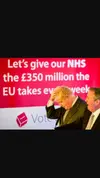
Btw here's an official vote leave event

View attachment 31182


You're not seeing the wood for the trees, joey. What you posted was an aspiration. A desire. NOT a total commitment.

This IS FACT: "...FACT: Britain's offical bill for EU membership is £19 billion per year or £350 million every week - the cost of a new hospital..."

Paid over: £350 million per week (outwith anything that comes back).

Cost of a new hospital: £350 million.

SImple imdisputeable figures.

Try twisting it any way you like, but you won't convince me that the mathematics are incorrect, as an example...
 
The Government should make an immediate commitment to exempt EU scientists and researchers already working in the UK from wider potential immigration controls, MPs on the Science and Technology Committee have demanded.


Science and Technology Committee Chair Stephen Metcalfe MP:


“Uncertainty over Brexit threatens to undermine some of the UK’s ongoing international scientific collaborations. Telling EU scientists and researchers already working in the UK that they are allowed to stay is one way the Government could reduce that uncertainty right away.”


Planning for the UK‘s exit negotiations is still underway and uncertainty remains about our future relationship with the EU. The MPs are therefore calling on the Government to act quickly and set out a vision for science. The Committee wants to see the Government commit in the Autumn Statement to raise science expenditure as a percentage of GDP.


Chair of the Committee Stephen Metcalfe MP:


“The forthcoming Autumn Statement is a chance for the Government to demonstrate its commitment to making science and research a linchpin of our economy after Brexit and to place it at the heart of an emerging Industrial Strategy. As a Science nation we know we already punch well above our weight, but when it comes to research and development funding we are falling behind other developed nations. If we want to make the most of the economic opportunities that Brexit could bring, we must increase our science funding in line with key competitors like Germany and the US.”


The Committee also believes it is vital, in light of the continuing uncertainty about the risks and opportunities associated with leaving the EU for UK science and research, that the Government has a comprehensive communication strategy.


Stephen Metcalfe MP added:


“The Government has provided some helpful and welcome short-term reassurances for the science community – on funding for research and access to student loans – but it needs to do more to make sure its message gets through.”


The Committee also points to the importance of UK science having a strong voice in the negotiations. It argues that the new Department for Exiting the European Union (DExEU) should urgently appoint a Chief Scientific Advisor.


Stephen Metcalfe MP concluded:


“We are not convinced that the needs of science and research are at the heart of DExEU’s thinking and planning for Brexit. That’s why we are calling on DExEU to hire a Chief Scientific Advisor as a matter of priority. The concerns and needs of our world class research establishments and scientists working in the UK must be heard at the negotiating table.”


Evidence submitted to the Committee’s inquiry showed that the science community’s hopes and fears for the future revolved around five key issues:


• Funding – in particular the need to secure ongoing access to EU sources such as Horizon 2020 and its successors

• People – specifically the attractiveness of the UK as a place to live, work and study, and the need to provide guarantees to those already working here.

• Collaboration – for UK researchers to continue to be part of multi-national projects and continue to influence the EU’s research agenda and strategic direction

• Regulation – ensuring that regulations which facilitate research collaboration and access to the EU market are retained, and those which hinder innovation are revised.

• Facilities – concerns about the ability of UK researchers to continue to access EU research facilities in other countries, and the need to protect the future of those currently hosted in the UK.
 
You're not seeing the wood for the trees, joey. What you posted was an aspiration. A desire. NOT a total commitment.

This IS FACT: "...FACT: Britain's offical bill for EU membership is £19 billion per year or £350 million every week - the cost of a new hospital..."

Paid over: £350 million per week (outwith anything that comes back).

Cost of a new hospital: £350 million.

SImple imdisputeable figures.

Try twisting it any way you like, but you won't convince me that the mathematics are incorrect, as an example...

Not sure how anyone an twist a picture like but fair play for trying to convince me otherwise
 
Status
Not open for further replies.

Welcome

Join the Everton conversation today.
Fewer ads, full access, completely free.

🛒 Visit Shop

Support Grand Old Team by checking out our latest Everton gear!
Back
Top