Current Affairs EU In or Out

In or Out

  • In

    Votes: 688 67.9%
  • Out

    Votes: 325 32.1%

  • Total voters
    1,013
Status
Not open for further replies.
Look it up......

There is not one country on the planet that the UK can't trade with now. There is no one product the UK can't trade now. No business person in any sector of the economy has ever said that there are trade restrictions on UK products to any country, with the exception of sanctions on Russia, Iran and the US embargo of Cuba.

It is a misnomer to imply that 'free trade' agreements, with the world, stopped by the EU, will 'liberate' UK trade being able to sell more.
 
There is not one country on the planet that the UK can't trade with now. There is no one product the UK can't trade now. No business person in any sector of the economy has ever said that there are trade restrictions on UK products to any country, with the exception of sanctions on Russia, Iran and the US embargo of Cuba.

It is a misnomer to imply that 'free trade' agreements, with the world, stopped by the EU, will 'liberate' UK trade being able to sell more.

We all know that thanks, it's been mentioned many times in this thread. Do you understand what is meant by a free trade agreement and how that could be applied to selling say financial services in say China, or how it can break down restrictive barriers to entry allowing competition. I'm sure you do.........
 
We all know that thanks, it's been mentioned many times in this thread. Do you understand what is meant by a free trade agreement and how that could be applied to selling say financial services in say China, or how it can break down restrictive barriers to entry allowing competition. I'm sure you do.........

Standard Life had to build a few schools in India to sell into that market about 20 years ago.

Didnt end well.

But that is of little point.

Despite being a reluctant Remain voter, I am quite excited at how this will all pan out. Bound to be some bumps in the road, whats new there, and so far, (very early days), May seems to have a pretty steady hand.
 
We all know that thanks, it's been mentioned many times in this thread. Do you understand what is meant by a free trade agreement and how that could be applied to selling say financial services in say China, or how it can break down restrictive barriers to entry allowing competition. I'm sure you do.........

"Friday's result also threatens to redefine Britain's growing financial services relationship with China, which has agreed to a number of joint projects as part of the China-UK Economic and Financial Dialogue (EFD) program to deepen economic ties between the two counties, based largely on the UK's membership of the EU.

Last year, the British government and China's Vice Premier Ma Kai announced plans to launch a London-Shanghai equity trading link, a mutual recognition scheme for distributing funds products, cooperation on cross-listing exchange products, measures to "cement" London as a yuan clearing hub, and a commitment on the part of several Chinese financial firms to set up bases in London - in addition to strategic Chinese infrastructure investments.

The UK Treasury said last year's agreement ushered in a "golden era" for relations between the two countries. But these projects are now in doubt amid uncertainty over the UK's future access to the EU single financial market, said sources and consultants.

"Inward investment by China into the UK under the dialogue has been focused on infrastructure projects and I wouldn't expect that should change with Brexit, but on financial services projects with China, that's at significant risk now," said Andrew Naylor, a Singapore-based executive director at Cicero Group, a consultancy that has been helping Asian financial firms weigh the Brexit risks". Reuters.

The UK already sells financial services to China. Which could be at risk when/if the UK leaves the EU.

Which products are the UK not able to sell at the moment and to which countries due to 'restrictive barriers' that doesn't allow competition?

As I said it is a misnomer, to suggest that 'free trade' agreements will 'liberate' UK trade i.e 'break down restrictive barriers to entry allowing competition' and the UK will sell more and quicker. The EU isn't restricting the UK from trading with some countries due to not having 'free trade' agreements.
 
Standard Life had to build a few schools in India to sell into that market about 20 years ago.

Didnt end well.

But that is of little point.

Despite being a reluctant Remain voter, I am quite excited at how this will all pan out. Bound to be some bumps in the road, whats new there, and so far, (very early days), May seems to have a pretty steady hand.

We shall see what becomes of it. Now I'm off to the pub......
 
Joe, see the threadmark at the bottom of the thread - I did it to provide a timely reminder how much the EU actually costs (clue: it isn't anywhere near £8-10bn a year)
Please watch newsnight on the iplayer the present claimed it was a 10 billion contribution deficit!
No I don't want to google oh hang on -

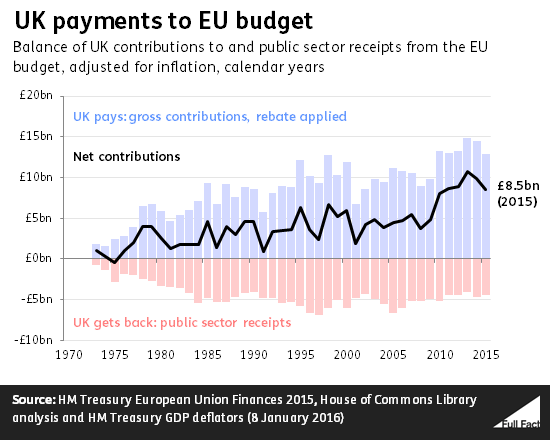
The UK pays more into the EU budget than it gets back.

In 2015 the UK government paid £13 billion to the EU budget, and EU spending on the UK was £4.5 billion. So the UK’s ‘net contribution’ was estimated at about £8.5 billion.

Each year the UK gets an instant discount on its contributions to the EU—the ‘rebate’—worth almost £5 billion last year. Without it the UK would have been liable for £18 billion in contributions.

send to Brussels" this higher figure of £18 billion, or anything equivalent per week or per day. The rebate is applied straight away, so the UK never contributes this much.

The UK’s contributions to the budget vary from year to year. They’ve been larger recently than in previous decades.

UK%20payments%20to%20EU%20budget%20since%201973.png


A membership fee isn’t the same as the economic cost or benefit

Being in the EU costs money but does it also create trade, jobs and investment that are worth more?

We can be pretty sure about how much cash we put in, but it’s far harder to be sure about how much, if anything, comes back in economic benefits. “There is no definitive study of the economic impact of the UK’s EU membership or the costs and benefits of withdrawal”, as the House of Commons Library says.

£55 million a day doesn't include the rebate and is not based on recommended figures

The claim that the UK’s membership fee is £55 million a day comes from the £20 billion annual UK payment to EU institutions listed in the Office for National Statistics' (ONS) Pink Book.

The ONS told us this isn’t the correct figure to use. It has another set of figureswhich actually represent official government payments, although this isn’t clear from the release.

The £20 billion figure includes payments to EU institutions by UK households, and so doesn’t represent what the government pays as a ‘membership fee’.

The Treasury has more up to date estimates than the ONS, and uses slightly different accounting methods. They show we paid in £13 billion in 2015.

We previously said that “it's reasonable to describe £55 million as our ‘membership fee’, but it ignores the fact that we get money back as well.”

This was based on the understanding that the rebate is paid up front and then sent back, which we now know is wrong.

£350 million a week doesn’t include the rebate but uses better figures

It’s also been claimed that we send £350 million a week to the EU. That also misses out the rebate, although is based on better figures for the UK’s contributions.

£350 million is what we would pay to the EU budget, without the rebate.

But the UK actually pays just under £250 million a week.

The UK Statistics Authority has said the EU membership fee figure of £19 billion a year, or £350 million a week, is "not an amount of money that the UK pays to the EU each year".

£500 billion cost since joining the EU has the same problem

A further claim is that, if you add up the UK’s payments to the EU budget since 1973, we’ve contributed nearly £500 billion in total.

It uses the correct ONS figures on official contributions, although the ONS published slightly revised figures earlier this week. It also factors in inflation to reflect the rise in prices over the last four decades.

But it still doesn’t account for our rebate, so doesn’t represent what we have actually paid. Applying the discount reduces the figure to about £380 billion, or £9 billion a year.

The UK gets money back

The government then gets some of that money back, mainly through payments to farmers and for poorer areas of the country such as Wales and Cornwall.

In 2015, the UK's ‘public sector receipts’ amounted to £4.5 billion

So overall we paid in £8.5 billion more than we got back, or £23 million a day.

The Treasury figures note payments the EU makes directly to the private sector, such as research grants. In 2013, these were worth an estimated £1.4 billion, so including them could reduce our net contribution further still.

The money we get back will be spent on things the government may or may not choose to fund if we left the EU. It’s not enough to look at the net contribution in isolation because what we get back isn’t fully under our control.

Different figures from different sources

The Treasury's European Union Finances release provides the best figures for the UK’s contributions to the EU budget, according to the ONS.

The Treasury and ONS both publish figures on the subject, but they're slightly different. The ONS also publishes other figures on contributions to EU institutions which don't include all our payments or receipts, which complicates matters.

The ONS figures ultimately come from the Treasury, and the numbers aren't the same because they categorise and account for the payments differently.

The European Commission is still another source of information which shows lower contributions.

Correction 25 February 2016

We replaced the original article from 2014 with a more detailed explanation. We’ve corrected what we said about the claim that the UK’s EU ‘membership fee’ is £55 million a day, as noted in the text above.

Update 27 May 2016

We've added the UK Statistics Authority's views on the claim that we send "£350 million a week" to the EU.

By Full Fact Team

Related posts:

Last updated: 25 Feb 2016


TWEET


SHARE


EU referendum Google questions

 
But we have circa £70 Billion of GDP with the EU.

Which whatever way you cut and paste it, has been put at risk.

Reckon we will be ok personally, but some folk just focus on the costs of membership, whilst totally ignoring the benefits.
 
Please watch newsnight on the iplayer the present claimed it was a 10 billion contribution deficit!
No I don't want to google oh hang on -

The UK pays more into the EU budget than it gets back.

In 2015 the UK government paid £13 billion to the EU budget, and EU spending on the UK was £4.5 billion. So the UK’s ‘net contribution’ was estimated at about £8.5 billion.

Each year the UK gets an instant discount on its contributions to the EU—the ‘rebate’—worth almost £5 billion last year. Without it the UK would have been liable for £18 billion in contributions.

send to Brussels" this higher figure of £18 billion, or anything equivalent per week or per day. The rebate is applied straight away, so the UK never contributes this much.

The UK’s contributions to the budget vary from year to year. They’ve been larger recently than in previous decades.

UK%20payments%20to%20EU%20budget%20since%201973.png


A membership fee isn’t the same as the economic cost or benefit

Being in the EU costs money but does it also create trade, jobs and investment that are worth more?

We can be pretty sure about how much cash we put in, but it’s far harder to be sure about how much, if anything, comes back in economic benefits. “There is no definitive study of the economic impact of the UK’s EU membership or the costs and benefits of withdrawal”, as the House of Commons Library says.

£55 million a day doesn't include the rebate and is not based on recommended figures

The claim that the UK’s membership fee is £55 million a day comes from the £20 billion annual UK payment to EU institutions listed in the Office for National Statistics' (ONS) Pink Book.

The ONS told us this isn’t the correct figure to use. It has another set of figureswhich actually represent official government payments, although this isn’t clear from the release.

The £20 billion figure includes payments to EU institutions by UK households, and so doesn’t represent what the government pays as a ‘membership fee’.

The Treasury has more up to date estimates than the ONS, and uses slightly different accounting methods. They show we paid in £13 billion in 2015.

We previously said that “it's reasonable to describe £55 million as our ‘membership fee’, but it ignores the fact that we get money back as well.”

This was based on the understanding that the rebate is paid up front and then sent back, which we now know is wrong.

£350 million a week doesn’t include the rebate but uses better figures

It’s also been claimed that we send £350 million a week to the EU. That also misses out the rebate, although is based on better figures for the UK’s contributions.

£350 million is what we would pay to the EU budget, without the rebate.

But the UK actually pays just under £250 million a week.

The UK Statistics Authority has said the EU membership fee figure of £19 billion a year, or £350 million a week, is "not an amount of money that the UK pays to the EU each year".

£500 billion cost since joining the EU has the same problem

A further claim is that, if you add up the UK’s payments to the EU budget since 1973, we’ve contributed nearly £500 billion in total.

It uses the correct ONS figures on official contributions, although the ONS published slightly revised figures earlier this week. It also factors in inflation to reflect the rise in prices over the last four decades.

But it still doesn’t account for our rebate, so doesn’t represent what we have actually paid. Applying the discount reduces the figure to about £380 billion, or £9 billion a year.

The UK gets money back

The government then gets some of that money back, mainly through payments to farmers and for poorer areas of the country such as Wales and Cornwall.

In 2015, the UK's ‘public sector receipts’ amounted to £4.5 billion

So overall we paid in £8.5 billion more than we got back, or £23 million a day.

The Treasury figures note payments the EU makes directly to the private sector, such as research grants. In 2013, these were worth an estimated £1.4 billion, so including them could reduce our net contribution further still.

The money we get back will be spent on things the government may or may not choose to fund if we left the EU. It’s not enough to look at the net contribution in isolation because what we get back isn’t fully under our control.

Different figures from different sources

The Treasury's European Union Finances release provides the best figures for the UK’s contributions to the EU budget, according to the ONS.

The Treasury and ONS both publish figures on the subject, but they're slightly different. The ONS also publishes other figures on contributions to EU institutions which don't include all our payments or receipts, which complicates matters.

The ONS figures ultimately come from the Treasury, and the numbers aren't the same because they categorise and account for the payments differently.

The European Commission is still another source of information which shows lower contributions.

Correction 25 February 2016

We replaced the original article from 2014 with a more detailed explanation. We’ve corrected what we said about the claim that the UK’s EU ‘membership fee’ is £55 million a day, as noted in the text above.

Update 27 May 2016

We've added the UK Statistics Authority's views on the claim that we send "£350 million a week" to the EU.

By Full Fact Team

Related posts:

Last updated: 25 Feb 2016


TWEET


SHARE


EU referendum Google questions

European Union Finances 2015: statement on the 2015 EU Budget and measures to counter fraud and financial mismanagement

Joey that figure includes a thing called TOR. TOR - Traditional Own Resources payments - which is another word for custom duties/tariffs imposed on goods imported into the EU- TOR payments at 75 per cent to the EU. The remaining 25 per cent is retained by the UK to cover the costs of administering collection on behalf of the EU. This amounts £2.4 billion to the EU and the UK keeps £800 million. As this is paid by those exporting into the UK it is not an expense on the UK.

In 2015 the figure was £17.7 billion which includes £3.2 (TOR payment) = £14.5 billion includes VAT payment of £2.5 billion.

The UK gets a rebate - "the estimated value of the UK’s rebate in 2015 is €5.6 billion (£4.4 billion)" £14.5 billion - £4.4 billion = £10.1 billion including VAT.

The UK also receives this money,

"UK public sector receipts in 2015, mainly from the European Agricultural Guarantee (EAGF), European Agricultural Fund for Rural Development (EAFRD) and the Social and Regional Development Funds, are expected to be around £4.4 billion. The majority of these receipts will either be paid to, or used in support of, the private sector but are channelled through government departments or agencies".

£10.1 billion minus this £4.4 billion= £5.7 billion.

The UK also receives, "The EU makes some payments directly to the private sector, for example to carry out research activities. These payments do not appear in the public sector’s accounts. It is estimated that in 2013, these receipts were worth £1.4 billion. These payments are not included in Tables 3.A or 3.C-F, which provide data on public sector receipts only.

So that is £5.7 billion minus £1.4 billion = £4.3 billion includes VAT.

The cost of the UK being in the EU is £4.3 billion which includes £2.5 billion VAT.
 
Last edited:
Status
Not open for further replies.

Welcome

Join the Everton conversation today.
Fewer ads, full access, completely free.

🛒 Visit Shop

Support Grand Old Team by checking out our latest Everton gear!
Back
Top