

zzr45
#MURDERINGSCUM
From the BBC.The computer modelling has been published?
The modelling by Imperial College London has been heavily informed by the experience in Italy and is influencing decisions at the heart of government.
From the BBC.The computer modelling has been published?

So self isolate
Don’t go to places where there is many people
Wash your hands
Stay away from pubs clubs restaurants
BUT We won’t order you to close any of the above because then we will be liable for many insurance claims, so instead keep open all of your small business’s but we’re telling everyone to stay clear!!!
Seriously that’s the F ‘Kin’ message from our leader..
Oh and kids keep going to school.
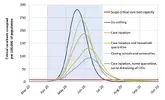
That's the point though, and the Imperial paper clearly states this. They don't believe the suppression (ie lockdown) approach is sustainable, and certainly not for the ~18 months they believe it will take for a vaccine to be ready. We've spoken at length on other threads about the health implications of austerity and poverty, and such a lockdown would cause poverty on a nationwide scale.
Like I said, there isn't really an easy way out of this situation, and the Imperial team are clear that locking down the country for a (relatively) short period won't result in this thing going away. It's not a case of the government's approach having this outcome (x number of deaths) and lockdown resulting in 0 deaths. Not at all.
From the BBC.
The modelling by Imperial College London has been heavily informed by the experience in Italy and is influencing decisions at the heart of government.
It will be better if you take a look at seriously infected countries. I hate to use China as example but there you go. Korea is another example getting the numbers down to a sustainable infection rate. If the results continue to improve, more and more restrictions will be lifted, and at this rate it will be a few months. rather than 18months as you’ve suggested. Nobody knows if it works but at lease with measures, less people will die and hospital will cope. It’s really a choice between short term extended measures or Long term suffering with mild measures. I don’t believe herd immunity is the way out. They might as well inject everyone with the virus and it could all finish within a month if that’s the case.

Maybe not but they are ok taking the money each month! IMO They should be able to cover every person/business they insure at any time.I'm not sure the insurance industry could even afford to pay out on the scale they'd be required to.
Mitigation. Here the aim is to use NPIs (and vaccines or drugs, if available) not to interrupt transmission completely, but to reduce the health impact of an epidemic, akin to the strategy adopted by some US cities in 1918, and by the world more generally in the 1957, 1968 and 2009 influenza pandemics. In the 2009 pandemic, for instance, early supplies of vaccine were targeted at individualswith pre-existing medical conditions which put them at risk of more severe disease . In this scenario,The guidelines in that link are not in accordance with the UK governments initial herd immunity policy. I was asking for the data or computer models for that. The government themselves now say that they have realized their initial conclusions were flawed and have switched track.

That's the thing though, from the Imperial paper
"Cities in which these interventions were implemented early in the epidemic were successful at reducing case numbers while the interventions remained in place and experienced lower mortality overall. However, transmission rebounded once controls were lifted."

Indeed. Lockdown advocates are basically asking the government to prop up vast numbers of organisations, and the people who are/used to be employed by them. That's a level of welfare that's unprecedented and I'm not sure just how feasible it is.
Mitigation. Here the aim is to use NPIs (and vaccines or drugs, if available) not to interrupt transmission completely, but to reduce the health impact of an epidemic, akin to the strategy adopted by some US cities in 1918, and by the world more generally in the 1957, 1968 and 2009 influenza pandemics. In the 2009 pandemic, for instance, early supplies of vaccine were targeted at individualswith pre-existing medical conditions which put them at risk of more severe disease . In this scenario,
population immunity builds up through the epidemic, leading to an eventual rapid decline in case numbers and transmission dropping to low levels....
The aim of mitigation is to reduce the impact of an epidemic by flattening the curve, reducing peak incidence and overall deaths (Figure 2). Since the aim of mitigation is to minimise mortality, the interventions need to remain in place for as much of the epidemic period as possible. Introducing such interventions too early risks allowing transmission to return once they are lifted (if insufficient herd immunity has developed); it is therefore necessary to balance the timing of introduction with the scale of disruption imposed and the likely period over which the interventions can be maintained. In this scenario, interventions can limit transmission to the extent that little herd immunity is acquired – leading to the possibility that a second wave of infection is seen once interventions are lifted.
I mean that’s pretty clear to me. It also ties in with what was said last week in that measures would come in when they need to..

Indeed. Lockdown advocates are basically asking the government to prop up vast numbers of organisations, and the people who are/used to be employed by them. That's a level of welfare that's unprecedented and I'm not sure just how feasible it is.

Maybe not but they are ok taking the money each month! IMO They should be able to cover every person/business they insure at any time.

Talk over here is that indeed a rebound is likely after relaxation of restrictions at least there will be systems and procedures in place that can be applied to slow things down again.This is obviously the worry, but think that any additional time we can buy will be helpful, in terms of health, as it will get a vaccine further down the road, new anti-viral meds can be trialled, get a better prepared infrastructure around the hospitals etc.
Think we’re stuck choosing between taking a kick in either the left or right ball.
Join the Everton conversation today.
Fewer ads, full access, completely free.