Current Affairs 2017 General Election

2017 general election

  • Lib Dems

    Votes: 24 6.5%
  • Labour

    Votes: 264 71.0%
  • Tories

    Votes: 41 11.0%
  • Cheese on the ballot paper

    Votes: 35 9.4%
  • SNP

    Votes: 4 1.1%
  • Plaid Cymru

    Votes: 4 1.1%

  • Total voters
    372
Status
Not open for further replies.
Not a good day for the Tories. Firstly, Damien Green making an ass of himself on the Marr show about how the Tories have costed Labour's manifesto but not their own. Then the buffoon Johnson was on about that infamous £350 million a week for the NHS promise, claiming it was in the manifesto but clearly it wasn't.

And then the bad news coming to May in her bunker that the dementia tax isn't going down to well with the aged Tory brigade. She will find it hard, during the election, to drop this and make a u-turn as she did for the 'unpopular' National Insurance increases for the self-employed.
 
Theresa May’s dementia tax is so vicious that even The Daily Mail is backing away from her
MAY 21ST, 2017
JPEG-image-729644CB4E12-1-16x16.jpeg
JOHN SHAFTHAUER UK


lg.php

When the Conservative manifesto was released many people were shocked by the inclusion of what’s been branded the ‘dementia tax‘. A policy which means anyone who needs care will be charged after they die if they’re worth over £100,000. A valuation which will include people’s homes as well as savings. Even if they’ve paid their way all their life.

The Daily Mail initially presented the proposal as a positive. But the growing backlash against the policy has been so strong that even it is backing away from it.

Paper trail
On 18 May The Daily Mail gave the policy front page attention. It framed the story as if it were a big win for the elderly. It also pointed out it’s available to ‘EVERYONE’. Just in case some people worried they might miss out on having their property and life savings seized:

Daily-Mail-nbspnews-paper-front-page-Thursday-18th-May-2017-ThursdayThoughts-paperstoday.jpg


On 19 May The Daily Mail praised Theresa May’s ‘honesty’ and wrote on their front page:

Theresa May yesterday put the needs of ordinary working families at the heart of a pragmatic plan to deliver a better deal for ‘mainstream Britain’.

Daily-Mail-nbspnews-paper-front-page-Friday-19th-May-2017-FridayThoughts-paperstoday.jpg


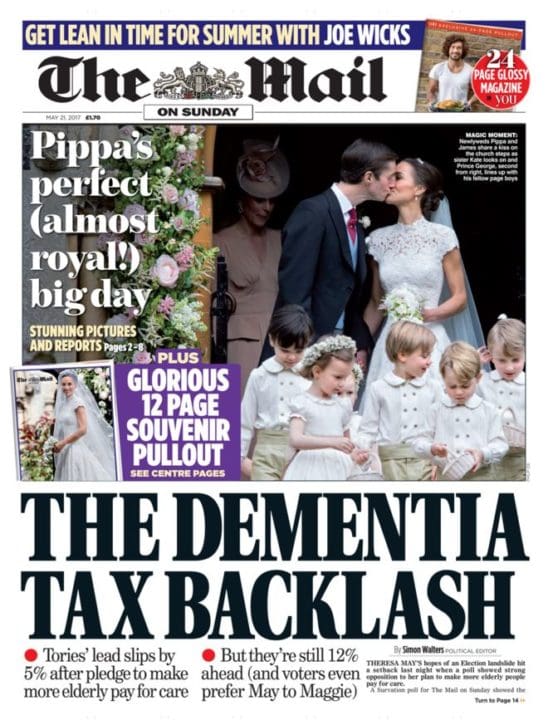
But by 21 May, the backlash had set in. The message had got out that the Tories were going after people’s assets and savings. And The Daily Mail put some considerable distance between itself and the policy it had praised just a few short days ago:

96135919_mail-1.jpg


The dementia tax
It’s important to note that The Daily Mail is openly referring to the policy as the ‘dementia tax’. Obviously, this is not how the Conservative manifesto refers to it. This is a name given to it by critics of the cruel policy. A policy which will affect many people who suffer from conditions like dementia.

The fact that The Mail on Sunday has openly used the name on its front page shows that they’ve given up trying to defend what could be May’s biggest misstep yet. An article by Simon Walters, The Mail on Sunday’s political editor, presents the ‘dementia tax’ without a positive spin:

The proposals would mean that tens of thousands of people who receive care at home could face costly bills as – for the first time – the value of a person’s home will be included in their assets, with only the last £100,000 protected.

But he also calls the cruel policy a ‘tough choice’ that is “vindicated” by her other plans:

Mrs May’s decision not to flinch from tough decisions in her manifesto is vindicated by a more favourable response to other proposals.

Backlash
May is taking many things for granted. She’s assuming unwavering support from the elderly, the right-wing press, and her supporters. As such, she’s running a horrible campaign in which she fails to give an account of herself. Probably because any true account would mean explaining why she’s punishing the very voters she relies on.

The Daily Mail may support the Tories, but they can’t support policies that so blatantly attack their readers. The problem for May is that policies which target ordinary people are what she’s selling. And as a result, voters are deserting her in droves.
 
Theresa May’s dementia tax is so vicious that even The Daily Mail is backing away from her
MAY 21ST, 2017
JPEG-image-729644CB4E12-1-16x16.jpeg
JOHN SHAFTHAUER UK


lg.php

When the Conservative manifesto was released many people were shocked by the inclusion of what’s been branded the ‘dementia tax‘. A policy which means anyone who needs care will be charged after they die if they’re worth over £100,000. A valuation which will include people’s homes as well as savings. Even if they’ve paid their way all their life.

The Daily Mail initially presented the proposal as a positive. But the growing backlash against the policy has been so strong that even it is backing away from it.

Paper trail
On 18 May The Daily Mail gave the policy front page attention. It framed the story as if it were a big win for the elderly. It also pointed out it’s available to ‘EVERYONE’. Just in case some people worried they might miss out on having their property and life savings seized:

Daily-Mail-nbspnews-paper-front-page-Thursday-18th-May-2017-ThursdayThoughts-paperstoday.jpg


On 19 May The Daily Mail praised Theresa May’s ‘honesty’ and wrote on their front page:

Theresa May yesterday put the needs of ordinary working families at the heart of a pragmatic plan to deliver a better deal for ‘mainstream Britain’.

Daily-Mail-nbspnews-paper-front-page-Friday-19th-May-2017-FridayThoughts-paperstoday.jpg


But by 21 May, the backlash had set in. The message had got out that the Tories were going after people’s assets and savings. And The Daily Mail put some considerable distance between itself and the policy it had praised just a few short days ago:

96135919_mail-1.jpg


The dementia tax
It’s important to note that The Daily Mail is openly referring to the policy as the ‘dementia tax’. Obviously, this is not how the Conservative manifesto refers to it. This is a name given to it by critics of the cruel policy. A policy which will affect many people who suffer from conditions like dementia.

The fact that The Mail on Sunday has openly used the name on its front page shows that they’ve given up trying to defend what could be May’s biggest misstep yet. An article by Simon Walters, The Mail on Sunday’s political editor, presents the ‘dementia tax’ without a positive spin:

The proposals would mean that tens of thousands of people who receive care at home could face costly bills as – for the first time – the value of a person’s home will be included in their assets, with only the last £100,000 protected.

But he also calls the cruel policy a ‘tough choice’ that is “vindicated” by her other plans:

Mrs May’s decision not to flinch from tough decisions in her manifesto is vindicated by a more favourable response to other proposals.

Backlash
May is taking many things for granted. She’s assuming unwavering support from the elderly, the right-wing press, and her supporters. As such, she’s running a horrible campaign in which she fails to give an account of herself. Probably because any true account would mean explaining why she’s punishing the very voters she relies on.

The Daily Mail may support the Tories, but they can’t support policies that so blatantly attack their readers. The problem for May is that policies which target ordinary people are what she’s selling. And as a result, voters are deserting her in droves.

Agree with this completely. That policy was/is a ridiculous own goal and I cringed the moment I saw it.
 
Does he get those kind of crowds in Wokingham? Or Scotland for that matter? The man needs to wander out of his echo chamber a bit

He had crowds so big in Hebden Bridge (Calder Valley, Tory seat since 2010) that he had to give the same speech twice so everybody could see it.

He had large crowds in Leamington Spa, another Tory seat.

He's not only campaigning in Merseyside...
 
There may be even more bad news for the Tories on the way - the Electoral Commission has just announced that all charities will be required to disclose all activity that may be deemed as political since June last year, or face fines and criminal proceedings under the Lobbying Act.

The "New Schools Network" is a charity set up to argue for and help set up free schools, and which the Tories have provided the lions share of its funding (via grants from the government) and most of its higher staff since 2010. All of its work is political. All of its meetings, co-ordination, funding arrangements, lobbying and whatnot since June 2016 over what has been a controversial and expensive set of reforms are about to come to light.
 
more "responsible" calls for higher taxes

"Of course, we'd still feel safer with Bernie Madoff in charge over Bernie Sanders, but isn't it interesting how commies like Piketty might technically be right, even if we should mostly still ignore them"

https://www.ft.com/content/a4e01ef4-3c8d-11e7-821a-6027b8a20f23

"Americans grouse about taxes. But only 8 per cent of them are bothered by what they themselves pay; 67 per cent feel that someone else — the rich, the poor, corporations — is not paying their fair share, as Vanessa Williamson notes in Read My Lips: Why Americans Are Proud to Pay Taxes.

That perception of opacity and unfairness, exemplified by the Panama Papers or the reluctance of President Donald Trump to release his own records, is associated either with hostility against the lower “47 per cent” of the population (Mitt Romney’s criticism in 2012 of poor Americans who do not earn enough to pay income tax) or members of the 1 per cent sheltering money in the Cayman Islands.

The key point is that Americans do not mind paying taxes; as Ms Williamson’s research shows, they view it as a civic duty that entitles them to “respect from other citizens”. But they do worry the system is not fair or efficient.

They are right. A few days ago, Congress began a debate over tax reform that is likely to last some time. Both Republicans and Democrats believe the system needs an overhaul. But unfortunately, the Trump administration and the Republicans in Congress are proposing the same old solution: tax cuts for the wealthy and for companies.

The argument is that trickle-down economics will somehow magically start working to bolster growth, even though there is no evidence over the past 20 years that this has been the case. Tax cuts in 2001 and 2003 during George W Bush’s administration did not juice growth, nor did any Obama era cuts.

In fact, the biggest growth surge in recent memory happened during the Bill Clinton years in the 1990s, against a backdrop of rising tax rates.

The notion that cutting taxes on rich individuals and companies is the way to bolster underlying economic growth dies hard. Even liberals who favour a more progressive system inadvertently tap into that mythology.

If the past few decades have shown us anything, it is that, as the rich have got richer, they have not created higher trend growth for the economy overall. In the 1950s, the top marginal tax rate for individuals was 90 per cent and the corporate rate was over 50 per cent. Today, the corporate rate is roughly 35 per cent (most companies pay far less) and the individual rate 39.6 per cent. Yet real per capita gross domestic product is growing about half as fast. That is why some economists and policymakers are beginning to consider a radical idea: not only are higher taxes not bad for the economy, they may even be good for it.

As the most recent International Monetary Fund Global Economic Outlook pointed out, high income inequality and the populism it breeds is the key threat to economic growth. There is little doubt that falling tax rates over recent decades have fuelled the wealth gap; countries such as the US and UK that had the largest reductions in top tax rates also showed the biggest increases in inequality.

What is interesting is the lack of evidence that lowering those rates raised investment, the key part of the trickle-down mythology. As a Roosevelt Institute analysis points out, business in the US is investing marginal earnings and borrowed funds at 25 per cent the rate of the 1960s. When you consider that tax rates were so much higher then, arguments from groups such as the Business Roundtable or the US Chamber of Commerce that companies would invest more in the US if tax rates were lower seem nonsensical.

It is likely that companies would put any extra money from a lower rate on repatriation of foreign cash into share buybacks. The 2003 dividend tax did not increase investment, but the 2004 repatriation holiday bolstered buybacks 21.5 per cent. That has the effect of disconnecting the markets from the real economy and potentially heightening the risk of a market crash, something that researchers within the US Treasury department have worried about for some time.

It also jacks up the pay of executives, leading top earners to push for more salary than they ordinarily would, according to research by economists Emmanuel Saez and Thomas Piketty. That is part of their argument for a much higher tax rate on rich individuals.

Even using a classical economic analysis of the optimal tax rates for the rich (based on how high taxes could be without removing the incentive for the rich to work more), you would come up with a top rate of about 57 per cent, much higher than today’s level. Messrs Piketty and Saez tally up more inputs, like the propensity of executives to rent-seek when taxes are low and when they are high executives do not shift more of their wealth into lower taxed capital assets, and they come up with a higher optimal rate of 83 per cent.

Nobody is suggesting that rich Americans or companies should pay that level of tax. But it is wrong to believe that cutting taxes bolsters growth and that paying them, what ever Mr Trump might say, is stupid. As Ms Williamson points out, it is one of the few things that holds society together."

 
I finished paying off the mortgage on my modest home a year before I retired after decades of working full-time. I live with my wife and my youngest daughter, who's physically disabled and unable to work. Our house has been specially modified so as that it's amenable for people with her disability. I'm getting on in years and dementia is common amongst males in my family. What will happen to my daughter if I get ill and spend the last two years of my life in a £1000 a week nursing home before carking it? Due to rising property prices, our house is worth much more than the £100k that Theresa May says she'll let people keep. My disabled daughter would have to leave the house she's lived in for decades,the house that is specially modified for her needs. And where would she go? £100k is a lot of money, but it doesn't buy you much property-wise.
 
Poor children being 'fed diluted milk', report finds
  • 12 May 2017
_96005843_gettyimages-649219030.jpg
Image copyrightGETTY IMAGES
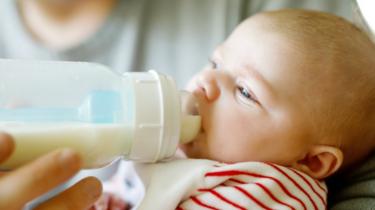
Some UK children are living in cold, damp and overcrowded conditions and being fed diluted milk, a report says.

Of 266 doctors, 40% said they had had trouble discharging a child from their care because of not wanting to send them back to inadequate housing.

One doctor said it was "not unusual" for families of up to seven people to live in one-bedroom flats.

The Royal College of Paediatrics and Child Health, which compiled the report, called it "disturbing reading".

The study, carried out in conjunction with the Child Poverty Action Group, found examples of parents depriving themselves of food to care for their children and having to rely on food banks.

Mouse-infested
Others could not afford clothes, toothbrushes or toothpaste, the study found.

Doctors said some children were growing at a level lower than what would be expected due to poor diets.

A medic quoted in the report said: "I recently saw a child who was living in a mouse-infested house - the mum and baby plus four other kids were living upstairs as the mice had totally destroyed their living room."

_96005846_gettyimages-157289108.jpg
Image copyrightGETTY IMAGES
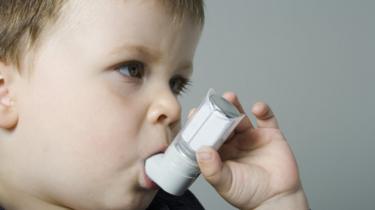
Image captionPoor housing conditions can exacerbate breathing problems in children
Living in cold, damp and overcrowded housing makes respiratory conditions worse, with some children being unwell with back-to-back illnesses, the doctors said.

One added: "It is not unusual to hear about extended families of five to seven people, maybe more, living in one-bedroom apartments, or single mothers with two or three children living in bedsits with a shared kitchen and bathroom."

Almost a third of those asked said not being able to keep warm at home contributed "very much" to the ill-health of children and a third said it contributes "somewhat".

Doctors also said poverty had an impact on children's mental health, adding they felt "worry, stress and anxiety".

'Devastating effect'
Some said children were having a "little part of their childhood taken away, a part of their day they will spend worrying instead of playing or learning".

Health promotion officer at the RCPCH, Professor Russell Viner, said: "Poverty has a devastating effect on child health and this report makes disturbing reading."

Alison Garnham, chief executive of CPAG, said: "Day in, day out, doctors see the damage rising poverty does to children's health.

"Low family incomes, inadequate housing and cuts to support services are jeopardising the health of our most vulnerable children.

"We can and must do better to protect the well-being of future generations.

"Re-instating the UK's poverty-reduction targets would be an obvious place to start."
 
I finished paying off the mortgage on my modest home a year before I retired after decades of working full-time. I live with my wife and my youngest daughter, who's physically disabled and unable to work. Our house has been specially modified so as that it's amenable for people with her disability. I'm getting on in years and dementia is common amongst males in my family. What will happen to my daughter if I get ill and spend the last two years of my life in a £1000 a week nursing home before carking it? Due to rising property prices, our house is worth much more than the £100k that Theresa May says she'll let people keep. My disabled daughter would have to leave the house she's lived in for decades,the house that is specially modified for her needs. And where would she go? £100k is a lot of money, but it doesn't buy you much property-wise.

Its a stupid idea.
 
Status
Not open for further replies.

Welcome

Join the Everton conversation today.
Fewer ads, full access, completely free.

🛒 Visit Shop

Support Grand Old Team by checking out our latest Everton gear!
Back
Top