Current Affairs The Far Right

Status
Not open for further replies.
I would agree with that article almost completely.

It hasn't just been right wing parties that people have turned to though - there have been left wing parties in Spain and Greece and if Labour here had better captured the mood of the people they could have benefited.

Rather than much of our population being racist though, I would say (as the writer seems to be saying) that it is economic disenfranchisement that has lead to votes for Brexit and Trump and right wing parties.

Infact elections are virtually always decided by voters perceptions of how well they were doing and what their prospects would be like under future governments.

I suspect that most Brexit and Trump voters voted on this basis - that it couldn't get much worse for them and they had nothing to lose by voting for something different. They would have also remembered a time when things were different and when their prospects were better and in Brexits case this would have been a time when we were not part of the EU or at least before it moved to a political union.

I would disagree that Brexit was a right wing phenomena though (though it may have been a populist one).

Virtually anyone whose views are considered far left was pro Brexit as the EU is seen by those people (as well as many voters) as having perpetuated the economic conditions that the writer of the article mentions.

Whether things will get much better out of the EU or under Trump I doubt (that would IMO take a radically different economical or political system) but at least there is a chance of it which is why people voted as they did

I agree that economic disenfranchisement is probably the root cause, and I'm not sure any 'remain' voters would argue with that either. Where we diverge I suspect is around the solution. Most of the populist parties would have you believe that the answer is a simple one, which in the populist left means blaming big business, and in the populist right means blaming foreigners. Neither is the cause of the challenges facing many people today, and what concerns me is that we've created a world whereby people are so polarised, and therefore so attached to past decisions, that we become detached from reality.

Look at Trump for instance, and how so many Republicans put up the blinkers to his daily blunders precisely because they invested so much in the man as the saviour that to do otherwise is incredibly hard. I strongly suspect that if/when Trump fails long-term, it's created a world where anyone but Trump will be blamed. That's not healthy at all as it just creates an ever greater divide between those that are disenfranchised and the rest.
 
Don't get me wrong, it's nothing personal at all, and your contributions to these threads have been great, I'm just saying that when people paint Trump or Brexit as the will of the people, as in all of the supporters of each voted for the same reasons and are akin to a homogeneous block, I'm not sure those people can then say that 'they' didn't vote for racist or far-right means just because some did.

As an aside, an interesting piece was published by the RSA yesterday - https://www.thersa.org/discover/pub...obalisation-alienation-and-economic-democracy

If 2016 brought Brexit, Donald Trump and a backlash against cosmopolitan visions of globalisation and society, the great fear for 2017 is further shocks from right-wing populists like Geert Wilders in Holland and Marine Le Pen in France. A new mood of intolerance, xenophobia and protectionist economics seems to be in the air. The Conversation

In a world of zero-hour contracts, Uber, Deliveroo and the gig economy, access to decent work and a sustainable family income remains the main fault line between the winners and losers from globalisation. Drill into the voter data behind Brexit and Trump and they have much to do with economically marginalised voters in old industrial areas, from South Wales to Nord-Pas-de-Calais, from Tyneside to Ohio and Michigan.

These voters’ economic concerns about industrial closures, immigrants and businesses decamping to low-wage countries seemed ignored by a liberal elite espousing free trade, flexible labour and deregulation. They turned instead to populist “outsiders” with simplistic yet ultimately flawed political and economic narratives.

Much has been said about the crisis of liberal political democracy, but these trends look inextricably linked with what is sometimes referred to as economic democracy. This is about how well dispersed economic decision-making power is and how much control and financial security people have over their lives. I’ve been involved in a project to look at how this compares between different countries. The results say much about the point we have reached, and where we might be heading in future.

The index
Our economic democracy index looked at 32 countries in the OECD (omitting Turkey and Mexico, which had too much missing data). While economic democracy tends to focus on levels of trade union influence and the extent of cooperative ownership in a country, we wanted to take in other relevant factors.

We added three additional indicators: “workplace and employment rights”; “distribution of economic decision-making powers”, including everything from the strength of the financial sector to the extent to which tax powers are centralised; and “transparency and democratic engagement in macroeconomic decision-making”, which takes in corruption, accountability, central bank transparency and different social partners’ involvement in shaping policy.

What is striking is the basic difference between a more “social” model of northern European capitalism and the more market-driven Anglo-American model. Hence the Scandinavian countries score among the best, with their higher levels of social protection, employment rights and democratic participation in economic decision-making. The reverse is true of the more deregulated, concentrated and less democratic economies of the English-speaking world. The US ranks particularly low, with only Slovakia below it. The UK too is only 25th out of 32.
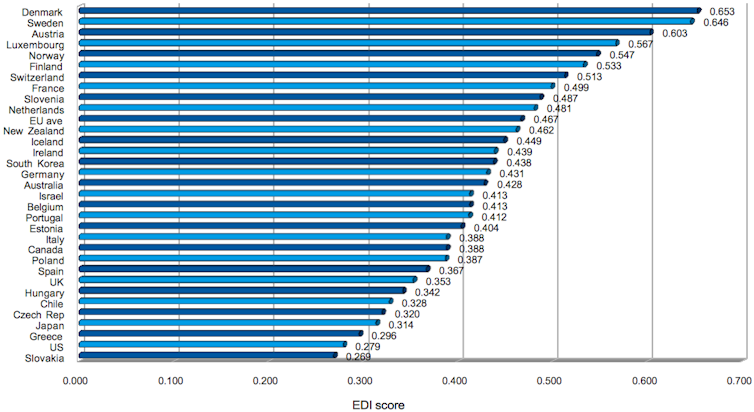

Economic Democracy Index, figures from 2013.
Interestingly, France ranks relatively highly. This reflects its strong levels of job protection and employee involvement in corporate decision-making – the fact that the far right has been strong in France for a number of years indicates its popularity stems from race at least as much as economics.

Yet leading mainstream presidential candidates François Fillon and Emmanuel Macron are committed to reducing France’s protections. These are often blamed – without much real evidence – for the country’s sluggish job creation record. There is a clear danger both here and in the Netherlands that a continuing commitment to such neoliberal labour market policies might push working class voters further towards Le Pen and Wilders.

One other notable disparity in the index is between the scores of Austria and Germany, despite their relatively similar economic governance. Germany’s lower ranking reflects the growth of labour market insecurity and lower levels of job protection, particularly for part-time workers as part of the Hartz IV labour market reforms in the 1990s that followed reunification.

The index also highlights the comparatively poor levels of economic democracy in the “transition” economies of eastern Europe. The one very interesting exception is Slovenia, which merits further study. It might reflect both its relatively stable transition from communism and the civil war in the former Yugoslavia, and the continuing presence of active civil society elements in the trade union and cooperative movements. Southern European economies also tend to rank below northern European countries, as does Japan.

Poverty and inequality
The index provides strong evidence that xenophobic politics may be linked to changing levels of economic participation and empowerment – notwithstanding the French data. We found that the greater the poverty and inequality in a country, the lower the rates of economic democracy.

These findings suggest, for example, that the Anglo-American-led attack on trade unions and flexible labour policies may actually drive up poverty and inequality by cutting welfare benefits and driving up individual employment insecurity. While the OECD itself advocated these policies until recently, countries with high levels of economic democracy such as Norway, Denmark and Iceland have much lower levels of poverty than countries such as the US and UK.

Far-right populism is on the march everywhere, including the Nordic countries. But Brexit, Trump and the more serious shift to the far right in Eastern Europe have been accompanied by diminishing economic security and rights at work, disenfranchised trade unions and cooperatives, and economic decision-making concentrated among financial, political and corporate elites.

We will monitor these scores in future to see what happens over time. It will be interesting to see how the correlations between economic democracy, poverty and voting patterns develop in the coming years. For those looking for answers to the crisis in liberal democracy, this may well be it.

It is very interesting to note that the World Happiness Report has listed Norway , Denmark, Iceland, Switzerland, Finland, The Netherlands, New
Zealand and Sweden in the top 10 happiest countries in the world.

And they are all in the top half of the Economic Democracy Index table you posted - The exceptions being Canada and Australia.
 
It is very interesting to note that the World Happiness Report has listed Norway , Denmark, Iceland, Switzerland, Finland, The Netherlands, New
Zealand and Sweden in the top 10 happiest countries in the world.

And they are all in the top half of the Economic Democracy Index table you posted - The exceptions being Canada and Australia.

This is it, I think there are quite probably a number of sensible, maybe even boring things that can be done to shape things a little bit differently, but the populists tend to prescribe solutions that are simultaneously very radical, whilst also portraying such change as very simple.
 
I agree that economic disenfranchisement is probably the root cause, and I'm not sure any 'remain' voters would argue with that either. Where we diverge I suspect is around the solution. Most of the populist parties would have you believe that the answer is a simple one, which in the populist left means blaming big business, and in the populist right means blaming foreigners. Neither is the cause of the challenges facing many people today, and what concerns me is that we've created a world whereby people are so polarised, and therefore so attached to past decisions, that we become detached from reality.

Look at Trump for instance, and how so many Republicans put up the blinkers to his daily blunders precisely because they invested so much in the man as the saviour that to do otherwise is incredibly hard. I strongly suspect that if/when Trump fails long-term, it's created a world where anyone but Trump will be blamed. That's not healthy at all as it just creates an ever greater divide between those that are disenfranchised and the rest.

Trump isn't great I agree (I had thought he might do good for the disenfranchised people who voted for him but so far it doesn't look like it - and yes I agree most of you on here did tell me so) but the alternatives and previous incumbents weren't great either (in both the US and the UK) where 10s and hundreds of thousands have needlessly been killed and some of the leaders should IMO have been tried for war crimes.

I think there was a greater possibility of Hilary starting a world war than there will be Trump starting one.

I agree any solutions are not simple populist ones but I think any solution would need quite a bit of regulation to make a happy decent society. I cant see the latter happening when the corporations dictate to governments rather than the other way around.

I would start (in typical goal setting fashion) with what we want to achieve and then look at what needs to be done to achieve it.

I'd take the things from other countries that work well (and Cuba from the socialist and Singapore from the capitalist both have some - maybe the Nordic countries too).
 
I see some of the moderators have adopted a far right stance, thread banning me for trying to project a little humour.

@orly banned for no reason.

Like Kristallnacht all over again this.
 
You what?

Get over yourself/grow up you idiot.
Bit ridiculous to be lashing out insults for something that was said in jest. You're a moderator, this is hardly acting like one is it.

So I think it is you who should grow up. I won't stoop to insults.
 
You just did.
Really?

Clearly another moderator saw it for the tongue in cheek post it was by thread banning me almost immediately with the message "nein".

I'm baffled why you'd pick up a post from over a week ago and reply with such vitriol, but then you do have form, especially with new members.
 
Really?

Clearly another moderator saw it for the tongue in cheek post it was by thread banning me almost immediately with the message "nein".

I'm baffled why you'd pick up a post from over a week ago and reply with such vitriol, but then you do have form, especially with new members.

It was reported.
 
You reckon I trawl threads to see stuff that aint right? Sake.

Get over it. You referenced the reffing of this place as akin to a nazi campaign against Jews.

I, for one, found that offensive.

Remember, this aint your playground.
I never said you did, I don't know what you do on here apart from ban new members.

You're the one who brought it up and called me an idiot. I'm not the one who needs to get over anything. That's you.

I'll accept it was a bit extreme but there's far worse posted and there's constant off topic posts by a certain member that never get addressed.

I also know it's not my playground, I've never claimed it was so once again a baffling comment.
 
Status
Not open for further replies.

Welcome

Join the Everton conversation today.
Fewer ads, full access, completely free.

🛒 Visit Shop

Support Grand Old Team by checking out our latest Everton gear!
Back
Top