Current Affairs The Far Right

Status
Not open for further replies.
That doesn't answer my question.

I want to hear the so called ideologies of the so called 'far right'. I have concerns over health tourism and I disagree with the fact that EU students in Scotland receive free education while English, Welsh and N.I students must pay. I also disagree with the fact that EU nationals may claim benefits in Britain does this make me a member of the far right?

In my opinion the 'far right' should only ever be used to describe groups such as the K.K.K and the likes not working class people who have concerns over large uncontrolled imagination.
I thought I answered your question. I agree with what you would describe as the far right (though I am not sure what "large uncontrolled imagination" is).

There are areas of government policy where there may be reasonable scope for disagreement - such as the issues you raise. I think the railways should be nationalised. It is not "far right" to think otherwise, any more than it would be Stalinist to propose renationalisation.

And then there are areas which are founded on blind prejudice, racism and fascism. Plainly they are not the same.

Edit - The last lot are the people in the pictures I posted.
If 'imagination' was a typo for 'immigration' - Plainly many people, of all classes, feel concerned that immigration from some areas, or all, has been too high. There are many who take a different view. It seems to me that GB was covered in ice 10,000 years ago, and we are all descended from immigrants.
All societies impose some form of immigration control. In a democracy we vote, and the majority dictate how it develops. If everyone here is treated fairly, without discrimination on the basis of nationality or ethnicity then that should be ok.
I would disagree with people who wanted to treat other people here differently because they are not white and/or 'British'. There is a spectrum of people with such views. If they are extreme, they are "far right"
 
Last edited:
I thought I answered your question. I agree with what you would describe as the far right (though I am not sure what "large uncontrolled imagination" is).

There are areas of government policy where there may be reasonable scope for disagreement - such as the issues you raise. I think the railways should be nationalised. It is not "far right" to think otherwise, any more than it would be Stalinist to propose renationalisation.

And then there are areas which are founded on blind prejudice, racism and fascism. Plainly they are not the same.

I've been on the sauce tonight lol.

I meant immigration needing my bed soon I think.
 
Agree with you there.

What about Farage and his lot.

Would you say they fall into being far right?

I say no, but am interested in what everyone else thinks...

UKIP are a populist party occupying what I would currently recognise as a centre-right position.
Calling them far-right would, in my opinion, be wrong on two counts:

First it ignores the vast gap between the perceived intolerance that is associated with UKIP and the outright hatred of recognised far-right groups. That is not to say that some UKIP voters won't be guilty of xenophobia - but if you compare a distrust of minority groups to the lynchings that occurred in late 19th/early 20th century USA then you remove the significance of those actions and the dark place they hold in human history.

Second, and as a result of the first point, labelling UKIP voters as nazis, racists and fascists is harmful rhetoric that only serves to further alienate them and push them further into the echo chamber in which populist politics thrives.

Granted there may be common ground between certain individuals that subscribe to both UKIP and far-right ideals, but I don't think UKIP itself falls into the far-right category.
 
That doesn't answer my question.

I want to hear the so called ideologies of the so called 'far right'. I have concerns over health tourism and I disagree with the fact that EU students in Scotland receive free education while English, Welsh and N.I students must pay. I also disagree with the fact that EU nationals may claim benefits in Britain does this make me a member of the far right?

In my opinion the 'far right' should only ever be used to describe groups such as the K.K.K and the likes not working class people who have concerns over large uncontrolled imagination.

Short answer: No.

Slightly longer answer: You seem to share some of the same political ideals that would place you on the right side of the spectrum. Nothing you have said would place you in the far-right, in my opinion. In fact you are a lot closer to the centre ground that hovers somewhere around the conservatives and UKIP. People who identify with centre-right often voice the same concerns as you, often using terms like "we should be taking care of our own citizens first" - which is a valid political opinion and is probably very widespread in the UK right now, in particular England.
 
It's no coincidence that the rise of far-right parties emerge as the public get a thirst for anti-immigration. Far right parties like, like Le Pen's, use people's immigration fears to mask a real agenda of pure nationalism.
 
Agree with you there.

What about Farage and his lot.

Would you say they fall into being far right?

I say no, but am interested in what everyone else thinks...

I would say a party which wants a private NHS, to ban the burqa, create strict immigration controls, give more powers to the police while abolishing the crown prosecution service and 'end multiculturalism' led by a man who is anti abortion and believes laws discriminating against gay people should be scrapped is a far-right party. Don't believe it's attempts at media polishing. You cannot polish a far-right turd.
 
I think what most of you call the "far right" isn't, and may one day look fondly such moderates as Farage and Le Pen.

I don't know much about LePen but I certainly agree it's possible that will happen with Farage. He will certainly go down in the history books for his campaigning for the referendum on the EU and leadership on that issue.
 
I don't know much about LePen but I certainly agree it's possible that will happen with Farage. He will certainly go down in the history books for his campaigning for the referendum on the EU and leadership on that issue.

I think this is where the, understandable, confusion lies. A while back you had Cummings (the campaign director for Leave) admit in a Spectator article that the campaign won because of lies. This was met by OldBlue (I think) saying the campaign meant nothing, it was all about the implementation, hence this guy is meaningless. At the same time, you've just said someone who implements none of what he campaigns for will go down in history due purely to his campaigning.

I appreciate that among 17 million people there will be a huge variance in opinions and motivations, but when people try and paint those 17 million as one united bloc, such variance comes across as a bit disingenuous.
 
That doesn't answer my question.

I want to hear the so called ideologies of the so called 'far right'. I have concerns over health tourism and I disagree with the fact that EU students in Scotland receive free education while English, Welsh and N.I students must pay. I also disagree with the fact that EU nationals may claim benefits in Britain does this make me a member of the far right?

In my opinion the 'far right' should only ever be used to describe groups such as the K.K.K and the likes not working class people who have concerns over large uncontrolled imagination.

I'm not sure about the rules on child benefit but regarding all the other benefits for a few years now they have only been open to EU nationals to claim if they have worked and thus contributed in tax and NI, which I think is fair enough
 
I think this is where the, understandable, confusion lies. A while back you had Cummings (the campaign director for Leave) admit in a Spectator article that the campaign won because of lies. This was met by OldBlue (I think) saying the campaign meant nothing, it was all about the implementation, hence this guy is meaningless. At the same time, you've just said someone who implements none of what he campaigns for will go down in history due purely to his campaigning.

I appreciate that among 17 million people there will be a huge variance in opinions and motivations, but when people try and paint those 17 million as one united bloc, such variance comes across as a bit disingenuous.

I'm not saying I agree with him or would ever vote for him (though if Brexit had been obstructed I might have had to think about that) but do think he will go down in history for effectively leading a movement or campaign for Britain to leave the EU and I do think it's possible that (regardless of anything else about his policies) he will be in years to come thought of fondly for that
 
I'm not saying I agree with him or would ever vote for him (though if Brexit had been obstructed I might have had to think about that) but do think he will go down in history for effectively leading a movement or campaign for Britain to leave the EU and I do think it's possible that (regardless of anything else about his policies) he will be in years to come thought of fondly for that

Don't get me wrong, it's nothing personal at all, and your contributions to these threads have been great, I'm just saying that when people paint Trump or Brexit as the will of the people, as in all of the supporters of each voted for the same reasons and are akin to a homogeneous block, I'm not sure those people can then say that 'they' didn't vote for racist or far-right means just because some did.

As an aside, an interesting piece was published by the RSA yesterday - https://www.thersa.org/discover/pub...obalisation-alienation-and-economic-democracy

If 2016 brought Brexit, Donald Trump and a backlash against cosmopolitan visions of globalisation and society, the great fear for 2017 is further shocks from right-wing populists like Geert Wilders in Holland and Marine Le Pen in France. A new mood of intolerance, xenophobia and protectionist economics seems to be in the air. The Conversation

In a world of zero-hour contracts, Uber, Deliveroo and the gig economy, access to decent work and a sustainable family income remains the main fault line between the winners and losers from globalisation. Drill into the voter data behind Brexit and Trump and they have much to do with economically marginalised voters in old industrial areas, from South Wales to Nord-Pas-de-Calais, from Tyneside to Ohio and Michigan.

These voters’ economic concerns about industrial closures, immigrants and businesses decamping to low-wage countries seemed ignored by a liberal elite espousing free trade, flexible labour and deregulation. They turned instead to populist “outsiders” with simplistic yet ultimately flawed political and economic narratives.

Much has been said about the crisis of liberal political democracy, but these trends look inextricably linked with what is sometimes referred to as economic democracy. This is about how well dispersed economic decision-making power is and how much control and financial security people have over their lives. I’ve been involved in a project to look at how this compares between different countries. The results say much about the point we have reached, and where we might be heading in future.

The index
Our economic democracy index looked at 32 countries in the OECD (omitting Turkey and Mexico, which had too much missing data). While economic democracy tends to focus on levels of trade union influence and the extent of cooperative ownership in a country, we wanted to take in other relevant factors.

We added three additional indicators: “workplace and employment rights”; “distribution of economic decision-making powers”, including everything from the strength of the financial sector to the extent to which tax powers are centralised; and “transparency and democratic engagement in macroeconomic decision-making”, which takes in corruption, accountability, central bank transparency and different social partners’ involvement in shaping policy.

What is striking is the basic difference between a more “social” model of northern European capitalism and the more market-driven Anglo-American model. Hence the Scandinavian countries score among the best, with their higher levels of social protection, employment rights and democratic participation in economic decision-making. The reverse is true of the more deregulated, concentrated and less democratic economies of the English-speaking world. The US ranks particularly low, with only Slovakia below it. The UK too is only 25th out of 32.
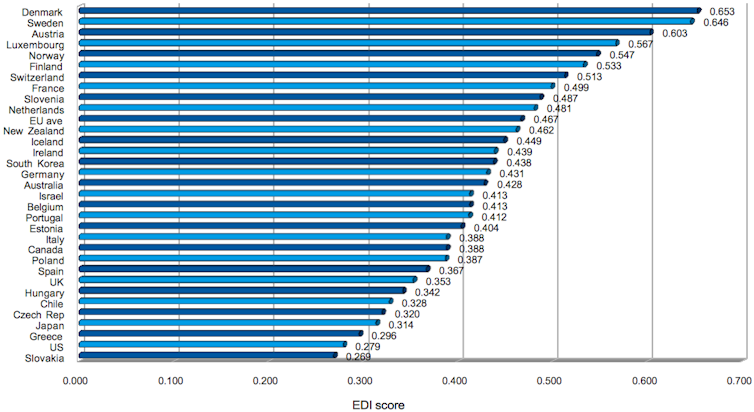

Economic Democracy Index, figures from 2013.
Interestingly, France ranks relatively highly. This reflects its strong levels of job protection and employee involvement in corporate decision-making – the fact that the far right has been strong in France for a number of years indicates its popularity stems from race at least as much as economics.

Yet leading mainstream presidential candidates François Fillon and Emmanuel Macron are committed to reducing France’s protections. These are often blamed – without much real evidence – for the country’s sluggish job creation record. There is a clear danger both here and in the Netherlands that a continuing commitment to such neoliberal labour market policies might push working class voters further towards Le Pen and Wilders.

One other notable disparity in the index is between the scores of Austria and Germany, despite their relatively similar economic governance. Germany’s lower ranking reflects the growth of labour market insecurity and lower levels of job protection, particularly for part-time workers as part of the Hartz IV labour market reforms in the 1990s that followed reunification.

The index also highlights the comparatively poor levels of economic democracy in the “transition” economies of eastern Europe. The one very interesting exception is Slovenia, which merits further study. It might reflect both its relatively stable transition from communism and the civil war in the former Yugoslavia, and the continuing presence of active civil society elements in the trade union and cooperative movements. Southern European economies also tend to rank below northern European countries, as does Japan.

Poverty and inequality
The index provides strong evidence that xenophobic politics may be linked to changing levels of economic participation and empowerment – notwithstanding the French data. We found that the greater the poverty and inequality in a country, the lower the rates of economic democracy.

These findings suggest, for example, that the Anglo-American-led attack on trade unions and flexible labour policies may actually drive up poverty and inequality by cutting welfare benefits and driving up individual employment insecurity. While the OECD itself advocated these policies until recently, countries with high levels of economic democracy such as Norway, Denmark and Iceland have much lower levels of poverty than countries such as the US and UK.

Far-right populism is on the march everywhere, including the Nordic countries. But Brexit, Trump and the more serious shift to the far right in Eastern Europe have been accompanied by diminishing economic security and rights at work, disenfranchised trade unions and cooperatives, and economic decision-making concentrated among financial, political and corporate elites.

We will monitor these scores in future to see what happens over time. It will be interesting to see how the correlations between economic democracy, poverty and voting patterns develop in the coming years. For those looking for answers to the crisis in liberal democracy, this may well be it.

 
Don't get me wrong, it's nothing personal at all, and your contributions to these threads have been great, I'm just saying that when people paint Trump or Brexit as the will of the people, as in all of the supporters of each voted for the same reasons and are akin to a homogeneous block, I'm not sure those people can then say that 'they' didn't vote for racist or far-right means just because some did.

As an aside, an interesting piece was published by the RSA yesterday - https://www.thersa.org/discover/pub...obalisation-alienation-and-economic-democracy

If 2016 brought Brexit, Donald Trump and a backlash against cosmopolitan visions of globalisation and society, the great fear for 2017 is further shocks from right-wing populists like Geert Wilders in Holland and Marine Le Pen in France. A new mood of intolerance, xenophobia and protectionist economics seems to be in the air. The Conversation

In a world of zero-hour contracts, Uber, Deliveroo and the gig economy, access to decent work and a sustainable family income remains the main fault line between the winners and losers from globalisation. Drill into the voter data behind Brexit and Trump and they have much to do with economically marginalised voters in old industrial areas, from South Wales to Nord-Pas-de-Calais, from Tyneside to Ohio and Michigan.

These voters’ economic concerns about industrial closures, immigrants and businesses decamping to low-wage countries seemed ignored by a liberal elite espousing free trade, flexible labour and deregulation. They turned instead to populist “outsiders” with simplistic yet ultimately flawed political and economic narratives.

Much has been said about the crisis of liberal political democracy, but these trends look inextricably linked with what is sometimes referred to as economic democracy. This is about how well dispersed economic decision-making power is and how much control and financial security people have over their lives. I’ve been involved in a project to look at how this compares between different countries. The results say much about the point we have reached, and where we might be heading in future.

The index
Our economic democracy index looked at 32 countries in the OECD (omitting Turkey and Mexico, which had too much missing data). While economic democracy tends to focus on levels of trade union influence and the extent of cooperative ownership in a country, we wanted to take in other relevant factors.

We added three additional indicators: “workplace and employment rights”; “distribution of economic decision-making powers”, including everything from the strength of the financial sector to the extent to which tax powers are centralised; and “transparency and democratic engagement in macroeconomic decision-making”, which takes in corruption, accountability, central bank transparency and different social partners’ involvement in shaping policy.

What is striking is the basic difference between a more “social” model of northern European capitalism and the more market-driven Anglo-American model. Hence the Scandinavian countries score among the best, with their higher levels of social protection, employment rights and democratic participation in economic decision-making. The reverse is true of the more deregulated, concentrated and less democratic economies of the English-speaking world. The US ranks particularly low, with only Slovakia below it. The UK too is only 25th out of 32.


Economic Democracy Index, figures from 2013.
Interestingly, France ranks relatively highly. This reflects its strong levels of job protection and employee involvement in corporate decision-making – the fact that the far right has been strong in France for a number of years indicates its popularity stems from race at least as much as economics.

Yet leading mainstream presidential candidates François Fillon and Emmanuel Macron are committed to reducing France’s protections. These are often blamed – without much real evidence – for the country’s sluggish job creation record. There is a clear danger both here and in the Netherlands that a continuing commitment to such neoliberal labour market policies might push working class voters further towards Le Pen and Wilders.

One other notable disparity in the index is between the scores of Austria and Germany, despite their relatively similar economic governance. Germany’s lower ranking reflects the growth of labour market insecurity and lower levels of job protection, particularly for part-time workers as part of the Hartz IV labour market reforms in the 1990s that followed reunification.

The index also highlights the comparatively poor levels of economic democracy in the “transition” economies of eastern Europe. The one very interesting exception is Slovenia, which merits further study. It might reflect both its relatively stable transition from communism and the civil war in the former Yugoslavia, and the continuing presence of active civil society elements in the trade union and cooperative movements. Southern European economies also tend to rank below northern European countries, as does Japan.

Poverty and inequality
The index provides strong evidence that xenophobic politics may be linked to changing levels of economic participation and empowerment – notwithstanding the French data. We found that the greater the poverty and inequality in a country, the lower the rates of economic democracy.

These findings suggest, for example, that the Anglo-American-led attack on trade unions and flexible labour policies may actually drive up poverty and inequality by cutting welfare benefits and driving up individual employment insecurity. While the OECD itself advocated these policies until recently, countries with high levels of economic democracy such as Norway, Denmark and Iceland have much lower levels of poverty than countries such as the US and UK.

Far-right populism is on the march everywhere, including the Nordic countries. But Brexit, Trump and the more serious shift to the far right in Eastern Europe have been accompanied by diminishing economic security and rights at work, disenfranchised trade unions and cooperatives, and economic decision-making concentrated among financial, political and corporate elites.

We will monitor these scores in future to see what happens over time. It will be interesting to see how the correlations between economic democracy, poverty and voting patterns develop in the coming years. For those looking for answers to the crisis in liberal democracy, this may well be it.

I would agree with that article almost completely.

It hasn't just been right wing parties that people have turned to though - there have been left wing parties in Spain and Greece and if Labour here had better captured the mood of the people they could have benefited.

Rather than much of our population being racist though, I would say (as the writer seems to be saying) that it is economic disenfranchisement that has lead to votes for Brexit and Trump and right wing parties.

Infact elections are virtually always decided by voters perceptions of how well they were doing and what their prospects would be like under future governments.

I suspect that most Brexit and Trump voters voted on this basis - that it couldn't get much worse for them and they had nothing to lose by voting for something different. They would have also remembered a time when things were different and when their prospects were better and in Brexits case this would have been a time when we were not part of the EU or at least before it moved to a political union.

I would disagree that Brexit was a right wing phenomena though (though it may have been a populist one).

Virtually anyone whose views are considered far left was pro Brexit as the EU is seen by those people (as well as many voters) as having perpetuated the economic conditions that the writer of the article mentions.

Whether things will get much better out of the EU or under Trump I doubt (that would IMO take a radically different economical or political system) but at least there is a chance of it which is why people voted as they did
 
Status
Not open for further replies.

Welcome

Join the Everton conversation today.
Fewer ads, full access, completely free.

🛒 Visit Shop

Support Grand Old Team by checking out our latest Everton gear!
Back
Top