Riots in Ukraine

Status
Not open for further replies.
Well they're not daft.

Engineer a war + get tax-payers to foot the bill with ludicrous spending on defence budgets, (including £2.5bn on aircraft that doesn't even work, but we have to pay for anyway) = profit.

And then that technology will eventually filter through to the likes of IBM and Apple for a further profit.
 
For who?

How about if you say invaded a State with large quantities of natural resources, once you'd flattened their tin pot 'dictator' you carved up the distribution of these resources "amongst your own" and allowed the new fledgling state to spend their slice of the proceeds on major rebuilding projects, the contracts for the which went to some more "of your own".....expensive indeed...

Surely that's more expensive than simply trading with them?
 
For who?

How about if you say invaded a State with large quantities of natural resources, once you'd flattened their tin pot 'dictator' you carved up the distribution of these resources "amongst your own" and allowed the new fledgling state to spend their slice of the proceeds on major rebuilding projects, the contracts for the which went to some more "of your own".....expensive indeed...

For all involved, especially those without power, but also for those in power. Tell me what Yanukovych has now for all his gold doors? What does Kim Jong Un have, other than complete control of the poorest state in the history of the world? I don't see what Putin gains from his power grab in the long term.

I understand I'm making an axiomatic claim here, but I will maintain this position. Broad economic benefit is inversely proportional to concentration of power.
 
So what would those groups gain from a war in Ukraine?

Arm Dealers and stock exchangers would make money and lots of it. When the ashes are smoldering they will be very rich indeed.

Economies of winning countries would become prosperous.

The men behind the governments would become very powerful indeed.

Not sure what you're getting at here...

I think what @Bruce Wayne is after is that there the powerful have much more to be gained from peace/free trade than war. I would think this is true in all eras, not just the present, but I may be overreaching.

Certainly it can be seen that those with most power today gain the least by their power (Kim Jong Il/Kim Jong Un), and those that gain the most are in nations with the least centralized power. Maybe this is a passing trend in the current era, but I think many in the US see this to be a universal truth. Putin, I suspect, would disagree with this claim, but there is much cultural history to understand to get at why the US would agree and Russia would oppose free trade vs concentration of power.

*Would love to see a chart of concentration of power vs. per capita wealth in modern states < starts searching >


But by defenition there should never be war because of the benefits of trade.

Truth is you can't account for the raw desire of man. Some people love fishing, some men like their fowling and some men like to hear the cannonball roaring.

It has gone on for hundereds of years and will always exist. The wise or greedy will always in this society encourage and benefit from that.
 
So what would those groups gain from a war in Ukraine?

The following is a study upon the main beneficiaries of the Iraq/Afgan war


The next question after “How much did the war cost?” is, “Where did the money go?” Issues such as corruption, fraud, and war profiteering attract media attention, but there’s a more fundamental question about who were the primary beneficiaries of the very large amounts of money that have been dispersed by the US government.

The work involved in putting this together is enormous. It involves looking through financial statements of thousands of companies and hundreds of thousands of contracts. The transparency is very poor, so I’m still trying to make sense of what I’m finding.

Joe Stiglitz and I have estimated the total budgetary and economic cost of the war as somewhere around $4 trillion and growing. That $4 trillion includes operational components, long-term veterans’ benefits, Social Security benefits, long-term military reset, and a variety of other social and economic costs. This study looks at the most narrow subset of this, which is about $1.7 trillion in direct operational costs and increases to the Department of Defense budget.

The short answer to who benefited from the wars is:
1) unsurprisingly, the petroleum industry;
2) surprisingly, the large health care companies serving the military;
3) defense contractors (particularly highly specialized defense contractors like those who make specialized armor, do infrastructure and munitions cleanup, and train the Iraqi police); and
4) within the military, the army has been the big winner compared to the other forces.

We know that the story of Iraq is almost inseparable from the story of oil. Before the wars, Iraq was a small but significant oil exporter to the US. After the war started, production fell off; so one set of beneficiaries were those who made up the gap, primarily Canada and Mexico. Petroleum-related expenditures have averaged about 10 percent of US war spending in Iraq, and about 25 percent of US war spending in Afghanistan. In Iraq there were more than 500 bases being operated with their own generators. There were about 42,000 specialized military vehicles in Iraq, using very high octane fuel costing about $13 for a liter of fuel, on vehicles that go about two miles a gallon. That’s about $26 per mile for fuel.

Why is it that the costs in Iraq and Afghanistan grew from about $4 billion a month in the early stages of the war, to about $16 billion a month by 2008? The GAO, Congressional Research Service, CBO, etc. have pointed out that increases in personnel and operating tempo only explain a small part of this rise. One of the major explanatory variables has been the increase in oil prices.

The average troop today consumes 27 gallons a day, compared with 1.6 gallons per day in World War II. Secretary Gates estimated that every one-dollar price increase in a barrel of oil costs the Department of Defense $130 million. This rise in oil price, from $25 per barrel to $140 per barrel at the peak in 2008, was a major factor in the rise in operating costs.

Ten percent of the top 100 DoD contractors are now petroleum companies, including three in the top 20 contractors, compared with zero in 1999. The scale of some of these contracts is simply stunning. Just last week International Oil Trading Company in Florida was awarded a $1.1 billion new contract. There are hundreds of other oil companies that are lower down the food chain, but to give you a sense of the scale of it, the top three (BP, Royal Dutch Shell, and Bharain Petroleum Co.) earned $5.5 billion in 2009 for Defense Department contracts associated with Iraq and Afghanistan.

The second sets of companies that have profited from the wars are the health care providers to the military. TRICARE is the medical insurance provider for active duty troops, retirees, and dependents. This has been the fastest growing component of the Defense Department’s budget for some years now, growing at more than 85 percent in real terms in the past decade. It’s now about 10 percent of the total defense budget, up from less than 6 percent in 2001. Three companies – Humana, Healthnet, and Tri-West Health Care – administer TRICARE’s three regions. If combined, they would actually be the sixth largest defense contractor: bigger than KBR, and just below the biggest defense contracting names such as Lockheed, Northrop Grumman, and Boeing.

A significant amount of this growth in military health care costs can be attributed to the war. First of all, for the active duty service members and their families, the differential between the costs of participating in TRICARE compared with the cost of paying for private insurance has grown enormously over the past decade. Per year, TRICARE costs $250 for an individual, and $460 for a family – compared to a cost of at least $4,000 in the private sector for similar coverage. Before the wars, the co-pays for TRICARE were scheduled to be increased; but that was canceled every year because of difficulties in recruiting. Accordingly, the percentage of enrolled eligible service members/families has grown from 45 percent in 1999 to 71 percent today. In just in the last two years, more than 400,000 service members and families have joined TRICARE. TRICARE has also been expanded to include mobilized Guards and many reservists who were not previously eligible. Utilization of services by active duty and their families has risen significantly as well, particularly for services such as counseling for active duty military, their spouses and children, and treatment for common musculoskeletal disorders that are typically incurred during active duty.

This has produced very healthy profits to the companies. The largest TRICARE provider, Humana, has tripled its revenues during this period; its profits have gone up about nine-fold, and the specific military premia income among after-duty troops has gone from $2.6 billion to $4.5 billion. The other companies enjoyed similar benefits.

Third, let’s turn to the most complicated sector: defense contractors. Just this past year, DoD awarded over 500,000 contracts for a total value of more than $350 billion. At least $200 billion has been spent in Iraq and Afghanistan on contracting since 2001. Procurement grew from 10 percent of war outlays in 2004 to 34 percent in 2008. That also includes the oil contracts. This research is particularly difficult because many of the Pentagon’s core tracking databases are dysfunctional. Several different systems are especially problematic. The Synchronized Pre-deployment Operational Track (SPOT) system is supposed to track information on contracts and personnel. However – in the way of all the wonderful euphemisms that come out of the war – the Pentagon refers to it as a system on which it has “lost visibility.” In 2010 the system reported $22.7 billion in contracts, but the GAO found it had missed out at least $4 billion due to double-counting, under-counting, and over-counting.

Another malfunctioning database is the CENTCOM tracking system. CENTCOM is the military command for the region. To prevent money falling into the hands of insurgents, this system is supposed to vet all non-US vendors who receive more than $100,000. However, the system is not working, because 74% of the vendors receive less than $100,000 – in some cases, just a few dollars less. Perhaps most disturbing is that over $40 billion (at a very conservative estimate) has been spent on a category called “Miscellaneous Foreign Con-tractors.” After Lockheed Martin and Boeing, “Miscellaneous Foreign Contractors” comprise the third largest contractor over the last 10 years, yet these are contractors on which there is no information.

Despite the lack of transparency in the Pentagon’s tracking systems, it is possible to piece together a partial picture of contractor earnings by searching the federal government’s overall procurement database and by looking at the financial statements of the contractors.

The major war activities involving contracted support were: construction and operation of over 500 bases in Iraq; land and air transportation; training of the Iraq and Afghan police and military (over $70 billion); infrastructure to support US military presence; reconstruction of water, roads and utilities in Iraq and Afghanistan; environmental clean-up; production of armed vehicles, Humvees and M-RAPS; and security services. Security services are all provided by private companies, such as Blackwater, and make up between 10 and 15 percent of expenditures. The firms that were involved directly in these activities were the primary beneficiaries of government war expenditures.

The war spending has produced a fundamental restructuring of corporate earnings for some of the publicly traded companies involved in these activities. For example, the Halliburton subsidiary KBR, which holds the biggest operational contract, LOGCAP (Logistics Civil Augmentation Program, providing contingency support), was the thirty-seventh largest Pentagon contractor in 1999, with contract values of $830 million. By the time it spun off from Halliburton in 2006, it was the sixth largest, with contracts totaling $24.2 billion. Another example, DynCorps – owned now by the hedge fund Veritas Capital – has grown very rapidly in profits and revenues. Fluor grew its operating profit from $23 million in 2001, to $142 million in 2010. URS grew from revenues of $2.3 billion to $9 billion. L3 Communications, which provides helicopter transportation, has seen its earnings rise from $2.3 to $15 million, and net income from $116 to $966 million.

Some of the firms that have earned the most money are privately held. These include Washington Group International, which does a lot of the construction of the bases; Environmental Chemical for munitions disposal; Armor Holdings – over $1 billion for armor for military vehicles; International American Products for the electrical wiring; and First Kuwaiti General, which built the US Embassy.

The fourth beneficiary from war is the Army, and to some extent, the Marines. Traditionally, the military has divided funds among the forces on the basis of historical proportions. However, during the past decade, it has invested much more in the Army, particularly in expanding the number of active duty troops. The number of forces in the Marines has also increased, though only temporarily. Meanwhile, the Pentagon has disinvested in the Navy and Air Force. The Air Force now has 2500 fewer aircraft, and the Navy has fewer than half the number of ships, as before the war.

One final objective is to identify who stands to reap the financial benefits from the aftermath of the conflicts. Iraq has the fourth largest known oil reserves in the world. It also has the tenth largest natural gas reserves and enormous amounts of minerals. These are concentrated in the northern Kurdish regions, and in the southern Shia regions, leading to many of the problems with the Sunni population in the middle.

The oil industry will be the main beneficiary of expanding oil, gas and mineral production in the future; but not, by and large, those firms based in the US and the UK. In Afghanistan, China has emerged as the biggest winner. China National Petroleum has signed a $3 billion deal to develop minerals, and it has signed the main deal for oil and gas reserves in Afghanistan. The US position has been that anything that can develop the economy in Afghanistan is a good thing, and we don’t want it to appear as if we’re in there for the oil; so China has become the de facto winner.

In Iraq, Exxon Mobil has a big contract in Kurdistan, but there have been also been major deals with producers in Turkey, Iran, China, South Korea, and France. What these actors have in common is that they did not support the US invasion. Turkey, for example, has emerged as a big winner with an $11 billion contract to build housing, several billion dollars to expand wholesaling distribution. South Korea is building several billion dollars in power plants, and has cornered the market on a lot of the infrastructure services that will enable Iraq to increase its oil production.

Iraq wants to quadruple its oil production, and has awarded 12 major contracts so far: six of them for oil fields that are already known and producing, and the other six for fields that are not yet commercially developed. South Korea, Turkey, and France have emerged as the winners in providing the water and electricity infrastructure needed to make even half of the planned expansion come true.

In conclusion, this is a very early picture of who the beneficiaries were in Iraq and Afghanistan. What we see is that the cost of the war is not the whole story. I think the overall lesson from doing this research is that, as with constructing the cost of the war, finding it so difficult to figure out where the money was spent is a disturbing problem. The nation would be better served if our tracking and accounting systems allowed this scale of spending to be transparent, so we have the potential to draw lessons from it for the future.

Linda Bilmes is a full-time faculty member at the Harvard Kennedy School where she teaches budgeting, applied budgeting, and public finance. She has held senior positions in government, including Assistant Secretary and Chief Financial Officer of the US Department of Commerce, Deputy Assistant Secretary of Commerce for Administration, and US Representative to several high-ranking commissions. Bilmes has written extensively on financial and budgetary issues.

 
Arm Dealers and stock exchangers would make money and lots of it. When the ashes are smoldering they will be very rich indeed.

Economies of winning countries would become prosperous.

The men behind the governments would become very powerful indeed.

....

But by defenition there should never be war because of the benefits of trade.

Truth is you can't account for the raw desire of man. Some people love fishing, some men like their fowling and some men like to hear the cannonball roaring.

It has gone on for hundereds of years and will always exist. The wise or greedy will always in this society encourage and benefit from that.

I don't see many who take long term gains from war and keep them. The Rothschilds were able to control war with their wealth, not the other way around. I agree that in theory trade wins and in practice war wins, but this does not mean that war is a better way to wealth. Instead it may confirm again that men are stupid, with short-sighted interests.

Then again, by all accounts the Rothschild fortune is divided and dwindled, so maybe "in the long run, we're all dead."
 
I don't see many who take long term gains from war and keep them. The Rothschilds were able to control war with their wealth, not the other way around. I agree that in theory trade wins and in practice war wins, but this does not mean that war is a better way to wealth. Instead it may confirm again that men are stupid, with short-sighted interests.

Then again, by all accounts the Rothschild fortune is divided and dwindled, so maybe "in the long run, we're all dead."


But to generate benefit from war then you don't really need to see the long term benefit, away from passing down to children to inherit.

If you want to buy into the many conspiracy theories floating about, there is a lot more than meets the eye behind the public eye. Secret societies and the such. Not advocating the theories by any means, haven't got a clue personally. But if anything like that did exist, well they would be the biggest benefitters to the whole exercise.
 
Has this been posted yet?


An apparently bugged phone conversation in which a senior US diplomat disparages the EU over the Ukraine crisis has been posted online. The alleged conversation between Assistant Secretary of State Victoria Nuland and the US Ambassador to Ukraine, Geoffrey Pyatt, appeared on YouTube on Thursday. It is not clearly when the alleged conversation took place.

Here is a transcript, with analysis by BBC diplomatic correspondent Jonathan Marcus:

Warning: This transcript contains swearing.

Voice thought to be Nuland's: What do you think?

Jonathan Marcus: At the outset it should be clear that this is a fragment of what may well be a larger phone conversation. But the US has not denied its veracity and has been quick to point a finger at the Russian authorities for being behind its interception and leak.
Voice thought to be Pyatt's: I think we're in play. The Klitschko [Vitaly Klitschko, one of three main opposition leaders] piece is obviously the complicated electron here. Especially the announcement of him as deputy prime minister and you've seen some of my notes on the troubles in the marriage right now so we're trying to get a read really fast on where he is on this stuff. But I think your argument to him, which you'll need to make, I think that's the next phone call you want to set up, is exactly the one you made to Yats [Arseniy Yatseniuk, another opposition leader]. And I'm glad you sort of put him on the spot on where he fits in this scenario. And I'm very glad that he said what he said in response.

Jonathan Marcus: The US says that it is working with all sides in the crisis to reach a peaceful solution, noting that "ultimately it is up to the Ukrainian people to decide their future". However this transcript suggests that the US has very clear ideas about what the outcome should be and is striving to achieve these goals. Russian spokesmen have insisted that the US is meddling in Ukraine's affairs - no more than Moscow, the cynic might say - but Washington clearly has its own game-plan. The clear purpose in leaking this conversation is to embarrass Washington and for audiences susceptible to Moscow's message to portray the US as interfering in Ukraine's domestic affairs.
Nuland: Good. I don't think Klitsch should go into the government. I don't think it's necessary, I don't think it's a good idea.

Anti-government protesters in Kiev
Anti-government protesters have been camped out in Kiev since November
Pyatt: Yeah. I guess... in terms of him not going into the government, just let him stay out and do his political homework and stuff. I'm just thinking in terms of sort of the process moving ahead we want to keep the moderate democrats together. The problem is going to be Tyahnybok [Oleh Tyahnybok, the other opposition leader] and his guys and I'm sure that's part of what [President Viktor] Yanukovych is calculating on all this.

Nuland: [Breaks in] I think Yats is the guy who's got the economic experience, the governing experience. He's the... what he needs is Klitsch and Tyahnybok on the outside. He needs to be talking to them four times a week, you know. I just think Klitsch going in... he's going to be at that level working for Yatseniuk, it's just not going to work.

Pyatt: Yeah, no, I think that's right. OK. Good. Do you want us to set up a call with him as the next step?

Nuland: My understanding from that call - but you tell me - was that the big three were going into their own meeting and that Yats was going to offer in that context a... three-plus-one conversation or three-plus-two with you. Is that not how you understood it?

Pyatt: No. I think... I mean that's what he proposed but I think, just knowing the dynamic that's been with them where Klitschko has been the top dog, he's going to take a while to show up for whatever meeting they've got and he's probably talking to his guys at this point, so I think you reaching out directly to him helps with the personality management among the three and it gives you also a chance to move fast on all this stuff and put us behind it before they all sit down and he explains why he doesn't like it.

Nuland: OK, good. I'm happy. Why don't you reach out to him and see if he wants to talk before or after.

Pyatt: OK, will do. Thanks.

Nuland: OK... one more wrinkle for you Geoff. [A click can be heard] I can't remember if I told you this, or if I only told Washington this, that when I talked to Jeff Feltman [United Nations Under-Secretary-General for Political Affairs] this morning, he had a new name for the UN guy Robert Serry did I write you that this morning?

Jonathan Marcus: An intriguing insight into the foreign policy process with work going on at a number of levels: Various officials attempting to marshal the Ukrainian opposition; efforts to get the UN to play an active role in bolstering a deal; and (as you can see below) the big guns waiting in the wings - US Vice-President Joe Biden clearly being lined up to give private words of encouragement at the appropriate moment.
Pyatt: Yeah I saw that.

Nuland: OK. He's now gotten both Serry and [UN Secretary General] Ban Ki-moon to agree that Serry could come in Monday or Tuesday. So that would be great, I think, to help glue this thing and to have the UN help glue it and, you know, [Poor language removed] the EU.

Jonathan Marcus: Not for the first time in an international crisis, the US expresses frustration at the EU's efforts. Washington and Brussels have not been completely in step during the Ukraine crisis. The EU is divided and to some extent hesitant about picking a fight with Moscow. It certainly cannot win a short-term battle for Ukraine's affections with Moscow - it just does not have the cash inducements available. The EU has sought to play a longer game; banking on its attraction over time. But the US clearly is determined to take a much more activist role.
Pyatt: No, exactly. And I think we've got to do something to make it stick together because you can be pretty sure that if it does start to gain altitude, that the Russians will be working behind the scenes to try to torpedo it. And again the fact that this is out there right now, I'm still trying to figure out in my mind why Yanukovych (garbled) that. In the meantime there's a Party of Regions faction meeting going on right now and I'm sure there's a lively argument going on in that group at this point. But anyway we could land jelly side up on this one if we move fast. So let me work on Klitschko and if you can just keep... we want to try to get somebody with an international personality to come out here and help to midwife this thing. The other issue is some kind of outreach to Yanukovych but we probably regroup on that tomorrow as we see how things start to fall into place.

Nuland: So on that piece Geoff, when I wrote the note [US vice-president's national security adviser Jake] Sullivan's come back to me VFR [direct to me], saying you need [US Vice-President Joe] Biden and I said probably tomorrow for an atta-boy and to get the deets [details] to stick. So Biden's willing.

Pyatt: OK. Great. Thanks.

Jonathan Marcus: Overall this is a damaging episode between Washington and Moscow. Nobody really emerges with any credit. The US is clearly much more involved in trying to broker a deal in Ukraine than it publicly lets on. There is some embarrassment too for the Americans given the ease with which their communications were hacked. But is the interception and leaking of communications really the way Russia wants to conduct its foreign policy ? Goodness - after Wikileaks, Edward Snowden and the like could the Russian government be joining the radical apostles of open government? I doubt it. Though given some of the comments from Vladimir Putin's adviser on Ukraine Sergei Glazyev - for example his interview with the Kommersant-Ukraine newspaper the other day - you don't need your own listening station to be clear about Russia's intentions. Russia he said "must interfere in Ukraine" and the authorities there should use force against the demonstrators.
Ukrainian opposition leaders Vitaly Klitschko (L) and Arseny Yatsenyuk (R) meet with U.S. Assistant Secretary of State for European and Eurasian Affairs Victoria Nuland (2nd L) in Kiev February 6, 2014.
Ms Nuland and Mr Pyatt (centre) met Ukrainian opposition leaders Vitaly Klitschko (L) and Arseny Yatsenyuk (R) on Thursday
US Assistant Secretary of State Victoria Nuland meets President Viktor Yanukovych in Kiev. Photo: 6 February 2014
She also met President Yanukovych
 
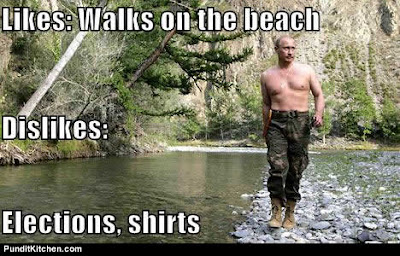
putin.jpg
 
Reinforces the notion that America is a lot more active than a neutral observer in the shaping of the Ukrainian unelected government tbh mate, nice post

I don't think anybody in their right mind would claim that America is just a neutral observer, surely?
 
Status
Not open for further replies.

Welcome

Join the Everton conversation today.
Fewer ads, full access, completely free.

🛒 Visit Shop

Support Grand Old Team by checking out our latest Everton gear!
Back
Top