Current Affairs Liz Truss

Status
Not open for further replies.
GDP is a measure of productivity, not income.
Any increase in per-capita GDP goes to somebody. You're correct that doing things at-a-glance using per-capita GDP ignores things like a Gini coefficient and costs. Unless I have some reason to believe that the underlying cost function on the production of goods and services has changed over the time period in question, an increase in per-capita GDP should translate into a corresponding increase in per-capita incomes. How that distributes is where a Gini coefficient comes in.
 
Any increase in per-capita GDP goes to somebody. You're correct that doing things at-a-glance using per-capita GDP ignores things like a Gini coefficient and costs. Unless I have some reason to believe that the underlying cost function on the production of goods and services has changed over the time period in question, an increase in per-capita GDP should translate into a corresponding increase in per-capita incomes. How that distributes is where a Gini coefficient comes in.
Just saying that train drivers pay isn't associated with how productive they are. Across the board you would certainly hope that wages keep up with productivity.
 
Just saying that train drivers pay isn't associated with how productive they are. Across the board you would certainly hope that wages keep up with productivity.
My point was that the data suggests strong reason to believe that real incomes have decreased broadly by a very substantive amount in Britain in the last fifteen years. A rail worker should look at that and say, "I'm doing the exact same work for much less pay. This is nonsense." Off the top of my head, I cannot think of any genuinely democratic country where that sort of decrease in real income did not ultimately lead to a transition of power, and much sooner at that.

I went looking for income and GDP data for the obvious comparison case (Germany 1918-1933), but I don't think it exists. The St. Louis Fed only has GDP/GNP data back to 1947 for the U.S., income data is limited by the existence of an income tax, and everything written about Germany at the time seems to use proxies (and bad ones) for income. It doesn't look like Piketty has data, and I would think he would if it a means of compiling it existed.

I don't see how those data points can coexist with the Tories holding power for twelve years and Freedom House scoring Britain a 93/100. That flies in the face of absolutely everything I know about democratic politics. The best explanation I can come up with is that you can hold onto power for a long time if you calibrate boiling the frog just right, but even that doesn't work with an actual frog.

 
Like most of the governmental shamblings of late, not sure which thread is most appropriate, opted for here rather than the Grifting thread:


The Treasury is refusing to publish a forecast of the UK's economic outlook alongside this Friday's mini-Budget.
Independent forecaster the Office for the Budget Responsibility (OBR) has already provided a draft to Chancellor Kwasi Kwarteng, the BBC understands.
The Treasury Select Committee says a forecast is "vital" given recent government moves to curb living costs.
Action to cap annual energy bills could cost about £150bn, and tax cuts are expected on Friday.
The mini-Budget is expected to see the government reverse a rise in National Insurance and scrap a planned increase in corporation tax, which reports say could cost £30bn.
The draft forecast the OBR has provided does not include the impact of the energy bill help. It has offered to provide a forecast including this impact, but that has been rejected.
The fact the offer has not been taken up is raising some concerns about whether the government's tax and spending policy is "flying blind", given predictions that the UK is facing a lengthy recession.
MPs on the Treasury Select Committee wrote to the chancellor on Tuesday seeking assurance that an OBR forecast would be published.
"These forecasts are a vital indicator of the health of the nation's finances, and provide reassurance and confidence to international markets and investors," said the committee's chairman, Mel Stride.
"There has been a deterioration in our economic outlook since the last OBR forecast in March. There have been significant fiscal interventions since then and we are told there will be further significant interventions including major permanent tax cuts to be announced on Friday.
"Under these circumstances, it is vital that an independent OBR forecast is provided."
 
My point was that the data suggests strong reason to believe that real incomes have decreased broadly by a very substantive amount in Britain in the last fifteen years. A rail worker should look at that and say, "I'm doing the exact same work for much less pay. This is nonsense." Off the top of my head, I cannot think of any genuinely democratic country where that sort of decrease in real income did not ultimately lead to a transition of power, and much sooner at that.

I went looking for income and GDP data for the obvious comparison case (Germany 1918-1933), but I don't think it exists. The St. Louis Fed only has GDP/GNP data back to 1947 for the U.S., income data is limited by the existence of an income tax, and everything written about Germany at the time seems to use proxies (and bad ones) for income. It doesn't look like Piketty has data, and I would think he would if it a means of compiling it existed.

I don't see how those data points can coexist with the Tories holding power for twelve years and Freedom House scoring Britain a 93/100. That flies in the face of absolutely everything I know about democratic politics. The best explanation I can come up with is that you can hold onto power for a long time if you calibrate boiling the frog just right, but even that doesn't work with an actual frog.
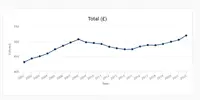
It looks like things fell quite a bit after the financial crisis, which is perhaps not surprising given the focus on financial services in the economy, but it's been making its way up since then (this is average real weekly wage btw)

1663687279095.webp
 
It looks like things fell quite a bit after the financial crisis, which is perhaps not surprising given the focus on financial services in the economy, but it's been making its way up since then (this is average real weekly wage btw)

View attachment 184592
Fair enough, but I would still expect a changeover at the bottom of the trough, especially given the somewhat elevated inflation rates everyone experienced post-financial-crisis when governments were effectively printing virtual currency like mad. People notice price increases. Instead, the Conservatives gained seats.

The graph does push things toward saner possible explanations for that result - Miliband was a really bad candidate, the Tories gerrymandered like mad after 2010, the SNP killed Labour's prospects and therefore tactical voting, or some or all of the above. Good thought on looking at this particular number more in depth; one would expect the Tories to hold on after 2015 on this data and the Brexit chaos, provided that they somehow survived that election.
 
She's delivering on what she promised... for now. when it becomes a raw effluent stew and its time to chow down it'll alter. This is window dressing, the core problems theyve sewn cant be magicked away. Bunker down all.
 
Someone has to realise soon that the trickle down economy only works in the good times. It is easy for those who have enough to distribute some of their wealth when they are confident that things will always remain in their favour. Unfortunately we are not in those times, those who may have enough for now will stock pile for the bad times ahead. The trickle down economy only works if those that have decide to be benevolent, it appears benevolence is an old fashioned virtue.
Liz Truss is a free marketeer, to her credit she doesn’t pretend to be anything other than a free marketeer. She will implement policies such as the bankers bonus system in the belief that if a group of people can make millions of pounds they might share some of it with poorer people.
England, because it is England that elects a Conservative Government, believe this fairytale to the extent that their working class party no longer put forward socialist policies but instead feels the need to mirror right wing ideology to make it electable.
The sooner the United Kingdom breaks up the better.
 
Someone has to realise soon that the trickle down economy only works in the good times. It is easy for those who have enough to distribute some of their wealth when they are confident that things will always remain in their favour. Unfortunately we are not in those times, those who may have enough for now will stock pile for the bad times ahead. The trickle down economy only works if those that have decide to be benevolent, it appears benevolence is an old fashioned virtue.
Liz Truss is a free marketeer, to her credit she doesn’t pretend to be anything other than a free marketeer. She will implement policies such as the bankers bonus system in the belief that if a group of people can make millions of pounds they might share some of it with poorer people.
England, because it is England that elects a Conservative Government, believe this fairytale to the extent that their working class party no longer put forward socialist policies but instead feels the need to mirror right wing ideology to make it electable.
The sooner the United Kingdom breaks up the better.
To be fair, I don't think it was ever about benevolence but more that richer people would both spend their money in places, thus creating jobs that way, and potentially also create new businesses themselves, thus also creating jobs. I don't think advocates of the theory for one minute assumed the rich would give their money away. Its ethos was always wrapped up in the notion that people who create jobs know more about what they need to thrive than the state does, so they should be given more control over how they spend their money. So yes, many of the ultra rich are pledging to give away vast chunks of their fortune, that's not really what "trickle down economics" is about.
 
The old trickle down economics,
Yep that's worked in the passed?
People at the top get more and then make sure it stays with them,
If it goes tits up , we bail them out , we pay for it ,they keep the bail out money and stay rich we get poorer and on it goes.
I know a very relevant joke about trickle down economics, however I doubt 99.9% of you will ever get it.
 
Someone has to realise soon that the trickle down economy only works in the good times. It is easy for those who have enough to distribute some of their wealth when they are confident that things will always remain in their favour. Unfortunately we are not in those times, those who may have enough for now will stock pile for the bad times ahead. The trickle down economy only works if those that have decide to be benevolent, it appears benevolence is an old fashioned virtue.
Liz Truss is a free marketeer, to her credit she doesn’t pretend to be anything other than a free marketeer. She will implement policies such as the bankers bonus system in the belief that if a group of people can make millions of pounds they might share some of it with poorer people.
England, because it is England that elects a Conservative Government, believe this fairytale to the extent that their working class party no longer put forward socialist policies but instead feels the need to mirror right wing ideology to make it electable.
The sooner the United Kingdom breaks up the better.
It's a bold stance to take as a PM only 2 years out from a GE.

Actually admitting that tax cuts etc will disproportiantly benefit the rich more when even the middle class is currently struggling. And that she is happy to be an unpopular PM.

Will be a short lasting PM as well if that's the case
 
Status
Not open for further replies.

Welcome

Join the Everton conversation today.
Fewer ads, full access, completely free.

🛒 Visit Shop

Support Grand Old Team by checking out our latest Everton gear!
Back
Top