Jordan Peterson Thread.

Status
Not open for further replies.
Progressive leftism is on the wane? Not with government-run universal healthcare, free or reduced-cost higher education, a national minimum income and many other progressive causes gaining in popularity. My goodness, conservative Missourians just voted down right-to-work laws in the state.

I like all those things, what's meant tho' is not classical progressive leftism as defined by students of politics, what's meant is regressive leftism (under the umbrella of progressivism), which is an exaggeration and even abuse of the classical ideals you list above.

The debate is so semantically-convoluted tho' that many dig themselves in a quagmire of terminology. See also alt-rightists calling themselves traditional liberals. It's getting to the point where none of these terms mean much anymore.
 
The Left’s Contempt for Jordan Peterson Is Perfectly Rational
http://nymag.com/daily/intelligence...of-jordan-peterson-is-perfectly-rational.html

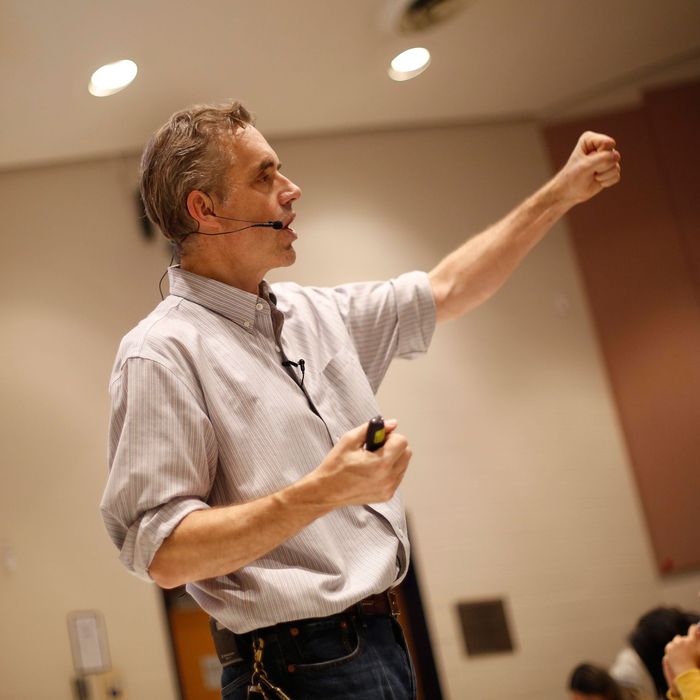
09-jordan-peterson.w700.h700.jpg

A contrarian snowflake in his ideological safe space. Photo: Rene Johnston/Toronto Star via Getty Images

Identity politics will be the death of the center-right. There was a time when America’s Burkean contrarians felt compelled to engage with the substance of their critics’ arguments; to meet facts with facts, disputations with counter-disputations. Now, they’re content to merely assert their identity as tellers of uncomfortable truths (and don’t you dare ask them to validate that identity, empirically; if a center-right contrarian identifies as unfailingly rational and free of racial, gender, or class biases, then one must accept this as her personal truth). In fact, these “intellectual dark web” browsers have become so defensive of their identitarian ideology, they’ve grown blind to any and all realities that might complicate their worldview.

If this dire assessment of the center-right sounds overwrought, just take a gander at Caitlin Flanagan’s new essay on Jordan Peterson in The Atlantic.

The thesis of the column is simple: For years, a silenced majority had been suffering under the tyrannical hegemony of left-wing identity politics — until Jordan Peterson set their minds free with his devastating rebuttal of that creed’s bogus premises. Flanagan writes that what Peterson “and the other members of the so-called ‘intellectual dark web’ are offering is kryptonite to identity politics”; that Peterson provided her son and his friends with “the only sustained argument against identity politics they had heard in their lives”; and that the left is afraid of Peterson’s ideas because they are “are completely inconsistent with identity politics of any kind.”

Not once in her (nearly 2,000-word) column does Flanagan define the “identity politics” she’s inveighing against, or so much as summarize Peterson’s argument against them. She does offer some examples of what she considers to be representative of the former: The Nation’s decision to apologize for publishing a poem written in African-American vernacular by a non-black poet; the alt-right’s pursuit of a white ethno-state; and former president Barack Obama — whom she dubs “the poet laureate of identity politics.”

There’s a strong case that the first item in this litany is, in fact, a genuine instance of left-wing ideological excess. And plenty of progressive writers have been making it. In fact, if Flanagan’s son is still in the market for “sustained arguments” against certain manifestations of progressive identity politics, he can find no shortage of them from left-wing intellectuals.

But Flanagan would rather attack an imaginary, monolithic left than contend with the actual one. And by positing Barack Obama as an exemplary practitioner of identity politics, she renders her conception of that phrase incomprensible. Obama literally launched his political career by proclaiming that African-Americans must “eradicate the slander that says a black youth with a book is acting white” — and that there was “not a black America and white America and Latino America and Asian America; there’s the United States of America.” The man’s commitment to a politics of universalism was so emphatic and unyielding, he spent his last year in office lecturing college students about the evils of “political correctness.”

If there is a reason that Flanagan associates Barack Obama with identity politics — beyond the fact that he is an African-American who participated in politics — she feels no need to spell it out. For an identitarian contrarian like Flanagan, assertion is sufficient; argument, unnecessary. People from her intellectual tribe recognize that Jordan Peterson is good, and identity politics (a phrase that ostensibly covers the political worldview of most everyone to her left or right) is bad. The fact that a person like her is making this claim is all the substantiation required; because people like her, her son, and Jordan Peterson are capable of perceiving objective reality, unmediated by ideology.

Flanagan actually implies this: She writes that once her son and his friends had digested Peterson’s thought, they found that it was suddenly “possible to talk about all kinds of things—religion, philosophy, history, myth—in a different way. They could have a direct experience with ideas, not one mediated by ideology.”

Here is how Petersen, who never allows identity to color his thought — and perceives ideas from myth, history, and philosophy, directly, unmediated by ideology —assesses The Feminine Mystique:

I read Betty Friedan’s book because I was very curious about it, and it’s so whiny, it’s just enough to drive a modern person mad to listen to these suburban housewives from the late ’50s ensconced in their comfortable secure lives complaining about the fact that they’re bored because they don’t have enough opportunity. It’s like, Jesus get a hobby.​

And here is how such a man perceives the feminine, in general:

You know you can say, “Well isn’t it unfortunate that chaos is represented by the feminine” — well, it might be unfortunate, but it doesn’t matter because that is how it’s represented. It’s been represented like that forever. And there are reasons for it. You can’t change it. It’s not possible.​

Flanagan’s suggestion that Jordan Peterson looks down on human existence from the Archimedean point is risible. But her essay’s most preposterous and telling claim — the one that exposes the center-right contrarian’s incapacity to even comprehend the existence of ideologically inconvenient facts — is this:

There are plenty of reasons for individual readers to dislike Jordan Peterson … There are many legitimate reasons to disagree with him on a number of subjects, and many people of good will do. But there is no coherent reason for the left’s obliterating and irrational hatred of Jordan Peterson.​

By definition, there can be no coherent reason for anyone’s irrational hatred of anything. But if we take Flanagan’s argument to be that the left has no rational basis for seeing Peterson as contemptible and dangerous, then her argument is absurd.

Peterson argues that human beings do not yet know whether it is possible for men and women to work together without the former sexually harassing the latter, to such an extent that segregated workplaces are preferable. He has stated, point blank, that women who do not want to be sexually harassed at work — but nevertheless wear makeup to the office — are hypocrites. In her essay, Flanagan accuses the left of mendaciously attaching “reputation-destroying ideas” to Peterson. But rest assured, Peterson has attached these ideas to himself:

Perhaps, Flanagan agrees with all of this. Perhaps, she thinks that, “Can men and women work together in the workplace?” is an open question, and that the only reason why women put on lipstick is to trigger thoughts of sex in men’s minds — and thus, if women who wear lipstick to the office get sexually harassed, they bear some responsibility for their own plight. But does Flanagan really believe that it would be incoherent for feminists to detest Peterson on the basis of these views?

Or did she simply ensconce herself in an ideological safe space that shielded these remarks from her awareness?

For the sake of argument, let’s say that Flanagan did not intend to defend Peterson’s thoughts on the propriety of wearing makeup to an office. After all, she claims to specifically prize the public intellectual’s dissection of identity politics. Is it actually the case that Peterson’s argument against identity politics is profound, and that the left has no coherent reason for disdaining him on the basis of it?

To answer this query, let’s take a look at what Peterson’s own fans have identified as “his finest moment” — his nutshell case for rejecting identity politics and embracing the individualist, “free market” traditions of “the West.”

This viral clip from one of Peterson’s lectures begins with the professor arguing that every single person in his audience is “oppressed.” The ensuing rant is worth quoting at length:

God only knows why. Maybe you’re too short, or you’re not as beautiful as you could be, or, you know, your parent, your grandparent was a serf — likely, because almost everbody’s grand-, great-grandparent was. And you’re not as smart as you could be. And you have a sick relative, and you have your own physical problems — and it’s like, frankly, you’re a mess. And you’re oppressed in every possible way including your ancestry and your biology. And the entire sum of human history has conspired to produce victimized you, with all your individual pathological problems. It’s like: YES! TRUE! OKAY!

But the problem is that, if you take the oppressed, you have to fractionate them and fractionate them, and it’s like: You’re a woman? Yeah, okay — well I’m a black woman. Well, I’m a black woman who has two children. Well, I’m a black woman who has two children, and one of them isn’t very healthy. And then, well, I’m a Hispanic woman, and I have a genius son who doesn’t have any money, so that he can’t go to university — and, you know, I had a hell of a time getting across the border. It was really hard on me to get my citizenship. My husband is an alcoholic brute. It’s like, well, yeah, that sucks too. And so, let’s fix all your oppression. And we’ll take every single thing into account, and then we’ll fix yours too. We’ll take every single thing into account.

It’s like: NO, you won’t because you can’t. You can’t. It is technically impossible. First of all, you can’t even list all the ways that you’re oppressed. Second, how are you going to weight them? Third, who’s going to decide? And that’s the bloody thing: Who’s gonna decide? That’s the thing.

Well, what’s the answer in the West? It’s like, in free markets … We’re going to outsource it to the marketplace. You’re going to take your sorry pathetic being, and you’re gonna try to offer me something that maybe I want. And I’m going to take my sorry pathetic being, and I’m gonna say, “well, all things considered, as well as I can understand them, maybe I could give you this much money”, which is actually a promise for that thing. And you’ve packed all of your damn oppression into the price. And I packed all my oppression into the willingness to pay it. And that solution sucks. It’s a bad solution. But compared to every other solution – man, it’s why 10 percent of us have freedom!​

Here, Peterson argues that seeking political solutions to problems of identity-based oppression is futile; that attempts to do so will inevitably bestow arbitrary powers on some tyrannical authority (Who’s gonna decide?); and thus, that the best society can do is to maintain free markets, where all individuals can seek to transcend their oppression by selling goods and services that other individuals wish to buy.

This narrative rests on so many flimsy premises it’s hard to know where to begin. Does Peterson genuinely believe that “free markets” are the best solution “the West” has found for a woman whose “genius son” can’t afford to go to college? Or for a mother with a sick child? Is he unaware of the existence of public universities, and his home country’s single-payer health-care system? Or does he not understand that people had to organize collectively — around shared identities of oppression (as with workers in trade unions or people who suffer from disabilities, in lobbying groups) — to bring these kinds of public goods into being? And is the question of “who will get to decide” whose oppression the state should prioritize redressing really so confounding? Didn’t “the West” develop republican institutions precisely so that the people’s elected representatives could adjudicate such claims, and be voted out of office if they do so in way that displeases a majority of the public?

But the core problem with Peterson’s argument — the one that best justifies the left’s contempt for him — is that it proceeds from the premise that it is impossible to draw a categorical distinction between oppressions that are rooted in race, gender, or class, and ineluctable misfortunes like “being less tall than one might prefer.” A moment’s scrutiny reveals the absurdity of this idea. But for anyone who finds comfort in Peterson’s claim — anyone who does not wish to believe that he has benefited from unearned privileges, or that America has racked up unpaid debts to the poor, to women, or its black citizens — the notion is superficially plausible enough to be taken at face value. Which is why it is so popular; and therefore, dangerous; and therefore, contemptible.

The fact that I am five feet and eight inches tall, instead of six-one, as I might prefer, is not a legacy of official government policies that were in operation during Jordan Peterson’s lifetime. The fact that the median white family lays claim to roughly nine times as much wealth as the median black one in the United States is.

For most of the 20th century, de jure segregation was a reality in both the North and South. Through the Federal Housing Administration, the U.S. government promoted homeownership by providing Americans with low-cost mortgage insurance — unless they lived in a neighborhood with a significant population of dark-skinned people. The government considered the mere presence of “Negroes” in an area to be dispositive evidence of its instability, and thus, made such places ineligible for mortgage insurance.

One effect of this policy was to exacerbate white racism by endowing it with rationality: An African-American moving next door didn’t just challenge a white homeowner’s tolerance for diversity, but represented a clear and present danger to the value of his family’s home (typically, its primary source of wealth). Meanwhile, federal authorities built officially segregated public housing complexes, and rendered many African-American neighborhoods objectively undesirable by concentrating toxic waste sites in their boundaries. These policies, combined with the deindustrialization of America’s cities; white Americans’ (heavily subsidized) flight to the suburbs; and the fact that many basic government services in the U.S. are funded from local property taxes trapped millions of African-Americans in segregated inner cities with few employment opportunities, underfunded public schools, and copious health hazards.

Jordan Peterson claims to be a champion of “equality of opportunity.” In many of his other lectures on the folly of identity politics (and of the left, more broadly), Peterson insists that Western societies have largely achieved such equality because the personality traits of “intelligence” and “conscientiousness” heavily correlate with success in the United States and Canada.

In his ideological blindness, the Canadian contrarian fails to consider the possibility that the socioeconomic conditions a person is born into might limit her opportunity to develop such traits. But anyone with an interest in engaging with history and social science, unmediated by center-right identity politics, knows that this is a certainty.

Thanks to the legacy of de jure segregation (and Jim Crow, and slavery), black children in the U.S. are several times more likely than white ones to grow up in neighborhoods and buildings that expose them to hazardous concentrations of lead. Such exposure can do durable damage to a child’s cognitive faculties, including her memory, attention, reasoning, and motor skills. Which is to say: By the time they arrive at kindergarten, many black children will already find themselves at a (potentially permanent) cognitive disadvantage, as a consequence of the inequitable housing conditions that they were born into. And then, such children will likely find themselves in an elementary school that has lower per-pupil funding — and a higher concentration of poverty among the student body (socioeconomic segregation has been shown to be detrimental to the educational outcomes of individual low-income students) — than their white peers.

Is the oppression that such children suffer indistinguishable from that weathered by people who are not “as beautiful as they could be”? Are “free markets” really a better solution to their plight than federal programs to remove lead from their housing complexes, and to increase funding to their schools? Would African-Americans organizing, as an identity group, to pressure lawmakers into passing such programs really be an invitation to tyranny? If the government decides to take no further action to remedy the racial inequalities that it engineered, would that be triumph for free markets? Would it mean that we averted the terrifying hypothetical of an arbitrary state power deciding which groups’ interests should be privileged and which should not?

Should black people in poverty-stricken, segregated communities stop complaining because Jordan Peterson’s great-grandfather was a serf? Is it difficult to understand how people as manifestly intelligent as Jordan Peterson and Caitlin Flanagan could possibly find that argument compelling (unless one stipulates that their political perceptions are biased by their racial identity and class position)?

In truth, only a tiny (albeit loud) minority on the American left reject the liberal, universalist ideals that Peterson and Flanagan claim to cherish. But one of the major obstacles to realizing such ideals in the United States is the refusal of wealthy, white America to recognize what doing so requires. If we want to live in a country where all children have a genuine opportunity to meet their potential, we must redistribute a massive amount of material resources to the people that we, as Americans, collectively conspired to deprive.

Peterson’s “sustained argument” against identity politics is antithetical to that project. That Peterson packages his 11th-grade libertarianism, and pseudoscientific misogyny, with genuine insights from clinical psychology, and stimulating reflections on mythic archetypes only makes him more dangerous; because it enables center-right ideologues like Caitlin Flanagan to blind themselves to those parts of his work that threaten their identity and ideology — just as they blind themselves to those parts of our society that do the same — and to then ask, incredulously, why the left is so afraid of engaging with their ideas.

 
The Left’s Contempt for Jordan Peterson Is Perfectly Rational
http://nymag.com/daily/intelligence...of-jordan-peterson-is-perfectly-rational.html

09-jordan-peterson.w700.h700.jpg

A contrarian snowflake in his ideological safe space. Photo: Rene Johnston/Toronto Star via Getty Images

Identity politics will be the death of the center-right. There was a time when America’s Burkean contrarians felt compelled to engage with the substance of their critics’ arguments; to meet facts with facts, disputations with counter-disputations. Now, they’re content to merely assert their identity as tellers of uncomfortable truths (and don’t you dare ask them to validate that identity, empirically; if a center-right contrarian identifies as unfailingly rational and free of racial, gender, or class biases, then one must accept this as her personal truth). In fact, these “intellectual dark web” browsers have become so defensive of their identitarian ideology, they’ve grown blind to any and all realities that might complicate their worldview.

If this dire assessment of the center-right sounds overwrought, just take a gander at Caitlin Flanagan’s new essay on Jordan Peterson in The Atlantic.

The thesis of the column is simple: For years, a silenced majority had been suffering under the tyrannical hegemony of left-wing identity politics — until Jordan Peterson set their minds free with his devastating rebuttal of that creed’s bogus premises. Flanagan writes that what Peterson “and the other members of the so-called ‘intellectual dark web’ are offering is kryptonite to identity politics”; that Peterson provided her son and his friends with “the only sustained argument against identity politics they had heard in their lives”; and that the left is afraid of Peterson’s ideas because they are “are completely inconsistent with identity politics of any kind.”

Not once in her (nearly 2,000-word) column does Flanagan define the “identity politics” she’s inveighing against, or so much as summarize Peterson’s argument against them. She does offer some examples of what she considers to be representative of the former: The Nation’s decision to apologize for publishing a poem written in African-American vernacular by a non-black poet; the alt-right’s pursuit of a white ethno-state; and former president Barack Obama — whom she dubs “the poet laureate of identity politics.”

There’s a strong case that the first item in this litany is, in fact, a genuine instance of left-wing ideological excess. And plenty of progressive writers have been making it. In fact, if Flanagan’s son is still in the market for “sustained arguments” against certain manifestations of progressive identity politics, he can find no shortage of them from left-wing intellectuals.

But Flanagan would rather attack an imaginary, monolithic left than contend with the actual one. And by positing Barack Obama as an exemplary practitioner of identity politics, she renders her conception of that phrase incomprensible. Obama literally launched his political career by proclaiming that African-Americans must “eradicate the slander that says a black youth with a book is acting white” — and that there was “not a black America and white America and Latino America and Asian America; there’s the United States of America.” The man’s commitment to a politics of universalism was so emphatic and unyielding, he spent his last year in office lecturing college students about the evils of “political correctness.”

If there is a reason that Flanagan associates Barack Obama with identity politics — beyond the fact that he is an African-American who participated in politics — she feels no need to spell it out. For an identitarian contrarian like Flanagan, assertion is sufficient; argument, unnecessary. People from her intellectual tribe recognize that Jordan Peterson is good, and identity politics (a phrase that ostensibly covers the political worldview of most everyone to her left or right) is bad. The fact that a person like her is making this claim is all the substantiation required; because people like her, her son, and Jordan Peterson are capable of perceiving objective reality, unmediated by ideology.

Flanagan actually implies this: She writes that once her son and his friends had digested Peterson’s thought, they found that it was suddenly “possible to talk about all kinds of things—religion, philosophy, history, myth—in a different way. They could have a direct experience with ideas, not one mediated by ideology.”

Here is how Petersen, who never allows identity to color his thought — and perceives ideas from myth, history, and philosophy, directly, unmediated by ideology —assesses The Feminine Mystique:

I read Betty Friedan’s book because I was very curious about it, and it’s so whiny, it’s just enough to drive a modern person mad to listen to these suburban housewives from the late ’50s ensconced in their comfortable secure lives complaining about the fact that they’re bored because they don’t have enough opportunity. It’s like, Jesus get a hobby.​

And here is how such a man perceives the feminine, in general:

You know you can say, “Well isn’t it unfortunate that chaos is represented by the feminine” — well, it might be unfortunate, but it doesn’t matter because that is how it’s represented. It’s been represented like that forever. And there are reasons for it. You can’t change it. It’s not possible.​

Flanagan’s suggestion that Jordan Peterson looks down on human existence from the Archimedean point is risible. But her essay’s most preposterous and telling claim — the one that exposes the center-right contrarian’s incapacity to even comprehend the existence of ideologically inconvenient facts — is this:

There are plenty of reasons for individual readers to dislike Jordan Peterson … There are many legitimate reasons to disagree with him on a number of subjects, and many people of good will do. But there is no coherent reason for the left’s obliterating and irrational hatred of Jordan Peterson.​

By definition, there can be no coherent reason for anyone’s irrational hatred of anything. But if we take Flanagan’s argument to be that the left has no rational basis for seeing Peterson as contemptible and dangerous, then her argument is absurd.

Peterson argues that human beings do not yet know whether it is possible for men and women to work together without the former sexually harassing the latter, to such an extent that segregated workplaces are preferable. He has stated, point blank, that women who do not want to be sexually harassed at work — but nevertheless wear makeup to the office — are hypocrites. In her essay, Flanagan accuses the left of mendaciously attaching “reputation-destroying ideas” to Peterson. But rest assured, Peterson has attached these ideas to himself:

Perhaps, Flanagan agrees with all of this. Perhaps, she thinks that, “Can men and women work together in the workplace?” is an open question, and that the only reason why women put on lipstick is to trigger thoughts of sex in men’s minds — and thus, if women who wear lipstick to the office get sexually harassed, they bear some responsibility for their own plight. But does Flanagan really believe that it would be incoherent for feminists to detest Peterson on the basis of these views?

Or did she simply ensconce herself in an ideological safe space that shielded these remarks from her awareness?

For the sake of argument, let’s say that Flanagan did not intend to defend Peterson’s thoughts on the propriety of wearing makeup to an office. After all, she claims to specifically prize the public intellectual’s dissection of identity politics. Is it actually the case that Peterson’s argument against identity politics is profound, and that the left has no coherent reason for disdaining him on the basis of it?

To answer this query, let’s take a look at what Peterson’s own fans have identified as “his finest moment” — his nutshell case for rejecting identity politics and embracing the individualist, “free market” traditions of “the West.”

This viral clip from one of Peterson’s lectures begins with the professor arguing that every single person in his audience is “oppressed.” The ensuing rant is worth quoting at length:

God only knows why. Maybe you’re too short, or you’re not as beautiful as you could be, or, you know, your parent, your grandparent was a serf — likely, because almost everbody’s grand-, great-grandparent was. And you’re not as smart as you could be. And you have a sick relative, and you have your own physical problems — and it’s like, frankly, you’re a mess. And you’re oppressed in every possible way including your ancestry and your biology. And the entire sum of human history has conspired to produce victimized you, with all your individual pathological problems. It’s like: YES! TRUE! OKAY!

But the problem is that, if you take the oppressed, you have to fractionate them and fractionate them, and it’s like: You’re a woman? Yeah, okay — well I’m a black woman. Well, I’m a black woman who has two children. Well, I’m a black woman who has two children, and one of them isn’t very healthy. And then, well, I’m a Hispanic woman, and I have a genius son who doesn’t have any money, so that he can’t go to university — and, you know, I had a hell of a time getting across the border. It was really hard on me to get my citizenship. My husband is an alcoholic brute. It’s like, well, yeah, that sucks too. And so, let’s fix all your oppression. And we’ll take every single thing into account, and then we’ll fix yours too. We’ll take every single thing into account.

It’s like: NO, you won’t because you can’t. You can’t. It is technically impossible. First of all, you can’t even list all the ways that you’re oppressed. Second, how are you going to weight them? Third, who’s going to decide? And that’s the bloody thing: Who’s gonna decide? That’s the thing.

Well, what’s the answer in the West? It’s like, in free markets … We’re going to outsource it to the marketplace. You’re going to take your sorry pathetic being, and you’re gonna try to offer me something that maybe I want. And I’m going to take my sorry pathetic being, and I’m gonna say, “well, all things considered, as well as I can understand them, maybe I could give you this much money”, which is actually a promise for that thing. And you’ve packed all of your damn oppression into the price. And I packed all my oppression into the willingness to pay it. And that solution sucks. It’s a bad solution. But compared to every other solution – man, it’s why 10 percent of us have freedom!​

Here, Peterson argues that seeking political solutions to problems of identity-based oppression is futile; that attempts to do so will inevitably bestow arbitrary powers on some tyrannical authority (Who’s gonna decide?); and thus, that the best society can do is to maintain free markets, where all individuals can seek to transcend their oppression by selling goods and services that other individuals wish to buy.

This narrative rests on so many flimsy premises it’s hard to know where to begin. Does Peterson genuinely believe that “free markets” are the best solution “the West” has found for a woman whose “genius son” can’t afford to go to college? Or for a mother with a sick child? Is he unaware of the existence of public universities, and his home country’s single-payer health-care system? Or does he not understand that people had to organize collectively — around shared identities of oppression (as with workers in trade unions or people who suffer from disabilities, in lobbying groups) — to bring these kinds of public goods into being? And is the question of “who will get to decide” whose oppression the state should prioritize redressing really so confounding? Didn’t “the West” develop republican institutions precisely so that the people’s elected representatives could adjudicate such claims, and be voted out of office if they do so in way that displeases a majority of the public?

But the core problem with Peterson’s argument — the one that best justifies the left’s contempt for him — is that it proceeds from the premise that it is impossible to draw a categorical distinction between oppressions that are rooted in race, gender, or class, and ineluctable misfortunes like “being less tall than one might prefer.” A moment’s scrutiny reveals the absurdity of this idea. But for anyone who finds comfort in Peterson’s claim — anyone who does not wish to believe that he has benefited from unearned privileges, or that America has racked up unpaid debts to the poor, to women, or its black citizens — the notion is superficially plausible enough to be taken at face value. Which is why it is so popular; and therefore, dangerous; and therefore, contemptible.

The fact that I am five feet and eight inches tall, instead of six-one, as I might prefer, is not a legacy of official government policies that were in operation during Jordan Peterson’s lifetime. The fact that the median white family lays claim to roughly nine times as much wealth as the median black one in the United States is.

For most of the 20th century, de jure segregation was a reality in both the North and South. Through the Federal Housing Administration, the U.S. government promoted homeownership by providing Americans with low-cost mortgage insurance — unless they lived in a neighborhood with a significant population of dark-skinned people. The government considered the mere presence of “Negroes” in an area to be dispositive evidence of its instability, and thus, made such places ineligible for mortgage insurance.

One effect of this policy was to exacerbate white racism by endowing it with rationality: An African-American moving next door didn’t just challenge a white homeowner’s tolerance for diversity, but represented a clear and present danger to the value of his family’s home (typically, its primary source of wealth). Meanwhile, federal authorities built officially segregated public housing complexes, and rendered many African-American neighborhoods objectively undesirable by concentrating toxic waste sites in their boundaries. These policies, combined with the deindustrialization of America’s cities; white Americans’ (heavily subsidized) flight to the suburbs; and the fact that many basic government services in the U.S. are funded from local property taxes trapped millions of African-Americans in segregated inner cities with few employment opportunities, underfunded public schools, and copious health hazards.

Jordan Peterson claims to be a champion of “equality of opportunity.” In many of his other lectures on the folly of identity politics (and of the left, more broadly), Peterson insists that Western societies have largely achieved such equality because the personality traits of “intelligence” and “conscientiousness” heavily correlate with success in the United States and Canada.

In his ideological blindness, the Canadian contrarian fails to consider the possibility that the socioeconomic conditions a person is born into might limit her opportunity to develop such traits. But anyone with an interest in engaging with history and social science, unmediated by center-right identity politics, knows that this is a certainty.

Thanks to the legacy of de jure segregation (and Jim Crow, and slavery), black children in the U.S. are several times more likely than white ones to grow up in neighborhoods and buildings that expose them to hazardous concentrations of lead. Such exposure can do durable damage to a child’s cognitive faculties, including her memory, attention, reasoning, and motor skills. Which is to say: By the time they arrive at kindergarten, many black children will already find themselves at a (potentially permanent) cognitive disadvantage, as a consequence of the inequitable housing conditions that they were born into. And then, such children will likely find themselves in an elementary school that has lower per-pupil funding — and a higher concentration of poverty among the student body (socioeconomic segregation has been shown to be detrimental to the educational outcomes of individual low-income students) — than their white peers.

Is the oppression that such children suffer indistinguishable from that weathered by people who are not “as beautiful as they could be”? Are “free markets” really a better solution to their plight than federal programs to remove lead from their housing complexes, and to increase funding to their schools? Would African-Americans organizing, as an identity group, to pressure lawmakers into passing such programs really be an invitation to tyranny? If the government decides to take no further action to remedy the racial inequalities that it engineered, would that be triumph for free markets? Would it mean that we averted the terrifying hypothetical of an arbitrary state power deciding which groups’ interests should be privileged and which should not?

Should black people in poverty-stricken, segregated communities stop complaining because Jordan Peterson’s great-grandfather was a serf? Is it difficult to understand how people as manifestly intelligent as Jordan Peterson and Caitlin Flanagan could possibly find that argument compelling (unless one stipulates that their political perceptions are biased by their racial identity and class position)?

In truth, only a tiny (albeit loud) minority on the American left reject the liberal, universalist ideals that Peterson and Flanagan claim to cherish. But one of the major obstacles to realizing such ideals in the United States is the refusal of wealthy, white America to recognize what doing so requires. If we want to live in a country where all children have a genuine opportunity to meet their potential, we must redistribute a massive amount of material resources to the people that we, as Americans, collectively conspired to deprive.

Peterson’s “sustained argument” against identity politics is antithetical to that project. That Peterson packages his 11th-grade libertarianism, and pseudoscientific misogyny, with genuine insights from clinical psychology, and stimulating reflections on mythic archetypes only makes him more dangerous; because it enables center-right ideologues like Caitlin Flanagan to blind themselves to those parts of his work that threaten their identity and ideology — just as they blind themselves to those parts of our society that do the same — and to then ask, incredulously, why the left is so afraid of engaging with their ideas.

Could have just said ' he's a self serving tit that's found his niche audience'. We'd have got there quicker.
 
I start teaching today and in my class of 200+ students I have had, so far, two email requests for "preferred name and prounouns". All the emails were very polite in the form of: "Dear Prof XXX, My name is [preferred name] and I'm a student in your class on XXX. I am transgender and have not undergone a legal name change yet. I would prefer that you call me [new name] and use the pronouns [gender-appropriate pronouns]. I'm excited about your class [or some other nicety], sincerely [new name].

Obviously, I told these kids that I would not be supporting their Marxist ideology that is responsible for the deaths of 30 million people, because that is the principled and un-attention-seeking way to deal with these requests.
 
I start teaching today and in my class of 200+ students I have had, so far, two email requests for "preferred name and prounouns". All the emails were very polite in the form of: "Dear Prof XXX, My name is [preferred name] and I'm a student in your class on XXX. I am transgender and have not undergone a legal name change yet. I would prefer that you call me [new name] and use the pronouns [gender-appropriate pronouns]. I'm excited about your class [or some other nicety], sincerely [new name].

Obviously, I told these kids that I would not be supporting their Marxist ideology that is responsible for the deaths of 30 million people, because that is the principled and un-attention-seeking way to deal with these requests.

You're guilty of a classic so what you're saying is...

JP does call students by their preferred monikers if he is asked to. He was objecting to such being enshrined in law as he disagrees in principle with the idea of compelled speech.
 
You're guilty of a classic so what you're saying is...

JP does call students by their preferred monikers if he is asked to. He was objecting to such being enshrined in law as he disagrees in principle with the idea of compelled speech.

He is an idiot for comparing the ostensibly forced use of preferred pronouns to the death of 30 million people. And particularly so, because there already existed, at the time of his ham-fisted more-principled-than-thou proclamation, hate-speech laws across several Canadian provinces that already banned the very thing he belatedly decided to publicly protest. He decided to make an issue of it once it went federal, but remained tight-lipped when it was previously implemented at the province level.

Also, Peterson is on record saying he would refuse to call individuals by their preferred pronouns.
 
He is an idiot for comparing the ostensibly forced use of preferred pronouns to the death of 30 million people. And particularly so, because there already existed, at the time of his ham-fisted more-principled-than-thou proclamation, hate-speech laws across several Canadian provinces that already banned the very thing he belatedly decided to publicly protest. He decided to make an issue of it once it went federal, but remained tight-lipped when it was previously implemented at the province level.

Also, Peterson is on record saying he would refuse to call individuals by their preferred pronouns.

You're exaggerating. His argument is that compelled speech can lead to the kind of newspeak-controls Orwell warned us about (i.e. Stalinism/Maoism) which as we know had high death tolls. It's a dramatic argument, but is certainly not idiotic. Or was Orwell also an idiot?

And you've linked a 55-minute video to prove JP said one certain thing? He's on record saying he would call students by their preferred names/pronouns if he was asked by them, so you'll have to provide a minute:second count on that video.
 
You're exaggerating. His argument is that compelled speech can lead to the kind of newspeak-controls Orwell warned us about (i.e. Stalinism/Maoism) which as we know had high death tolls. It's a dramatic argument, but is certainly not idiotic. Or was Orwell also an idiot?

And you've linked a 55-minute video to prove JP said one certain thing? He's on record saying he would call students by their preferred names/pronouns if he was asked by them, so you'll have to provide a minute:second count on that video.

I don't have to provide you with anything. Do your own legwork.

And to compare the ostensibly forced use of preferred pronouns to the death of 30 million people (correction: 100 million people)--which is exactly what he said--is idiotic.
 
I don't have to provide you with anything. Do you own legwork.

You've just lost the argument. You link a 55-minute video claiming he said something, then refuse to say where in the video that thing may be heard.


And to compare the ostensibly forced use of preferred pronouns to the death of 30 million people (correction: 100 million people)--which is exactly what he said--is idiotic.

And despite me explaining the nuances of that comparison, you're still seeing in very basic terms, and then link to his Wikipedia page without being specific what exactly you're referring to in an attempt to prove your basic understanding is correct, ironically by saying that's "exactly what he said". When I do the 'legwork' to see what you might mean, I see a quote where JP is comparing to marxist doctrines, doctrines which ended up costing many lives. Which is what I wrote above (the bit where I said it's dramatic but not idiotic). I don't think you understanding what's meant by comparing doctrines, which, again ironically, is revealing the idiocy lies with your own argument.

It's very weak stuff from you. Don't think I'll bother, to be honest mate. Unless you provide me with a minute:second count to back up your first point, and you accept JP is comparing doctrines. Then maybe we could continue.
 
I don't think you understanding what's meant by comparing doctrines

*uff! as an old proofreader seeing this disturbs me a little...should be I don't think you understand or I don't think you're understanding...these things often happen when one is admonishing the other's lack of comprehension lol


*no capitals is cool now
 
You've just lost the argument. You link a 55-minute video claiming he said something, then refuse to say where in the video that thing may be heard.

Wow! Let me get this straight: because you refuse to do any legwork finding where Peterson has said he refuses to use gender neutral pronouns, then I've lost the argument. That's precious. Here's a hint: it is in the wikipedia quote that I posted and that you claimed to have read.

If you are going to work on that illogical level, here's something you'll have no doubt understanding: Unless you provide me with high-resolution scans of your passport and credit cards (front and back with no dates or numbers blocked out), then you have lost this argument as well as every other argument here on GOT. Forever and ever. And I am the winningest! Yay for me.

And despite me explaining the nuances of that comparison, you're still seeing in very basic terms, and then link to his Wikipedia page without being specific what exactly you're referring to in an attempt to prove your basic understanding is correct, ironically by saying that's "exactly what he said". When I do the 'legwork' to see what you might mean, I see a quote where JP is comparing to marxist doctrines, doctrines which ended up costing many lives. Which is what I wrote above (the bit where I said it's dramatic but not idiotic). I don't think you understanding what's meant by comparing doctrines, which, again ironically, is revealing the idiocy lies with your own argument.

It's very weak stuff from you. Don't think I'll bother, to be honest mate. Unless you provide me with a minute:second count to back up your first point, and you accept JP is comparing doctrines. Then maybe we could continue.

Peteron's quote is as follows (since you are too lazy to do legwork yourself despite me already posting this link): I will never use words I hate, like the trendy and artificially constructed words "zhe" and "zher." These words are at the vanguard of a post-modern, radical leftist ideology that I detest, and which is, in my professional opinion, frighteningly similar to the Marxist doctrines that killed at least 100 million people in the 20th century.

Therein above lies his refusal that you couldn't be compelled to find yourself. And his use of the term Marxism is completely wrong (something that I've also pointed out here on this forum...but let me guess: unless I provide you with a link and post# then I've lost the argument, correct?). He is conflating Marxism with authoritarianism. Marxism is a philosophy. How it has been put into practice by despots this past century is what Peterson is referring to. And referring to what those despots do as "Marxism" is simply wrong. His use of Marxism in that quote is about as correct as saying Venezuela is a socialist country--it's not, it is an authoritarian dictatorship run by a left-leaning corrupt fool. Further, there is literally nothing "nuanced," as you claim, about his quote. It is a blunt tethering of childish refusal--"will never use words I hate" coupled to a childish hyperbole "doctrines that killed 100 million people." Nuanced it is not. Finally, Peterson is trying make a slippery-slope argument. But his fears were irrational pot-stirring nonsense back in 2016 when he said the above quote. We know this because Ontario--where he lives and teaches--has had a gender identity clause in their hate-speech laws since 2012. But where was Peterson's outrage in 2012? ...crickets chirping. And despite living under such an ostensibly oppressive regime for four years, until he finally spoke up about it in 2016, there was no further curtailing of personal freedoms or any of the silly Orwellian scenarios that you or he intimated.

So you can stop calling my arguments "weak stuff" as I've outlined this all before on this site, but apparently in the absence of links, post# and other succoring spoon-feeding of information to you, I'm obviously not going to sway you. For the record, since winning is apparently important to you, I'll just say the following: I will never win an argument against you, and you are the winningest orator here on GOT.
 
Wow! Let me get this straight: because you refuse to do any legwork finding where Peterson has said he refuses to use gender neutral pronouns, then I've lost the argument. That's precious. Here's a hint: it is in the wikipedia quote that I posted and that you claimed to have read.

If you are going to work on that illogical level, here's something you'll have no doubt understanding: Unless you provide me with high-resolution scans of your passport and credit cards (front and back with no dates or numbers blocked out), then you have lost this argument as well as every other argument here on GOT. Forever and ever. And I am the winningest! Yay for me.


Peteron's quote is as follows (since you are too lazy to do legwork yourself despite me already posting this link): I will never use words I hate, like the trendy and artificially constructed words "zhe" and "zher." These words are at the vanguard of a post-modern, radical leftist ideology that I detest, and which is, in my professional opinion, frighteningly similar to the Marxist doctrines that killed at least 100 million people in the 20th century.

Therein above lies his refusal that you couldn't be compelled to find yourself. And his use of the term Marxism is completely wrong (something that I've also pointed out here on this forum...but let me guess: unless I provide you with a link and post# then I've lost the argument, correct?). He is conflating Marxism with authoritarianism. Marxism is a philosophy. How it has been put into practice by despots this past century is what Peterson is referring to. And referring to what those despots do as "Marxism" is simply wrong. His use of Marxism in that quote is about as correct as saying Venezuela is a socialist country--it's not, it is an authoritarian dictatorship run by a left-leaning corrupt fool. Further, there is literally nothing "nuanced," as you claim, about his quote. It is a blunt tethering of childish refusal--"will never use words I hate" coupled to a childish hyperbole "doctrines that killed 100 million people." Nuanced it is not. Finally, Peterson is trying make a slippery-slope argument. But his fears were irrational pot-stirring nonsense back in 2016 when he said the above quote. We know this because Ontario--where he lives and teaches--has had a gender identity clause in their hate-speech laws since 2012. But where was Peterson's outrage in 2012? ...crickets chirping. And despite living under such an ostensibly oppressive regime for four years, until he finally spoke up about it in 2016, there was no further curtailing of personal freedoms or any of the silly Orwellian scenarios that you or he intimated.

So you can stop calling my arguments "weak stuff" as I've outlined this all before on this site, but apparently in the absence of links, post# and other succoring spoon-feeding of information to you, I'm obviously not going to sway you. For the record, since winning is apparently important to you, I'll just say the following: I will never win an argument against you, and you are the winningest orator here on GOT.

although this is the very definition of a well reasoned argument between the two of you, come on lads, agree to disagree or something haha
 
Status
Not open for further replies.

Welcome

Join the Everton conversation today.
Fewer ads, full access, completely free.

🛒 Visit Shop

Support Grand Old Team by checking out our latest Everton gear!
Back
Top