Or, on a more serious note:
Steel crisis: they do not give a [Poor language removed]
You’re about to get a textbook lesson in neoliberalism
There’s a meme that keeps resurfacing in the genteel world of rightwing financial thought: that the term “neoliberalism” is in some way just a term of abuse, or a catch-all phrase invented by the left.
Well, as the UK steel industry faces instant closure — and let’s be clear that’s what Tata would do if it had to — we about to get a textbook lesson in what neoliberalism actually means. It means, when market logic clashes with human logic, the market must prevail and you must not give a [Poor language removed] about the social consequences.
At stake are two things.
First 40,000 manufacturing jobs in Tata and its supply chain. These are very high quality jobs. In the Stocksbridge Tata plant, for example, you’ll see three or four people using hand-held controllers operate a facility the size of an aircraft hangar, melting and re-forming massive bars of metal. At Port Talbot there’s a half-mile long rolling mill operated, last time I was there, by a shift of twelve people. At each site there are tens of apprentices currently studying to do these jobs, which if Tata closes will not exist.
So question number one is does the British government want to intervene to save these jobs, and the communities that depend on them.
The second issue is steel as a strategic resource. If you want an independent defence industry you have to have a steel industry. Given the nature of war, many of the things you need to fight it — like tanks, submarines and missiles — have to be made of metal. At some point that metal has to be produced in a furnace. Furnaces use large amounts of energy. Energy is expensive because we need to wean ourselves off carbon. So energy policy, trade policy and defence policy are at odds — fundamentally because there is no industrial policy to tie them together.
Indeed the ministry that should have an industrial policy is run by a man who, when the space between his ears registers a thought at all, believes there should not be an industrial policy.
Tata is in crisis because of a confluence of factors.
- The global steel glut because demand has collapsed, because eight years of central bank intervention have left the world economy on life support.
- China’s strategy of supporting its own unprofitable, and indeed bankrupt steel mills, thus dumping hundreds of tonnes of unsellable steel onto the world market, at prices Tata cannot match
- A strategy to combat climate change reliant on the crude use of energy taxes to dis-incentivise heavy industry, without any holistic plan for the industrial sector
- Europe’s refusal to allow state aid to industry, making it the only major economic bloc that has no effective industrial strategy
- The Conservative government’s refusal to face all this, delaying, prevaricating, swerving the issue, and basically lying to camera that it had the matter in hand on every occasion.
The Tories would not be facing a steel collapse now if they had a) put the suspension of state aid rules on the table with Brussels b) consistently argued against the EU imposing anti-dumping tariffs on China c) gave a [Poor language removed].
And let’s get to the point.
Not giving a [Poor language removed] — about industries, jobs or social consequences — is at the heart of the ideology the political elite has learned since they were at private school.
The
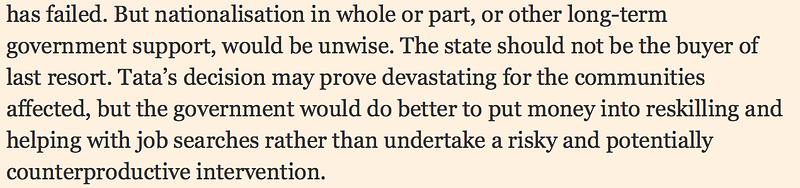
Financial Times this morning, in its editorial, raised not giving a [Poor language removed] to an art form. Don’t nationalise, it argued: don’t argue to lift state aid rules, don’t impose restrictions on Chinese steel. Because all of these things distort the global market, and the global market is the logic that brings prosperity.
The FT’s editorial: not giving a [Poor language removed] raised to a literary art form
Tata’s shock decision to sell its UK plants was also a defeat for the approach championed by the Community Union — the former iron and steel union — and local MP Stephen Kinnock. Backed by some workers at the Port Talbot plant, they told Jeremy Corbyn to soft-peddle on demands for nationalisation in order to appease Tata, or a mythical alternative buyer. They drew up a detailed turnaround plan that could have been enacted if either Tata or the Conservative government gave a [Poor language removed].
But they do not give a [Poor language removed].
Therefore the only answer is temporary nationalisation, the suspension of state aid rules, the long-term imposition of punitive tariffs on China, and the taxpayer injecting millions a year into the industry until it turns around. The British government could, and should, simply take Stephen Kinnock’s plan, appoint a crisis team in Whitehall to make it happen, buy the entire business from Tata for £1 and get to work.
Once it’s turned around, instead of handing the asset like a tray of After Eight mints to the next foreign-owned conglomerate in the queue, the British steel industry should become a mutually owned business, with permanent state support reflecting its strategic importance to national security. And if that’s not viable its strategic assets — the blast furnaces — should be permanently state owned and run at a loss in times of stress.
And here’s the wierdest thing. The Conservative cabinet is full of human beings who actually, on an individual level, do give a [Poor language removed]. Few are unbending economic robots. Some have even wavered towards suggesting there could be a state intervention to save the industry.
But immediately they have the FT, a legion of business consultancies, self-appointed experts, civil servants and — the irony — all the confederations that are supposed to support British industry actually urging them not to waver.
It’s an easy point to make: if you can bail out RBS and HBOS and Bradford and Bingley and Northern Rock — at the cost of billions — you can bail out the steel industry. But that’s forgetting the Conservatives were not in power when that had to be done. Whatever criticism you can make of the half-assed way Labour nationalised the banks, at least they did it. Looking at the self-created shambles Cameron is trying to handle now, I begin to doubt whether this cabinet would have even saved the banks in 2008 had it been in power.
I hope today Cameron can find some face-saving way of explaining to himself why the neoliberal logic of the FT is bullshit, and that Britain needs a steel industry, and that Wales should not become a post-industrial province.
If he does not, and we see the rapid closure of a strategic industry, then at all the country suppers in the mansions of Oxfordshire, at the rugby clubs, and in the hedge fund bordellos around London’s Shepherd Market, there’ll be so much sympathy for the steel workers it will overpower the cologne. “There, there, let’s re-skill them”, they will say; “and let’s exempt them, for a while, from coercive bullying at the job centres”. It is just cant.
The skill levels of this industry are so high; the ratio of capital to labour so high; that nine times out of ten “re-skilling” means simply de-skilling.
There is one other institution apart from the Cabinet that could save steel: the European Commission. It could, pro-actively, propose a state aid plan, and a rescue fund for the entire European steel industry, to help it compete with China. It could impose tariffs and suspend state aid rules.
But the Commission will not act for the same reason the British government will not act.
Repeat after me. They do not give a [Poor language removed].