
Current Affairs EU In or Out

In or Out

  • In

    Votes: 688 67.9%
  • Out

    Votes: 325 32.1%

  • Total voters
    1,013
Status
Not open for further replies.
there you go joey66, even the archers radio 4 running a story last few weeks saying the pickers have gone home and none of the locals want the job even those without a job so it must be true?
interesting link in there as well about robots doing the job, a UK university have harvested the first seed to crop harvest entirely by automation this year.
here is the link you cant open


Over half of recruitment companies could not find the labour even in the "quiet" first months of this year.

The figure has been released by the Association of Labour Providers.

A survey by the National Farmers Union shows that last year there was a 12.5% shortfall of seasonal workers required to work on horticulture farms.

This led to some valuable produce being left to rot in the fields.

The strawberry-picking robots doing a job humans won't

_101731292_closeupstrawberry.jpg

Image captionThe horticulture sector needs 80,000 seasonal workers a year
A total of 99% of seasonal workers on British farms come from Eastern Europe. Two-thirds of these come from Romania and Bulgaria.

Kent-based AG Recruitment and Management works in Romania to supply labour for 80 growers across the UK.

Over the next few months it needs to find 4,000 people to pick strawberries, raspberries, and eventually apples and pears. The agency is nowhere near that target, and is having to call farmers to say it will not have enough pickers for them.

According to co-director, Estera Amesz, the numbers of people wanting to work in Britain fell sharply after Brexit. A key issue was the fall in the value of the pound. She says it is also down to the uncertainty; people aren't sure what documents they now need.

"We used to have queues outside our office in Bucharest. Thirty to 40 people would come a day. Now, on a good day, it's a handful. We used to take the crème de la crème. Now, we are scraping the barrel."

The firm runs criminal history checks and the candidates do dexterity tests, but Mrs Amesz says her company has had to widen the net. She says she now considers those that, "have two hands and two legs, and stand a 50% chance of making it".

Rather than people coming to the company offices, they now have to travel deep into the Romanian countryside to sell the idea of coming to work in the UK.
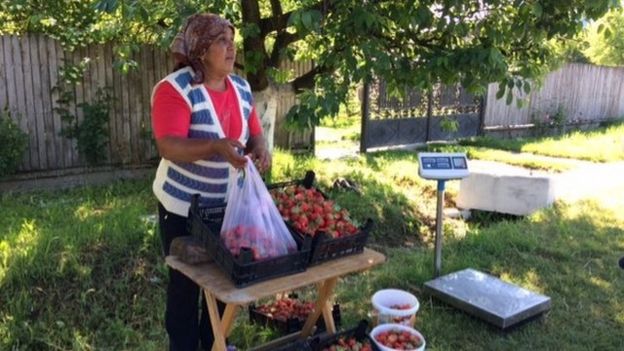
_101730228_strawberryseller.jpg

Image captionGeorgetta Sandulescu grows her own strawberries and sells them by the roadside
At one presentation in the city of Barlad, close to the border with Moldova, 30 people turn up, but only five sign up.

Alina Stan, 31, decides to make the journey. She has come to the UK before to pick flowers and fruit. With the money, she's building a house for her and her family. But as soon as she can, she'll stop coming. She says: "We hope in the next two years to be able to finish our home. But leaving my children behind is very difficult."
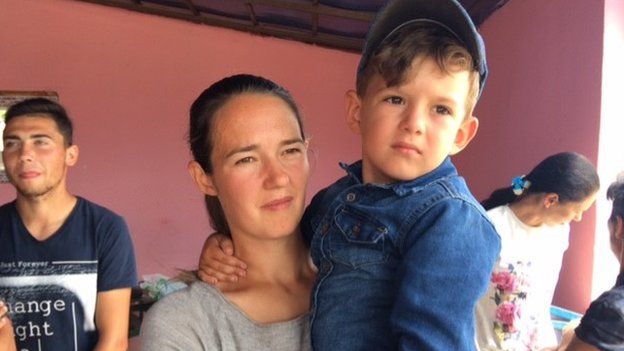
_101730230_alinaseasonalworker.jpg

Image captionAlina will journey almost 3,000km to work picking fruit at a farm in Birmingham
According to Doug Amesz, Estera Amesz' husband and business partner: "We need an incentive. Previously we were looking for people with some English, now we find it difficult to recruit anyone with English."

Romania is one of the poorest countries in Europe. It is one of the largest recipients of EU money.

However, almost 30 years after the Romanian Revolution of 1989 and the fall of the communist leader Nicolae Ceausescu, its economy is growing at 6.9%. That's a much faster rate compared to Britain's.

It's creating a newly wealthy middle class.
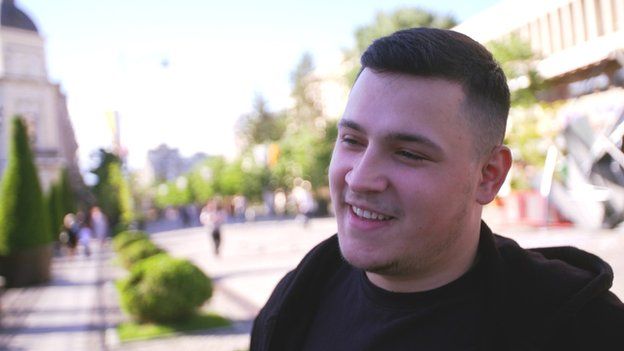
_101731294_puiujonut.jpg

Image captionGeography student Puiu Jonut, says English people can pick their own fruit
In Iasi, Romania's second city, young people say they have no intention of picking fruit.

Puiu Jonut, 23, studies geography.

"The English pick and choose what they want to do and leave the harder jobs for the foreigners," he told BBC News.

"There are a lot of English people that could work the fields and not let the fruit rot. That's why Brexit to me was really strange because the foreigners are coming to do the hard jobs and the low-paid jobs - surely you want them to stay."

Growers in Romania are also finding it tough to find pickers.

The director of the Research and Development Centre for Fruit Growing in Iasi, Gelu Corneanu, said: "It's really difficult to find workers to harvest our crops, mainly because they are attracted to other European countries.

"People tend to go and harvest garlic in Spain, then they harvest cherries in Romania and then they harvest strawberries in Greece."
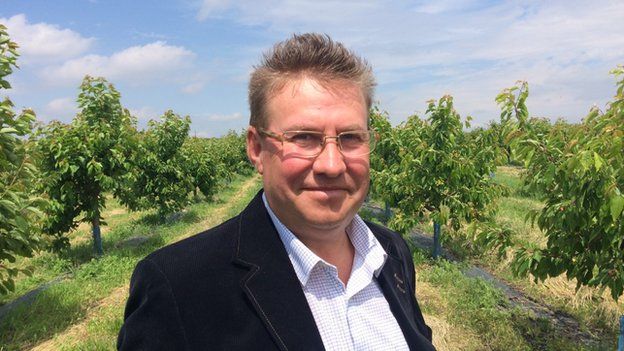
_101732115_gelucorneau.jpg

Image captionGelu Corneau says he struggles to find enough workers to pick his cherries
British farmers warned last year of the difficulties they were facing with recruitment, and according to the ALP report, three-quarters of agriculture and horticulture businesses anticipate shortages in low and unskilled roles in 2018.

Of these, over a quarter envisage a labour supply crisis. Some farmers have increased wages, bonuses, improved accommodation and other benefits to try to attract more foreign workers to come.

The government has pledged to address the issue of whether or not to introduce a scheme to give seasonal workers from further afield special permits to work in the UK, similar to the Seasonal Agricultural Workers Scheme (SAWS) that was closed in 2013. So far, no alternative has been proposed.
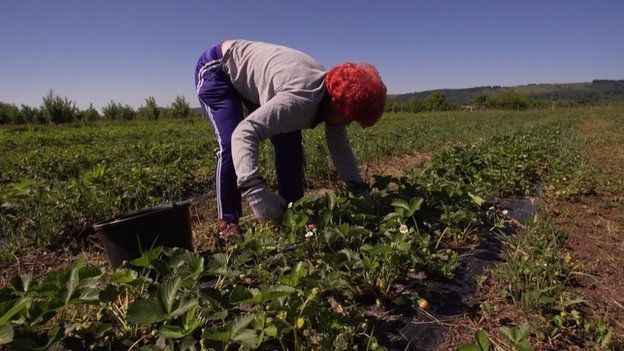
_101732113_strawberrypickers.jpg

Image caption90% of British farmers expect it to be harder to find seasonal labour this year
In a statement, the Department for Environment, Food and Rural Affairs, said: "Defra and the Home Office are working closely to ensure the labour needs of the agriculture sector are met once we leave the EU.

"We have been clear that up until December 2020, employers in the agricultural and food processing sectors will be free to recruit EU citizens to fill vacancies and those arriving to work will be able to stay in the UK afterwards."

You do know that that ^^^^ will be blamed on Remainers, or dismissed as Project Fear dont you?
 
You do know that that ^^^^ will be blamed on Remainers, or dismissed as Project Fear dont you?
It is project fear the cold March will have made crops slow then this heat in May and June will have surged growth so the fruit will need picking quickly hence fruit going to waste !
Growers don't need a glut in the market as lower prices!
Also Bamboo will romp away if not sprayed with Glysophatelol
 
We aren’t going to agree on it. I think Brexit is a disaster. You don’t. At least we can agree that Everton will probably win the league next year.
How do you know it's a disaster not happpend as yet - oh I forgot the economy was going to fall of the cliff as soon as we voted OUT-
By the way the myth that people who voted Out where not informed that we would leave the single market, and the customs union the remain campaign spelt that- put that about more than was on the sides of a bus!.........
Insult to Out voters......
Oh and the £8 million remain pamphlet stated that as a warning if you dared to vote out as you be outside the EU you would lose those two major things Remoaners at the top peddling this propaganda are big business in it for themselves not their workforce hence Jezza is anti EU!
 
How do you know it's a disaster not happpend as yet

How do you know its going to be great? Its not happened yet, and even the most staunch Leaver must concede that with the divvies we have sorting this out, aint going great, is it?

Still, make our own rules, save a ton of cash.
 
Syriza were elected on the promise that they would sock it to the man, just as leave campaigners said they would do. Reality has bitten them just as it is the Brexiters. I'm not sure in what galaxy looting and cronyism can be regarded as liberal btw. In fact, since 1995 to 2015 the president has come from the Greek Socialist Party. They were then replaced by the radical left. In the lower house the parliament has switched from the socialists to new democracy in pretty much every election for the last 30 years.

haha the word "socialist" in PASOK in not the smoking gun you seem to presume it to be. They were market-oriented pro-EU centrist liberals, about as "socialist" as Tony Blair was trade unionist. ... and yet looting the state and cronyism continued all the same.

"stick it to the man" - what's that, the Principal Skinner take on world affairs? people voted for Syriza because they were incensed at the corrupt governing parties who had plundered the country, bringing about the crisis in the first place; because they wanted leadership that wouldn't sacrifice Greek to save the German banks from market forces (which is more or less what Syriza actually did); and because the only plausible alternative on the right was the Nazis.

I'm not sure there's a way to put this without coming across as patronising, but you should work a bit harder to make sure you understand the situation before allowing your instincts to lead to you such strong convictions. It's always immediately clear on here when you're reacting solely from the heart.

I don't mean to hijack the conversation, but it's also impossible to understand why so many people are legitimately upset in countries that really do pose a threat the future of the EU, like Italy, if we refuse to accept that they were legitimately upset for similar reasons in Greece - tempting as it is to keep reassuring ourselves that we're the only responsible, enlightened parties in the room, and those who disagree with us are just a childish, emotional rabble
 
I don't mean to hijack the conversation, but it's also impossible to understand why so many people are legitimately upset in countries that really do pose a threat the future of the EU, like Italy, if we refuse to accept that they were legitimately upset for similar reasons in Greece - tempting as it is to keep reassuring ourselves that we're the only responsible, enlightened parties in the room, and those who disagree with us are just a childish, emotional rabble

not sure what your question/point is.
Why are we upset with the people who are upset with the EU. If we don't think its the same reason the Greeks were upset with the EU, then we must be right and everyone else is wrong and stupid?
 
not sure what your question/point is.
Why are we upset with the people who are upset with the EU. If we don't think its the same reason the Greeks were upset with the EU, then we must be right and everyone else is wrong and stupid?

sorry, that was maybe a bit inelegant. my point is that there are very legitimate reasons why people in places like Greece and Italy are upset with the EU, and if we ignore these, and instead just reassure ourselves that it is because they are wrong and stupid, then we are not likely to solve the problem, or improve never mind salvage the EU.

much as I think leaving the EU will be (and has been) a disaster for Britain, we also not going to get very far if we don't try a bit harder to understand the outcome than "they are all wrong and stupid".
 
sorry, that was maybe a bit inelegant. my point is that there are very legitimate reasons why people in places like Greece and Italy are upset with the EU, and if we ignore these, and instead just reassure ourselves that it is because they are wrong and stupid, then we are not likely to solve the problem, or improve never mind salvage the EU.

much as I think leaving the EU will be (and has been) a disaster for Britain, we also not going to get very far if we don't try a bit harder to understand the outcome than "they are all wrong and stupid".
ah, right, couldn't agree more.
I actually think that the point that Brexiters have made that they joined a trading block and now find themselves members of a political block is fair enough. I can also see why places like the south of Italy and Greece on the front line of an immigration wave, may feel let down by other member states. I can see why there are fears of tax harmonization and an EU army. These are all valid concerns.
I think the problem seems to be that a lot of people who voted remain did so with their heads and a lot of those who voted leave did so with their hearts.
Unfortunately, it seems to be easier to persuade people to let their hearts rule their heads rather than the other way around. And that's why there is a mandate to leave but no plan for how to leave.
 
ah, right, couldn't agree more.
I actually think that the point that Brexiters have made that they joined a trading block and now find themselves members of a political block is fair enough. I can also see why places like the south of Italy and Greece on the front line of an immigration wave, may feel let down by other member states. I can see why there are fears of tax harmonization and an EU army. These are all valid concerns.
I think the problem seems to be that a lot of people who voted remain did so with their heads and a lot of those who voted leave did so with their hearts.
Unfortunately, it seems to be easier to persuade people to let their hearts rule their heads rather than the other way around. And that's why there is a mandate to leave but no plan for how to leave.

Again, you see, you miss the point. Many people who voted Remain just don’t like change and are frightened of standing on their own two feet, hence the younger people voted Remain. Many people who voted to leave actually have experience of trading with the rest of the world and are not afraid of doing their own thing, hence the older people voted leave. I would suggest that your head and hearts argument is the exact reverse of reality.......
 
Again, you see, you miss the point. Many people who voted Remain just don’t like change and are frightened of standing on their own two feet, hence the younger people voted Remain. Many people who voted to leave actually have experience of trading with the rest of the world and are not afraid of doing their own thing, hence the older people voted leave. I would suggest that your head and hearts argument is the exact reverse of reality.......
Nobody is voting with their heart to stay in the EU. Nobody loves the EU. Being in the EU makes practical sense.
Longing for the days of yore is thinking with your heart. It was two generations ago Pete, times have changed.
Your post makes my point.
 
Unfortunately, it seems to be easier to persuade people to let their hearts rule their heads rather than the other way around. And that's why there is a mandate to leave but no plan for how to leave.

there was a very good article on this recently by Dani Rodrik, the economist

it's a bit long, but well worth reading in full (this is just an excerpt)

The divided public heart

https://aeon.co/essays/how-do-elites-manage-to-hijack-voters-ideas-of-themselves

"Ideas and interests both matter for political change, and the two feed into one another. On the one hand, economic interests drive the kind of ideas that politicians put forward. As Kenneth Shepsle, professor of government at Harvard University, put it in 1985, ideas can be regarded as ‘hooks on which politicians hang their objectives and further their interests’. However, ideas also shape interests. This happens because they alter voter preferences and/or shift their worldviews ex-post, in both cases shifting rankings over policy.

Ideas not only constrain interests, they can also hurt the very interests that helped to shape them. For example, financial interests’ propagation of the virtues of austerity and budget balance might have had the unintended consequence of helping to trigger Brexit – the institutional change with possibly the biggest blow against London’s financial interests in more than half a century – and the rise of populists in the rest of Europe. The promotion of trade agreements as highly beneficial to the entire US contributed to the election of the anti-trade Trump. In both cases, misleading cleavages or memes generated by previous power-holders lent themselves to a backlash.

Despite the 2008 financial crisis and the recession, financial interests in London continued to back fiscal austerity. Indeed, these interests played a key role in the dissemination of the ‘budget balance’ meme and the gospel of fiscal austerity. The ‘budget balance’ meme acquired such influence, establishing itself as a kind of orthodoxy, that even Labour-leaning policymakers found it difficult to resist. However, the actual implementation of fiscal austerity by the government (especially in the post-financial crisis world) arguably set the stage for Brexit, which is likely to seriously damage London’s financial sector. Recent work by the economist Sascha Becker at the University of Warwick in the UK and co-authors suggests that those voters who suffered most from fiscal austerity likely tipped the balance in favour of Brexit. The fiscal-austerity meme had limited the government’s ability to manipulate (on the policy front) in the face of a recession, which combined with the fact that a populace suffering from the financial crisis was vulnerable to memes about national identity and ‘taking back control’ with the Brexit vote.

Similarly in the US, the Republican Party (and the wealthy business interests that back it) have found it politically useful to disseminate memes and narratives that made identity central (eg, the ‘Willie Horton/weekend passes for felons’ anti-Democrat ad campaign of 1988, or the ‘welfare queen’ meme used by Ronald Reagan since the 1970s). The stoking of racism was one way to maintain support of the white middle and lower-middle classes who would have likely been economically better off under Democratic administrations. But the salience of racial identity made the Party eventually vulnerable to a takeover by Trump, with very different ideas on trade and immigration than the Republican establishment. If carried out, Trump’s nativist policies would harm the business interests that have traditionally backed the Party.

In more than one way, ideational politics carries a risk of unintended consequences. Money and organisational resources help, but they do not mean that vested interests can craft policy narratives and appeal to identity in ways that produce guaranteed outcomes. As we are consistently reminded, political outsiders sometimes introduce memes that draw on and mobilise popular attitudes and upset moneyed interests. Though the term is used more often in reference to minorities, identity politics also shapes perceptions of self-interest and desired policy outcomes of the economic and political elite.

Reagan’s tax reform provides an illustration. Business elites originally opposed the personal income cuts that he advocated. They worried about the adverse fiscal implications. Over time, theories of supply-side economics moved them to place greater weight on the incentive and supply effects, and many turned into enthusiastic advocates of across-the-board tax cuts. In South Korea and Taiwan through the late 1950s, political leaders viewed their objectives largely in military and geopolitical terms. This dictated inward-looking economic policies. Once they redefined their strategy as building strength through exports, economic goals began to loom much larger and their policies changed dramatically. Any explanation that relies on the importance of vested interests raises the question of where powerful groups get their ideas about their interests, and if they have soundly assessed what those interests are in fact.

* * *

For those who view politics in terms of a narrow and static notion of interests, the electoral support for Trump, Brexit and other populist movements seems to pose a puzzle. It seems as if many poor people are voting against their self-interest. But the puzzle is more apparent than real. It is rooted in a habit of thinking of interests only in economic terms, and also as fixed. Trump’s former chief strategist Steve Bannon understood well that interests are malleable. With the right message and framing, Bannon noted in 2013, you could change the political calculus by shaping popular perception of self-interest: ‘Trade is No 100 on the [Republican] Party’s list. You can make it No 1. Immigration is No 10. We can make it No 2.’

What appears to be culture might be economics – the consequence of identity or worldview memes marketed by economic elites for their own self-interest. For example, Reagan used the imagery of a ‘welfare queen’ to attack unemployment benefits and the welfare state. So identity politics was being deployed by him to ensure that voters supported the Republican low-tax economic agenda. Similarly, what might look like economics might be shaped by cultural predispositions that provide voters with their interpretive frameworks – such as Merkel’s celebration of the ‘Swabian housewife’ when making the case for austerity.

Defeating autocratic and nativist political movements will likely require strategies based on both ideas and interests. As we have seen in recent elections, proposing policies that are better suited to the economic needs of middle- and lower-income voters will likely not be enough. Successful challengers will also need to come up with narratives that help to reshape peoples’ worldviews and identities."
 
Status
Not open for further replies.

Welcome

Join the Everton conversation today.
Fewer ads, full access, completely free.

🛒 Visit Shop

Support Grand Old Team by checking out our latest Everton gear!
Back
Top