Current Affairs Donald Trump POS: Judgement cometh and that right soon

Status
Not open for further replies.
Except that isn't really the reality :)

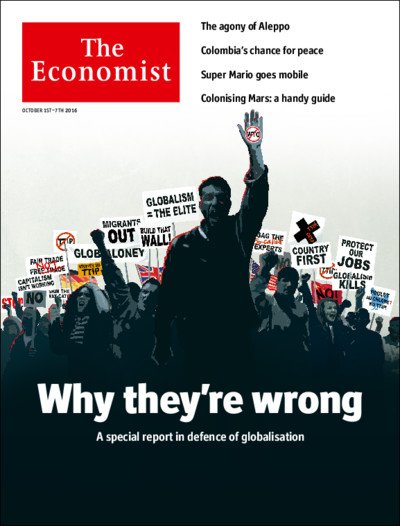
http://www.economist.com/news/books...ways-both-recently-according-swedish-economic

"HUMANS are a gloomy species. Some 71% of Britons think the world is getting worse; only 5% think it is improving. Asked whether global poverty had fallen by half, doubled or remained the same in the past 20 years, only 5% of Americans answered correctly that it had fallen by half. This is not simple ignorance, observes Johan Norberg, a Swedish economic historian and the author of a new book called “Progress”. By guessing randomly, a chimpanzee would pick the right answer (out of three choices) far more often.


People are predisposed to think that things are worse than they are, and they overestimate the likelihood of calamity. This is because they rely not on data, but on how easy it is to recall an example. And bad things are more memorable. The media amplify this distortion. Famines, earthquakes and beheadings all make gripping headlines; “40m Planes Landed Safely Last Year” does not.

Pessimism has political consequences. Voters who think things were better in the past are more likely to demand that governments turn back the clock. A whopping 81% of Donald Trump’s supporters think life has grown worse in the past 50 years. Among Britons who voted to leave the European Union, 61% believe that most children will be worse off than their parents. Those who voted against Brexit tend to believe the opposite.

Mr Norberg unleashes a tornado of evidence that life is, in fact, getting better. He describes how his great-great-great-great grandfather survived the Swedish famines of 150 years ago. Sweden in those days was poorer than Sub-Saharan Africa is today. “Why are some people poor?” is the wrong question, argues Mr Norberg. Poverty is the starting point for all societies. What is astonishing is how fast it has receded. In 1820, 94% of humanity subsisted on less than $2 a day in modern money. That fell to 37% in 1990 and less than 10% in 2015.

Not only have people grown much more prosperous; they also enjoy better health than even rich folk did in the past. This is due partly to galloping progress in medical science. When the swine flu pandemic threatened to become catastrophic in 2009, scientists sequenced the genome of the virus within a day and were producing a vaccine in less than six months.

The spread of basic technology, allowing for clean water and indoor plumbing, may have helped even more. Louis XIV’s palace was the pinnacle of 18th-century grandeur. Nonetheless, without flush toilets, it stank. “The passageways, corridors and courtyards are filled with urine and faecal matter,” wrote a contemporary observer. Now 68% of the world’s population have modern sanitation—a luxury denied to the Sun King—up from 24% in 1980.

People are growing smarter too. Americans scored, on average, 100 points on IQ tests just after the second world war. By 2002, using the same test, this had risen to 118, with the biggest improvements in answers to the most abstract problems. This “Flynn Effect”, as it is known, is observed in all countries that have modernised. The most likely reasons are better nutrition and the spread of education—brains that are well-fed and well-stimulated tend to work better—and environmental improvements such as the removal of lead from petrol.

Mr Norberg agrees with Steven Pinker, a psychologist, that humankind is also experiencing a “moral Flynn Effect”. As people grow more adept at abstract thought, they find it easier to imagine themselves in other people’s shoes. And there is plenty of evidence that society has grown more tolerant. As recently as 1964, even the American Civil Liberties Union agreed that homosexuals should be barred from government jobs. In 1987 only 48% of Americans approved of interracial dating; in 2012 that figure was 86% (and 95% of 18- to 29-year-olds). The caste system in India has eroded as individualistic values have spread: the proportion of upper-caste weddings with segregated seating fell from 75% to 13% between 1990 and 2008.

Despite the bloody headlines, the world is far safer than it used to be. The homicide rate in hunter-gatherer societies was about 500 times what it is in Europe today. Globally, wars are smaller and less frequent than they were a generation ago. The only type of violence that is growing more common is terrorism, and people wildly overestimate how much of it there is. The average European is ten times more likely to die by falling down stairs than to be killed by a terrorist. Evidence that the past was more brutal than the present can be gleaned not only from data but also from cultural clues. For example, children’s nursery rhymes are 11 times more violent than television programmes aired before 9pm in Britain, one study found.

That life is improving for most people does not mean it is improving for everyone. Male blue-collar workers in rich countries have seen their earnings stagnate. Even if the statistics fail properly to capture the benefits they enjoy as consumers of new technology, the slippage in their status is real and painfully felt.

Global warming is a worry, too, but Mr Norberg hopes that human ingenuity will tame it. He writes with enthusiasm about all kinds of green innovation. For example, thanks to more efficient farming technology, the world may have reached “peak farmland”. By the end of the century, an area twice the size of France will have been returned to nature, by one estimate.

This book is a blast of good sense. The main reason why things tend to get better is that knowledge is cumulative and easily shared. As Mr Norberg puts it, “The most important resource is the human brain...which is pleasantly reproducible.”"

This is interesting to read, in light of your post:
https://www.theguardian.com/money/b...-pay-people-earned-less-but-could-afford-more

"By chance it was the same week my 90-year-old father decided to show me his carefully filed tax returns from the 1960s (yes, that’s what counts for fun in the Collinson household). In 1963-64 his pay as an accounts clerk in London was £1,357 a year. In today’s money that equals a little over £25,000 a year once inflation is taken into account.

In some ways that £25,000 doesn’t look so great. After all, someone working in a similar role with his level of experience at the time might expect £35,000-£40,000 today. But then look at what an income of £25,000 bought in 1963 in London.

He had already been able to buy a new-build three-bed semi on the edge of the city, in Rise Park, Romford, and was paying the mortgage. His wife was at home looking after the expanding family of five. He also had a car – a Ford Popular – and a Philips television. Everything was paid for from his earned income, with almost nothing from inheritances. But holidays were infrequent, mostly to relatives and friends, and never abroad.

Economic growth since the 1960s has been real, but the link between growth and personal prosperity has broken down

His granddaughter now works in the same city, London, for the same pay, £25,000. But what does an income of £25,000 buy you in 2016? The chances of owning a house are unimaginable. Her income affords a room in an ex-council flatshare in a mouldy bit of south London. She has just given up her car as she can no longer justify the cost. She manages to keep ahead of the bills every month, but only just.

Houses in Rise Park, Romford, now sell for £400,000 to £450,000, or nearly 200 times the £2,400 my father paid when his home was built in 1956. Back then he had to pay a 10% deposit, or £240, equal to a fifth of his annual wage. His granddaughter would today have to find £40,000 to £50,000, or twice her annual gross pay. Yet another unimaginable prospect.

Now let’s take the mortgage. Halifax says that for a £400,000 loan the minimum salary is £84,000 a year. In other words, a young Londoner today would have to triple their pay to enjoy the same lifestyle as someone 53 years ago.

Tax is crucial. My father’s 1963-64 tax return shows income tax paid of just £28 and 14 shillings (£28.70). In other words, his effective tax rate was just 2.1%. This was largely because in the early 1960s the tax allowances given to parents with children were, relatively speaking, huge. Today his granddaughter suffers far more from “stoppages” than someone in the 1960s. Her take-home pay is around £1,600 a month after income tax and national insurance, not helped by the £53 a month deduction to cover her student loan. Her effective tax rate is around 23%.

That said, she’s just back from a weekend with friends in Budapest – but cheap Ryanair getaways are hardly a substitute for housing. Nor is the fact she has an iPhone, when my father in 1963 would walk to the end of the street to use a telephone box.

Economic growth since the 1960s has been real, but the link between growth and personal prosperity has broken down, probably since the 1990s. We can carry on pushing for increases in GDP, but it’s meaningless unless it translates into a recovery in living standards. If any government really wants to help the left-behinds, then cutting house prices and rents must be their first priority."
 
Ok. Then you have to understand that talking about Hillarys popular vote win is something like Hammers bragging of being world cup winners.

I still maintain that a result which was influenced by Russian hackers, combined with the cold reality that Trump got millions fewer votes than Clinton, goes some way to undermining his credibility and I certainly don't accept your "landslide" rhetoric.
 
I still maintain that a result which was influenced by Russian hackers, combined with the cold reality that Trump got millions fewer votes than Clinton, goes some way to undermining his credibility and I certainly don't accept your "landslide" rhetoric.
Thats your right, yes.

I admit in the light of earlier presidental wins Trump win doesnt necessarily look like landslide but from the perspective of under dog it can be seen as one.

Talking about rhetorics.....Russians....o my word x

When all the cards have been used...there was one extra card left....
...ladies and gentlemen may I present to you ....
THE RUSSIAN CARD
 
This is interesting to read, in light of your post:
https://www.theguardian.com/money/b...-pay-people-earned-less-but-could-afford-more

"By chance it was the same week my 90-year-old father decided to show me his carefully filed tax returns from the 1960s (yes, that’s what counts for fun in the Collinson household). In 1963-64 his pay as an accounts clerk in London was £1,357 a year. In today’s money that equals a little over £25,000 a year once inflation is taken into account.

In some ways that £25,000 doesn’t look so great. After all, someone working in a similar role with his level of experience at the time might expect £35,000-£40,000 today. But then look at what an income of £25,000 bought in 1963 in London.

He had already been able to buy a new-build three-bed semi on the edge of the city, in Rise Park, Romford, and was paying the mortgage. His wife was at home looking after the expanding family of five. He also had a car – a Ford Popular – and a Philips television. Everything was paid for from his earned income, with almost nothing from inheritances. But holidays were infrequent, mostly to relatives and friends, and never abroad.

Economic growth since the 1960s has been real, but the link between growth and personal prosperity has broken down

His granddaughter now works in the same city, London, for the same pay, £25,000. But what does an income of £25,000 buy you in 2016? The chances of owning a house are unimaginable. Her income affords a room in an ex-council flatshare in a mouldy bit of south London. She has just given up her car as she can no longer justify the cost. She manages to keep ahead of the bills every month, but only just.

Houses in Rise Park, Romford, now sell for £400,000 to £450,000, or nearly 200 times the £2,400 my father paid when his home was built in 1956. Back then he had to pay a 10% deposit, or £240, equal to a fifth of his annual wage. His granddaughter would today have to find £40,000 to £50,000, or twice her annual gross pay. Yet another unimaginable prospect.

Now let’s take the mortgage. Halifax says that for a £400,000 loan the minimum salary is £84,000 a year. In other words, a young Londoner today would have to triple their pay to enjoy the same lifestyle as someone 53 years ago.

Tax is crucial. My father’s 1963-64 tax return shows income tax paid of just £28 and 14 shillings (£28.70). In other words, his effective tax rate was just 2.1%. This was largely because in the early 1960s the tax allowances given to parents with children were, relatively speaking, huge. Today his granddaughter suffers far more from “stoppages” than someone in the 1960s. Her take-home pay is around £1,600 a month after income tax and national insurance, not helped by the £53 a month deduction to cover her student loan. Her effective tax rate is around 23%.

That said, she’s just back from a weekend with friends in Budapest – but cheap Ryanair getaways are hardly a substitute for housing. Nor is the fact she has an iPhone, when my father in 1963 would walk to the end of the street to use a telephone box.

Economic growth since the 1960s has been real, but the link between growth and personal prosperity has broken down, probably since the 1990s. We can carry on pushing for increases in GDP, but it’s meaningless unless it translates into a recovery in living standards. If any government really wants to help the left-behinds, then cutting house prices and rents must be their first priority."

Indeed - the elephant in the room is property, which has not changed in cost (for the better) in anyway, and things like health and education, which both suffer from Baumol's disease.
 
Except that isn't really the reality :)

http://www.economist.com/news/books...ways-both-recently-according-swedish-economic

"HUMANS are a gloomy species. Some 71% of Britons think the world is getting worse; only 5% think it is improving. Asked whether global poverty had fallen by half, doubled or remained the same in the past 20 years, only 5% of Americans answered correctly that it had fallen by half. This is not simple ignorance, observes Johan Norberg, a Swedish economic historian and the author of a new book called “Progress”. By guessing randomly, a chimpanzee would pick the right answer (out of three choices) far more often.


People are predisposed to think that things are worse than they are, and they overestimate the likelihood of calamity. This is because they rely not on data, but on how easy it is to recall an example. And bad things are more memorable. The media amplify this distortion. Famines, earthquakes and beheadings all make gripping headlines; “40m Planes Landed Safely Last Year” does not.

Pessimism has political consequences. Voters who think things were better in the past are more likely to demand that governments turn back the clock. A whopping 81% of Donald Trump’s supporters think life has grown worse in the past 50 years. Among Britons who voted to leave the European Union, 61% believe that most children will be worse off than their parents. Those who voted against Brexit tend to believe the opposite.

Mr Norberg unleashes a tornado of evidence that life is, in fact, getting better. He describes how his great-great-great-great grandfather survived the Swedish famines of 150 years ago. Sweden in those days was poorer than Sub-Saharan Africa is today. “Why are some people poor?” is the wrong question, argues Mr Norberg. Poverty is the starting point for all societies. What is astonishing is how fast it has receded. In 1820, 94% of humanity subsisted on less than $2 a day in modern money. That fell to 37% in 1990 and less than 10% in 2015.

Not only have people grown much more prosperous; they also enjoy better health than even rich folk did in the past. This is due partly to galloping progress in medical science. When the swine flu pandemic threatened to become catastrophic in 2009, scientists sequenced the genome of the virus within a day and were producing a vaccine in less than six months.

The spread of basic technology, allowing for clean water and indoor plumbing, may have helped even more. Louis XIV’s palace was the pinnacle of 18th-century grandeur. Nonetheless, without flush toilets, it stank. “The passageways, corridors and courtyards are filled with urine and faecal matter,” wrote a contemporary observer. Now 68% of the world’s population have modern sanitation—a luxury denied to the Sun King—up from 24% in 1980.

People are growing smarter too. Americans scored, on average, 100 points on IQ tests just after the second world war. By 2002, using the same test, this had risen to 118, with the biggest improvements in answers to the most abstract problems. This “Flynn Effect”, as it is known, is observed in all countries that have modernised. The most likely reasons are better nutrition and the spread of education—brains that are well-fed and well-stimulated tend to work better—and environmental improvements such as the removal of lead from petrol.

Mr Norberg agrees with Steven Pinker, a psychologist, that humankind is also experiencing a “moral Flynn Effect”. As people grow more adept at abstract thought, they find it easier to imagine themselves in other people’s shoes. And there is plenty of evidence that society has grown more tolerant. As recently as 1964, even the American Civil Liberties Union agreed that homosexuals should be barred from government jobs. In 1987 only 48% of Americans approved of interracial dating; in 2012 that figure was 86% (and 95% of 18- to 29-year-olds). The caste system in India has eroded as individualistic values have spread: the proportion of upper-caste weddings with segregated seating fell from 75% to 13% between 1990 and 2008.

Despite the bloody headlines, the world is far safer than it used to be. The homicide rate in hunter-gatherer societies was about 500 times what it is in Europe today. Globally, wars are smaller and less frequent than they were a generation ago. The only type of violence that is growing more common is terrorism, and people wildly overestimate how much of it there is. The average European is ten times more likely to die by falling down stairs than to be killed by a terrorist. Evidence that the past was more brutal than the present can be gleaned not only from data but also from cultural clues. For example, children’s nursery rhymes are 11 times more violent than television programmes aired before 9pm in Britain, one study found.

That life is improving for most people does not mean it is improving for everyone. Male blue-collar workers in rich countries have seen their earnings stagnate. Even if the statistics fail properly to capture the benefits they enjoy as consumers of new technology, the slippage in their status is real and painfully felt.

Global warming is a worry, too, but Mr Norberg hopes that human ingenuity will tame it. He writes with enthusiasm about all kinds of green innovation. For example, thanks to more efficient farming technology, the world may have reached “peak farmland”. By the end of the century, an area twice the size of France will have been returned to nature, by one estimate.

This book is a blast of good sense. The main reason why things tend to get better is that knowledge is cumulative and easily shared. As Mr Norberg puts it, “The most important resource is the human brain...which is pleasantly reproducible.”"

Real wages have been stagnant in the US since the 1970s, even as labour productivity has grown.
http://www.epi.org/publication/unde...-workers-pay-why-it-matters-and-why-its-real/

Almost half of Americans report being unable to handle an emergency $400 expense
https://www.washingtonpost.com/news...er-of-americans-who-cant-cover-a-400-expense/

Life expectancy is apparently declining in America
http://www.npr.org/sections/health-...-drops-for-first-time-in-decades-report-finds

Most people in Anglo-Saxon countries are working longer hours for less pay, their health and education standards are declining even as costs are skyrocketing, and their children can expect bleaker prospects still, even as stock prices and rents and corporate profits are hitting record highs. The Economist and Thomas Friedman-style liberals bear just as much of the blame for this as the Republican Party. The article you cite is true enough in some regards, but it completely misses the point of what people are so upset about. It's pure Panglossian naivety. If people who read the Economist want to earn political support for their trade agendas, they can start by listening to what voters are telling them, instead of dismissing them with crude caricatures:
Ct6WBTKWIAAs1IQ.jpg


Nobody cares what rate the national GDP grows by, or will be expected to grow by because of TTIP, when they're working more than 8 hours a day and are still in poverty.
 
Last edited by a moderator:
So you aren't even going to pretend that America is democratic? Somehow doubt you would be so glib if the system was rigged towards the dems.


I honestly don't think there would be any moaning about the result on the Republicans' part because a) they didn't even want Trump to win and b) never expected him too. This is liberal toy throwing and it's amazing to see the amount of straws being clutched by the same people who lambasted the Don for saying he mightn't have accepted the result
 
Also, the popular vote thing has to be put to bed. The US is a union of 50 states and the electoral system is the only way to stop the likes of New York and California patting their rust belt friends on the head every election
 
So you aren't even going to pretend that America is democratic? Somehow doubt you would be so glib if the system was rigged towards the dems.
Electoral College is actually unique and brilliant system. There is faults innit ofcourse. Someday it might even change but definitely not in near future. People who demand that system needs to be changed have to understand that the same system has elected democrats too. Way easier and cheaper way is to remember to campaign properly and maybe next time democrat candidate will win.
 
Status
Not open for further replies.

Welcome

Join the Everton conversation today.
Fewer ads, full access, completely free.

🛒 Visit Shop

Support Grand Old Team by checking out our latest Everton gear!
Back
Top