Current Affairs Coronavirus Thread - Serious stuff !!!

Status
Not open for further replies.
Also just to mention there is growing debate into how some countries have fared well to corona virus Vs others, one argument is that some countries especially those exposed to similar coronvirus may already have developed a T Cell response to Covid that may have protected them. Equally there is also discussion as to why some people are more impacted by Covid then others - again there is argument it could be T Cell related.

Again important not to draw any conclusions, but hadn't seen much on T Cells mentioned.
 
No daily updates on tv, now no updates at all.

It's because the death rate here from Covid19 is almost 100 per day...in the 'low risk' period. We're the sick man of Europe. A continuing cesspit.

They want to hide it away because the return to business they hoped for has cratered.

As far as i can see, they arent doing the daily tests either, surely vital data in working out the R0.
 
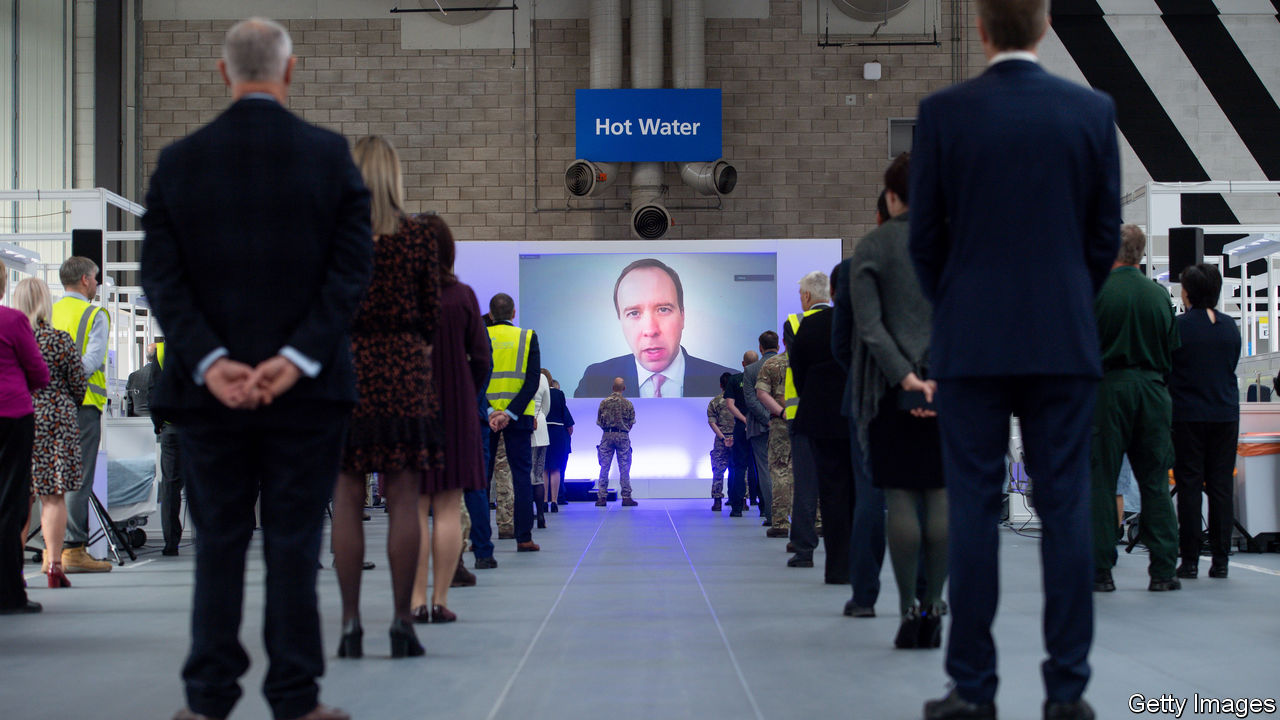
How centralisation impeded Britain’s covid-19 response

British politicians hoarded power, unlike their counterparts in Germany

20200718_BRP503.jpg


“I do not want to be sitting and talking about this in the aftermath of something that goes wrong,” Gabriel Scally, now president of the epidemiology and public health section of the Royal Society of Medicine, told a House of Commons committee in 2012. Working for the World Health Organisation at the time, he was worried that the big planned reform of the National Health Service (nhs) would impede the response to emergencies. “I have seen enough major incidents in my time to think that this is worrying.”

Dr Scally now finds himself in the position that he dreaded. He is one of the many public-health experts who believe that the failures in Britain’s response to the covid-19 pandemic have been the result not just of slow political decision-making, but also of the highly centralised nature of the British state.

Germany and South Korea, two of the countries that responded most successfully, both have public-health systems embedded in local government. In Germany, the federal government provided extra resources, but the response was run by 375 local authorities. In South Korea, the decision-making was mostly done by central government, but the implementation was local. In Britain, the response has been run and implemented from the centre.

Public health was a local matter in Britain for over a century. After a water pump in London’s Soho district was identified as the source of a cholera outbreak in 1854, councils began to build up the capacity to keep their communities clear of infectious diseases. But the centralised design of the NHS—“The sound of a dropped bedpan in Tredegar Hospital,” said its founder, Nye Bevan, “should reverberate in the Palace of Westminster”—shaped the way health provision developed.

In 1974, public health was detached from its local roots, as directors of public health (DPH) were taken out of local government and placed within the NHS. In 2013 a restructuring of the health service (see chart) under Andrew Lansley, the health secretary—the change that concerned Dr Scally—replaced a simple structure with a complex one. It split responsibility for public health between a national agency, Public Health England (PHE), which has responsibility for infectious diseases, and local authorities.

The reorganisation moved DPHs back into local authorities, but with fewer resources and less power. The timing—in the wake of the financial crisis—was bad, too. “We landed in local government just when it took a massive hit,” says a DPH in a London borough. According to the Health Foundation, a think-tank, the government grant to local authorities for public health fell by a fifth in real terms in the five years after 2014. A DPH in a county council says he has lost 30 of about 100 staff.

When covid-19 broke out, PHE was responsible for tracking the course of the epidemic, but had only 290 people nationally to do the job. By early March, it had been overwhelmed.

In Germany at that point, local authorities reallocated resources from functions that had been put on hold during lockdown—such as libraries or sexual health—and were given money by the federal government to hire medical students to help. Claudia Kaufhold of Germany’s Public Health Academy says that in the Charlottenburg-Wilmersdorf district of Berlin, where she used to be director of public health, the number of staff dedicated to track and trace rose from about 10 to roughly 130 at the beginning of March, for a population of 326,000. In Britain, the government instead created NHS Test and Trace, a national system directly answerable to Whitehall.

Andy Burnham, mayor of Greater Manchester, was arguing for a German-style response. “We would have had no problem scaling up,” he says. Local-area knowledge is essential to tracing infections, according to a director of public health. “Particularly with the vulnerability of ethnic minority people, it’s essential to know communities. You know where BME people are concentrated, you know community leaders.”

David Buck, of the King’s Fund, a think-tank, is sympathetic but points to the urgency and the scale required. “At that stage you probably needed a national response to ramp it up so quickly. But a lot of time had been wasted in not involving local government sooner.” He attributes that to policymakers’ centralising instinct. “The NHS is a command-and-control system. Local government is not a command-and-control system, so it feels distant to policymakers in Whitehall. When you have to do something quickly, you reach for the levers closest to you, and that you understand.”

Politicians have indeed struggled with the machinery of government. According to Bernard Jenkin, chair of the House of Commons Liaison Committee, there has been a constant refrain from Number 10 during the crisis that “the levers of power just came off”. That may be the result, in part, of the Lansley reforms: they replaced a clear chain of command with a fragmented system, which seems insufficiently joined-up. An email in mid-May from the office of the minister of state for care—who shares responsibility with local authorities for the care homes in which around half of British victims died—shows that her senior private secretary did not have an email distribution list for DPHs.

The instinct to centralise also frustrated the development of a contact-tracing app. At the beginning of the crisis, various apps on which people could log their symptoms were launched. Nearly a million people downloaded one created by Tim Spector of King’s College London and ZOE, a health startup, within 24 hours; it has now had 4m downloads. Soon after launch in March, the team asked for support from the government, NHS and charities, but was rejected on the grounds that the government was developing its own.

That effort, in the event, was also sunk by a desire to retain control. Faced with a choice between an app based on Google’s and Apple’s protocols under which data were decentralised, and one in which they were held by the NHS, the government went for the latter—and fell on its face, when the technology defeated the health service. The government is now going with the Google/Apple system, but has not said when the app will be ready.

To make matters worse, the development of testing capacity has also suffered from the urge to centralise. Christopher Stanley of MicrosensDx, a clinical-diagnostics company, had a covid-19 test ready in mid-March. He approached various parts of the government, to no avail. The testing regime was run by PHE, which was relying on its own capacity. Large-scale testing got off the ground only at the end of May, when the government started sourcing kits from companies like his.

Complaints about centralisation persist. Local authorities are struggling to get data from NHS Test and Trace. According to Leicester’s mayor, Sir Peter Soulsby, the city’s recent outbreak was exacerbated by poor-quality data and delays before they were provided. They are, he says, still too slow to arrive—the last batch came on July 4th—and they identify cases only at a postcode level, without addresses or workplaces, and with ethnicity for only a minority of cases.

Mr Burnham, in Manchester, concurs. “It’s like a local detective being asked to solve a crime without the names and addresses of witnesses or suspects,” he says. When he asked why more granular data were not provided, data-protection concerns were offered as the explanation. “It’s about as useful as a chocolate teapot,” says a DPH in southern England of the data—which is also a reasonable description of how parts of the machinery of government performed when the heat was on.■

 
How centralisation impeded Britain’s covid-19 response

British politicians hoarded power, unlike their counterparts in Germany

20200718_BRP503.jpg


“I do not want to be sitting and talking about this in the aftermath of something that goes wrong,” Gabriel Scally, now president of the epidemiology and public health section of the Royal Society of Medicine, told a House of Commons committee in 2012. Working for the World Health Organisation at the time, he was worried that the big planned reform of the National Health Service (nhs) would impede the response to emergencies. “I have seen enough major incidents in my time to think that this is worrying.”

Dr Scally now finds himself in the position that he dreaded. He is one of the many public-health experts who believe that the failures in Britain’s response to the covid-19 pandemic have been the result not just of slow political decision-making, but also of the highly centralised nature of the British state.

Germany and South Korea, two of the countries that responded most successfully, both have public-health systems embedded in local government. In Germany, the federal government provided extra resources, but the response was run by 375 local authorities. In South Korea, the decision-making was mostly done by central government, but the implementation was local. In Britain, the response has been run and implemented from the centre.

Public health was a local matter in Britain for over a century. After a water pump in London’s Soho district was identified as the source of a cholera outbreak in 1854, councils began to build up the capacity to keep their communities clear of infectious diseases. But the centralised design of the NHS—“The sound of a dropped bedpan in Tredegar Hospital,” said its founder, Nye Bevan, “should reverberate in the Palace of Westminster”—shaped the way health provision developed.

In 1974, public health was detached from its local roots, as directors of public health (DPH) were taken out of local government and placed within the NHS. In 2013 a restructuring of the health service (see chart) under Andrew Lansley, the health secretary—the change that concerned Dr Scally—replaced a simple structure with a complex one. It split responsibility for public health between a national agency, Public Health England (PHE), which has responsibility for infectious diseases, and local authorities.

The reorganisation moved DPHs back into local authorities, but with fewer resources and less power. The timing—in the wake of the financial crisis—was bad, too. “We landed in local government just when it took a massive hit,” says a DPH in a London borough. According to the Health Foundation, a think-tank, the government grant to local authorities for public health fell by a fifth in real terms in the five years after 2014. A DPH in a county council says he has lost 30 of about 100 staff.

When covid-19 broke out, PHE was responsible for tracking the course of the epidemic, but had only 290 people nationally to do the job. By early March, it had been overwhelmed.

In Germany at that point, local authorities reallocated resources from functions that had been put on hold during lockdown—such as libraries or sexual health—and were given money by the federal government to hire medical students to help. Claudia Kaufhold of Germany’s Public Health Academy says that in the Charlottenburg-Wilmersdorf district of Berlin, where she used to be director of public health, the number of staff dedicated to track and trace rose from about 10 to roughly 130 at the beginning of March, for a population of 326,000. In Britain, the government instead created NHS Test and Trace, a national system directly answerable to Whitehall.

Andy Burnham, mayor of Greater Manchester, was arguing for a German-style response. “We would have had no problem scaling up,” he says. Local-area knowledge is essential to tracing infections, according to a director of public health. “Particularly with the vulnerability of ethnic minority people, it’s essential to know communities. You know where BME people are concentrated, you know community leaders.”

David Buck, of the King’s Fund, a think-tank, is sympathetic but points to the urgency and the scale required. “At that stage you probably needed a national response to ramp it up so quickly. But a lot of time had been wasted in not involving local government sooner.” He attributes that to policymakers’ centralising instinct. “The NHS is a command-and-control system. Local government is not a command-and-control system, so it feels distant to policymakers in Whitehall. When you have to do something quickly, you reach for the levers closest to you, and that you understand.”

Politicians have indeed struggled with the machinery of government. According to Bernard Jenkin, chair of the House of Commons Liaison Committee, there has been a constant refrain from Number 10 during the crisis that “the levers of power just came off”. That may be the result, in part, of the Lansley reforms: they replaced a clear chain of command with a fragmented system, which seems insufficiently joined-up. An email in mid-May from the office of the minister of state for care—who shares responsibility with local authorities for the care homes in which around half of British victims died—shows that her senior private secretary did not have an email distribution list for DPHs.

The instinct to centralise also frustrated the development of a contact-tracing app. At the beginning of the crisis, various apps on which people could log their symptoms were launched. Nearly a million people downloaded one created by Tim Spector of King’s College London and ZOE, a health startup, within 24 hours; it has now had 4m downloads. Soon after launch in March, the team asked for support from the government, NHS and charities, but was rejected on the grounds that the government was developing its own.

That effort, in the event, was also sunk by a desire to retain control. Faced with a choice between an app based on Google’s and Apple’s protocols under which data were decentralised, and one in which they were held by the NHS, the government went for the latter—and fell on its face, when the technology defeated the health service. The government is now going with the Google/Apple system, but has not said when the app will be ready.

To make matters worse, the development of testing capacity has also suffered from the urge to centralise. Christopher Stanley of MicrosensDx, a clinical-diagnostics company, had a covid-19 test ready in mid-March. He approached various parts of the government, to no avail. The testing regime was run by PHE, which was relying on its own capacity. Large-scale testing got off the ground only at the end of May, when the government started sourcing kits from companies like his.

Complaints about centralisation persist. Local authorities are struggling to get data from NHS Test and Trace. According to Leicester’s mayor, Sir Peter Soulsby, the city’s recent outbreak was exacerbated by poor-quality data and delays before they were provided. They are, he says, still too slow to arrive—the last batch came on July 4th—and they identify cases only at a postcode level, without addresses or workplaces, and with ethnicity for only a minority of cases.

Mr Burnham, in Manchester, concurs. “It’s like a local detective being asked to solve a crime without the names and addresses of witnesses or suspects,” he says. When he asked why more granular data were not provided, data-protection concerns were offered as the explanation. “It’s about as useful as a chocolate teapot,” says a DPH in southern England of the data—which is also a reasonable description of how parts of the machinery of government performed when the heat was on.■
The utter shambles and danger to life that the "free market" represents.

All those who advocated allowing the profit principle to affect how our healthcare is administered should be shot.
 
Didn't we have a poll on here with similar results or am I getting confused with something else
This one? Even worse results tbh although a lot seemed in the “perhaps” category so could potentially be persuaded.

Seems to be quite close to YouGov UK polling
Now in disconcerting news, a new survey in the United Kingdom from the Center for Countering Digital Hate (CCDH) reveals that a significant amount of people in the United Kingdom, the European country with the highest number of infections, would either not have a coronavirus vaccine or were not sure if they would get one.

The YouGov conducted a poll from June 24 to 25, on behalf of the researchers at CCDH found that based on the poll of 1,663 people, a third of people would not likely get a coronavirus vaccine.

In the poll, the researchers asked the participants how inclined they would feel to get a vaccine once it gets available. About 6 percent of them said they would not get vaccinated, while 10 percent said they would “probably not.” An estimated 15 percent said they are not sure, which means that the total percentage of those who will not get the vaccine will be under a third of the total number of respondents.
 
This one? Even worse results tbh although a lot seemed in the “perhaps” category so could potentially be persuaded.

Seems to be quite close to YouGov UK polling
Now in disconcerting news, a new survey in the United Kingdom from the Center for Countering Digital Hate (CCDH) reveals that a significant amount of people in the United Kingdom, the European country with the highest number of infections, would either not have a coronavirus vaccine or were not sure if they would get one.

The YouGov conducted a poll from June 24 to 25, on behalf of the researchers at CCDH found that based on the poll of 1,663 people, a third of people would not likely get a coronavirus vaccine.

In the poll, the researchers asked the participants how inclined they would feel to get a vaccine once it gets available. About 6 percent of them said they would not get vaccinated, while 10 percent said they would “probably not.” An estimated 15 percent said they are not sure, which means that the total percentage of those who will not get the vaccine will be under a third of the total number of respondents.
On the positive side though, nearly 70% presumably said they would, which is a lot higher than the US.

Some of those maybes could be converted

But I don't understand those who would be against the vaccine when it will save both lives and jobs. I'd take it twice if it helped
 
On the positive side though, nearly 70% presumably said they would, which is a lot higher than the US.

Some of those maybes could be converted

But I don't understand those who would be against the vaccine when it will save both lives and jobs. I'd take it twice if it helped
Given that some vaccines are given in two doses anyway combined with us currently not knowing how long any immunity conferred will last I’d say there is a decent chance you might need to have two shots anyway mate!
 
Given that some vaccines are given in two doses anyway combined with us currently not knowing how long any immunity conferred will last I’d say there is a decent chance you might need to have two shots anyway mate!

Apparently if the Oxford Vaccine is successful they are looking at administering through using an inhaler.
 
Accepting the vaccine is not a reasonable decision, it is an act of faith.
The virus grows in the uncharted and complex environs of Nature, the vaccine in the clinical confines of a laboratory.
Do you trust the government (income tax is a temporary measure, electricity too cheap to meter, weapons of mass destruction) with a syringe?
More fool you.
 
Accepting the vaccine is not a reasonable decision, it is an act of faith.
The virus grows in the uncharted and complex environs of Nature, the vaccine in the clinical confines of a laboratory.
Do you trust the government (income tax is a temporary measure, electricity too cheap to meter, weapons of mass destruction) with a syringe?
More fool you.

Id be of the mind that people have a right, to take it or not take it when we hopefully have one. Everyone has a right to make a decision based on their own opinions of risk and live with the consequences, its pretty simple to my mind. There will be plenty looking for it, who might not recive it speedily and badily need it in the developing world to be worrying about peoples moral opinions on vaccines in the western world.

Where i find it difficult to follow that line of thinking is when it comes to children, but thankfully this virus seems to be less impactful on them.
 
Accepting the vaccine is not a reasonable decision, it is an act of faith.
The virus grows in the uncharted and complex environs of Nature, the vaccine in the clinical confines of a laboratory.
Do you trust the government (income tax is a temporary measure, electricity too cheap to meter, weapons of mass destruction) with a syringe?
More fool you.
It is an act of faith in the capability of the doctors working to create the vaccine but also a reasoned decision in that I will be able to review the trial results and establish for myself the likely risks/rewards compared to exposure of a virus that has killed and injured thousands.
 
Status
Not open for further replies.

Welcome

Join the Everton conversation today.
Fewer ads, full access, completely free.

🛒 Visit Shop

Support Grand Old Team by checking out our latest Everton gear!
Back
Top