Wayward Pines; Do I need to bother

Status
Not open for further replies.
These days, the name M Night Shyamalan doesn’t exactly inspire confidence. Lauded for his early successes, such as The Sixth Sense and Unbreakable, the director has since suffered a pretty spectacular fall from grace, with his more recent works (The Happening, The Last Airbender, and After Earth) lambasted for being heavy-handed, portentous, and downright terrible.

However, Wayward Pines, created by Chad Hodge, but with a pilot episode executive produced and directed by Shyamalan, wasn’t a complete disaster. We saw Secret Service Agent Ethan Burke (Matt Dillon) set off in pursuit of two missing fellow agents: just to make things more fun, it turned out he’d also been having an affair with one of them, Kate Hewson (Carla Gugino). After suffering a car crash, Burke found his way to a small Idaho town (the titular Pines), and collapsed and woke up in a hospital, at which point things started to get very, very weird.

The first Pines resident we encountered was hospital nurse Pam (Melissa Leo), whose creepily over-the-top cheerfulness soon gave way to outright sadism. The always-watchable Juliette Lewis also turned up as a sympathetic barmaid named Beverly, who later mysteriously vanished (then just as mysteriously re-appeared).

pines2_3304887b.jpg


Plot-wise, there were enough intriguing questions and twists to make the 40 or so minutes speed along nicely. Burke was clearly being prevented from contacting his family, or from escaping the town (there were echoes here of Shyamalan's 2004 film The Village, but only faint ones); Hewson turned up in Wayward Pines, alive and well, but 12 years older, despite only going missing five weeks ago, and Beverley appeared to believe that the year was 2000, instead of 2014.

Matt Dillon: 'I’ve never felt comfortable as a leading man

The usual fear at this stage would be that we were being set up for a frustrating lack of resolution: all questions, and no answers. However, as Wayward Pines is based on a novel (by Blake Crouch) with an apparently pretty satisfying final twist, there’s a good chance that, in this case, the myriad plot strands might actually be heading somewhere interesting. That said, given TV’s predilection for keeping things open-ended and endlessly commissioning further series, this isn’t guaranteed.

M Night Shyamalan interview: 'I offer originality'

More worrying was a distinct feeling of style-over-substance. Thanks to its small-town setting and supernatural-mystery subject matter, the adjective “Twin Peaks-esque” has already been liberally applied to Wayward Pines. But, while David Lynch’s Nineties series felt utterly original, here, it felt as if we were being force-fed a contrived, slightly camp oddness: a bad caricature of small-town American strangeness.

It also felt as if the aggressive quirkiness of the villagers – from the ice cream-guzzling Sheriff to the disconcertingly rude hotel-owner – was at the expense of any in-depth, empathy-building character development. By the end of the episode, thanks to all the twists, I was certainly experiencing some mild curiosity about what might happen to Burke. On an emotional level, however, I didn't really care
 
Fox’s limited-run, creepy-town thriller Wayward Pines doesn’t exist solely to troll its audience, but one could be forgiven for thinking otherwise after watching its opening scenes. The show begins with an extreme close-up of an eye belonging to Secret Service agent Ethan Burke (Matt Dillon), who snaps awake in an unfamiliar wooded area after suffering a trauma severe enough to leave his face gashed and bloody. He stumbles into the bucolic-to-a-fault Wayward Pines, Idaho, where it only takes a few disturbing interactions with the locals for Ethan to surmise he wound up there as a result of the kind of wrong turn that can’t be reconsidered. He tires of the town’s hostile hospitality and tries to hightail it out, only to discover that Wayward Pines is a town where you don’t outwear your welcome: Your welcome outwears you.

Pines, based on a well-regarded Blake Crouch novel, evokes a handful of influences, including The Prisoner and Twin Peaks, but its introductory sequence is most reminiscent of Lost, which also opens on the eyelid of a maverick-hero type who regains consciousness to find himself trapped in some sort of mystical netherworld. To make a conspicuous visual reference—literally a wink—to Lost is a ballsy move. Despite its many strengths, Lost’s legacy is informed less by its character building and emotional beats and more by its failure to exhaustively flesh out its mythology. Associating the two shows does Pines no favors with those who found Lost’s conclusion wanting. And as if to actively repel the once-bitten, the Pines pilot is directed by M. Night Shyamalan, whose personal brand has become synonymous with infuriating shaggy-dog stories.

Viewers with the courage to cruise past the “turn back” road signs will discoverWayward Pines is no more than what it appears to be in Wayward Pines. Pines leans on the same tropes as any show set in a bizarro anytown, from CBS’ short-livedAmerican Gothic to the Welcome To Night Vale podcast. But those tropes are deployed with such panache, Pines is brisk and rollicking, capable of defying gravity despite its narrative excess. At no point does the show inspire confidence in a satisfying conclusion, but it has such a hypnotic quality, the journey is interesting enough to take the pressure off the destination.

Ethan winds up in Wayward Pines while searching for a pair of his Secret Service colleagues, including his former partner Kate Hewson (Carla Gugino), with whom Ethan had an extramarital affair that continues to haunt his life with his wife and son. A severe auto accident lands Ethan in the local hospital, where he meets Nurse Pam (Melissa Leo), a sadistic caretaker who appears to have taken an oath to doonly harm. Nurse Pam is first in a parade of public servants, uniformed professionals, and dead-eyed townies who communicate to Ethan how precarious his situation is, either by being elliptically threatening or outright violent. The town sheriff (Terrence Howard), who inhales ice cream cones the way most small-town lawmen suck down brown liquor, informs Ethan of the bizarre code of conduct by which residents must abide. The rules are written in austere language that belies how unreasonable they are: Do not try to leave; do not discuss the past; always answer the phone when it rings. Wayward Pines: The simple life, it ain’t.

Even Ethan’s friendly conversation with kindly barkeep Beverly (Juliette Lewis), the most normal person for miles, turns weird when she hands him a cryptic note: “There are no crickets in Wayward Pines.” What Beverly is referring to is anyone’s guess, but as a meta statement about the show, it couldn’t be more true. Pinesdoesn’t pause long enough to give way to cricket song. It’s a 10-episode limited series that progresses like one. The pace isn’t unnecessarily frantic, but showrunner Chad Hodge has no reason to hold his powder, and it shows. The actors don’t hold back either. Leo and Howard are at their unrestrained best, but their performances don’t overpower the show or threaten to curdle into camp. The esteemed cast, which also includes Toby Jones and Hope Davis, is most important to the show’s unexpected buoyancy. Pines, like True Blood and American Horror Story before it, is the type of cuckoo-bananas television project that’s catnip to “serious actors” looking for something weird to do.

Pines is certainly weird, but it’s never predictable. After gradually becoming more ominous and unsettling with each episode, the story hooks a violent left in the fourth episode; by the end of the fifth, it’s a markedly different show from the pilot. The fifth episode, “The Truth,” has exposition bursting from its seams, with one character practically vomiting mumbo-jumbo about the secrets of Wayward Pines. In a show like this one, expository speeches tend to end too soon, but in Pines, the data dump can’t end quickly enough. When a show is this unexpectedly giddy, a lengthy, logical breakdown is nothing but a buzzkill.
 
These days, the name M Night Shyamalan doesn’t exactly inspire confidence. Lauded for his early successes, such as The Sixth Sense and Unbreakable, the director has since suffered a pretty spectacular fall from grace, with his more recent works (The Happening, The Last Airbender, and After Earth) lambasted for being heavy-handed, portentous, and downright terrible.

However, Wayward Pines, created by Chad Hodge, but with a pilot episode executive produced and directed by Shyamalan, wasn’t a complete disaster. We saw Secret Service Agent Ethan Burke (Matt Dillon) set off in pursuit of two missing fellow agents: just to make things more fun, it turned out he’d also been having an affair with one of them, Kate Hewson (Carla Gugino). After suffering a car crash, Burke found his way to a small Idaho town (the titular Pines), and collapsed and woke up in a hospital, at which point things started to get very, very weird.

The first Pines resident we encountered was hospital nurse Pam (Melissa Leo), whose creepily over-the-top cheerfulness soon gave way to outright sadism. The always-watchable Juliette Lewis also turned up as a sympathetic barmaid named Beverly, who later mysteriously vanished (then just as mysteriously re-appeared).

pines2_3304887b.jpg


Plot-wise, there were enough intriguing questions and twists to make the 40 or so minutes speed along nicely. Burke was clearly being prevented from contacting his family, or from escaping the town (there were echoes here of Shyamalan's 2004 film The Village, but only faint ones); Hewson turned up in Wayward Pines, alive and well, but 12 years older, despite only going missing five weeks ago, and Beverley appeared to believe that the year was 2000, instead of 2014.

Matt Dillon: 'I’ve never felt comfortable as a leading man

The usual fear at this stage would be that we were being set up for a frustrating lack of resolution: all questions, and no answers. However, as Wayward Pines is based on a novel (by Blake Crouch) with an apparently pretty satisfying final twist, there’s a good chance that, in this case, the myriad plot strands might actually be heading somewhere interesting. That said, given TV’s predilection for keeping things open-ended and endlessly commissioning further series, this isn’t guaranteed.

M Night Shyamalan interview: 'I offer originality'

More worrying was a distinct feeling of style-over-substance. Thanks to its small-town setting and supernatural-mystery subject matter, the adjective “Twin Peaks-esque” has already been liberally applied to Wayward Pines. But, while David Lynch’s Nineties series felt utterly original, here, it felt as if we were being force-fed a contrived, slightly camp oddness: a bad caricature of small-town American strangeness.

It also felt as if the aggressive quirkiness of the villagers – from the ice cream-guzzling Sheriff to the disconcertingly rude hotel-owner – was at the expense of any in-depth, empathy-building character development. By the end of the episode, thanks to all the twists, I was certainly experiencing some mild curiosity about what might happen to Burke. On an emotional level, however, I didn't really care


hitler wept...you really are posting bollocks
 
Agent Ethan Burke (Matt Dillon), the main character in Fox's new thriller Wayward Pines, could also do with some kind of mental health assessment. He was heading into the Idaho woods to trace some missing colleagues when a car crash landed him in the mysterious town of the title.

This is a place where everyone seems to be watching you and when you try to leave, you end up right back where you started. Was Agent Burke paranoid? Hallucinating? At the very least, he seemed to be coming down with a bad case of Twin Peaks derivative-itis.

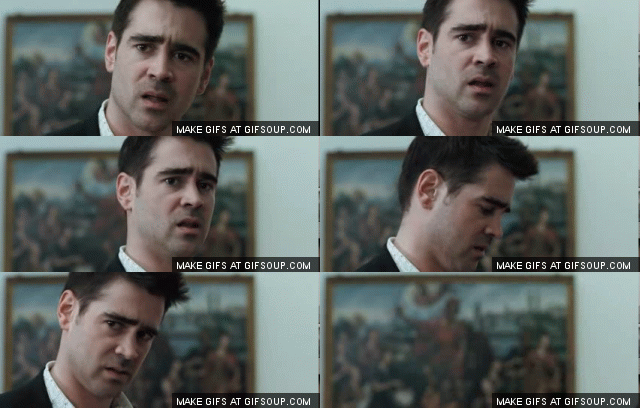
It's nice to see Eighties heart-throb Dillon back in a starring role, and his permanently confused facial expression is ideally suited to this series. Nor is Dillon the only notable member of a solid cast.


Oscar-winning Melissa Leo plays an over-cheery nurse, Juliette Lewis is the barmaid who comes to Ethan's aid and Toby Jones, fresh from the Bafta success earlier this week of Marvellous, plays a psychiatrist who's messing with Ethan's already fragile sanity.

Empire's Terrence Howard as Sheriff Pope looks set to be one of the series' stand-out villains, if his predatory way with a cone of rum 'n' raisin is anything to go by.

Since The Sixth Sense's M. Night Shyamalan is an exec producer who also directed this first episode, we know to expect the unexpected, and advance word from the States hints at an astonishing mid-season twist.

Whether this ultimately amounts to a satisfying story, or dissolves into a mass of frustrating loose ends is, however, anyone's guess.
 
Status
Not open for further replies.

Welcome

Join the Everton conversation today.
Fewer ads, full access, completely free.

🛒 Visit Shop

Support Grand Old Team by checking out our latest Everton gear!
Back
Top