Current Affairs The Conservative Party

Status
Not open for further replies.
Personal Independence Payment (PIP) receipt now determines whether the DWP regards a claimant as disabled. The government is engaging in PIP reassessment en masse.

We should all see where this is going. Disabled people have every reason to feel afraid. As before, medical evidence is superseded by unqualified assessment, while the "scrounger" narrative never went away.

 
Personal Independence Payment (PIP) receipt now determines whether the DWP regards a claimant as disabled. The government is engaging in PIP reassessment en masse.

We should all see where this is going. Disabled people have every reason to feel afraid. As before, medical evidence is superseded by unqualified assessment, while the "scrounger" narrative never went away.

Scum, get out now.

Let Rachel Reeves "tougher than the Tories on benefits" and Liz Kendall stick the boot in to the worst off instead *shrugs*.

None of these people have a 'kin clue.
 
I switched off when that woman asked why we couldn’t turn small boats around and push them back to France ffs…. I’m ashamed to say I live in the same country as these people.
There was one worse somehow, "why can't the French take a knife to em". The sooner generation boomer is dead and buried the sooner we can rejoice. Some of the nastiest most entitled 'I'm alright jacks' to ever crawl the earth. karens the lot!
 
That QT audience and the other examples posted in this thread are why the Tories will always have a chance, in any election.

What a hate filled, selfish, twisted shower of evil racist twunts this country is full of, Happy to be lied to and governed by these Eton etasblishment scumbags who just want them to stay in their lane and never better themselves.

The scary thing is these mutants will have bred and raised children with similar views, and the cycle continues. Just have to hope the younger generation turn away from this disgusting way of thinking.

Anyone thinking of not voting labour in future ,even with all their faults, will allow these Tory swines to retain power.
 
Looking at some of the stuff coming out in the last few days, i'm now convinced that their main goal is not controlling immigration or stopping small boats, but to come out of the ECHR and thats what they are gearing up for.
They want a low wage, deregulated economy.

This should be pushed everywhere.

11 times Jacob Rees-Mogg revealed what he really thinks about your rights​

The arch-Brexiteer wants to cut wages and holidays, and sack strikers. And as business secretary, he’s now in charge

caroline m.jpg

Caroline Molloy
8 September 2022, 2.00pm
PA-45022224.max-760x504.jpg

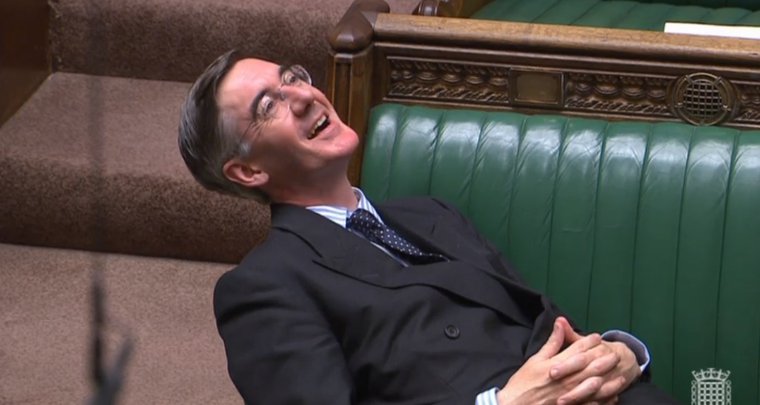
Jacob Rees-Mogg likes to take it easy at work. But he doesn't want you to.
|
House of Commons/PA Wire/PA Images

Share via​

Jacob Rees-Mogg is now the man in charge of our hard-won workers’ rights, as the secretary of state for business, energy and industrial strategy.
The UK’s last two prime ministers, Theresa May and Boris Johnson, both promised that Brexit would not weaken employment rights, and that EU-derived protections would be retained, or replaced by something even better. Reportedly, though, Liz Truss does not feel bound by the same promise, and appears to have brought in arch-Brexiteer Rees-Mogg to shred these rights.
The Trades Union Congress (TUC) has called for the government to ‘come clean’ over its plans. So what hints can we get from Rees-Mogg’s own words about workers’ rights over the years?

1. An end to EU rights to time off?​

In 2016, Channel 4’s Jon Snow asked Rees-Mogg if he supported keeping the following EU-derived employment rights listed by the TUC’s Nicola Smith: “Paid holiday, paid rest breaks, rights for time off if you’ve got kids and your kids are unwell, protection from discrimination when you’re pregnant.”

Help us uncover the truth about Covid-19

The Covid-19 public inquiry is a historic chance to find out what really happened.
MAKE A DONATION
Rees-Mogg replied: “I don’t support all these employment rights that come from Europe.”

2. Sacking striking workers?​

In 2011, Rees-Mogg called on the government to sack striking border officials, “imitating the robust action of the late US president Ronald Reagan in relation to recalcitrant air traffic controllers”.
In the notorious incident in 1981, Reagan sacked 11,359 striking workers, and banned them from ever working for the government again. In Britain, workers have been protected from being sacked for lawful striking since 1871, and Mogg’s suggestion was so extreme it drew chuckles and groans and was ignored by Cameron.
Truss threatened to impose ‘minimum standards agreements’ that would hinder unions’ rights to lawful strikes during her leadership campaign, but even she hasn’t suggested sacking workers who exercise their right to strike – yet.

3. Longer working weeks?​

Rees-Mogg complained in 2016 that Europe had effectively duped Britain into abiding by the “Working Time Directive” (which guarantees paid time off and stops workers being forced to work more than 48 hours a week). Calling the EU a “failed state”, he said that the European Court of Justice had “interpreted the [EU] treaties to mean completely different things from what we believed we had signed up to, so for example the Working Time Directive came in under health and safety laws even when we had an opt-out from the social chapter” [the part of EU treaty law that protects employment and other social rights]. Rees-Mogg had previously told parliament that he thought it was remarkable that the UN human rights convention covered paid time off, saying “It is hard to believe that the right to paid holiday is an absolute moral right.”

4. A lower minimum wage – or none at all?​

As a member of the red-wall-courting Johnson government, Rees-Mogg occasionally defended the minimum wage. But as a backbencher, he opposed its increase, and even its existence. In 2012, he coyly said: “Mr Deputy Speaker, you will rule me out of order if I argue that raising the minimum wage would be extremely unwise, so I would not dare to say it.” Writing in the Telegraph in 2014, he said the government should not raise the minimum wage – then £6.31 an hour – because that would lead “either to inflation or to unemployment”. Rather than setting any minimum wage at all, he said the government should “permit the free market to set wages”.

5. More zero-hours contracts?​

In 2013 he decried “lefties” seeking to ban zero-hours contracts, saying it was useful for business to have access to a pool of people who could be “called into work at short notice but are not guaranteed a specific level of employment”, adding that while workers with other obligations could say no sometimes, “naturally, they cannot refuse too often”. Such contracts, he argued, “benefit business, consumers and taxpayers by keeping costs down and they boost productivity allowing the efficient use of labour”, as well as offering a “route into employment”.

6. More two-tier workforces with exploited, rights-free agency staff?​

In May this year, Jacob Rees-Mogg picked the nine “most interesting” ideas for “Brexit benefits” to pursue, from 2,000 suggestions from the British public, including scrapping equal rights for agency workers, along with niche issues such as allowing more powerful vacuum cleaners and electric bikes. The pick – which could see agency workers losing basic rights like paid holiday, for example – was not a surprise. In the 2016 Channel 4 interview mentioned above, Rees-Mogg had singled out EU protections for agency workers as “very unhelpful” and among “elements that I would change”.

7. Lower pay for the regions, and fewer bargaining rights for unions?​

Teachers and NHS staff have, for decades, had their pay set nationally, meaning poorer areas can attract staff and unions have power to negotiate for large numbers. But in 2012 Jacob Rees-Mogg called not just for a huge extension of local pay (that is, lower pay in some regions) but also small, isolated negotiations in every workplace: “I urge Her Majesty’s government to go much further and to abolish national pay bargaining altogether [and] we need to go much further so that every school and every hospital decides the pay rates that it will give its employees.” Truss appeared to suggest – then quickly back away from – a policy of lower regional pay during her leadership campaign, but even she hasn’t suggested setting it at such a micro level (yet).

8. More ‘graft’ for workers?​

In August, Rees-Mogg backed Liz Truss’s leaked comments that British workers needed ‘more graft’, telling the Mail on Sunday that her remarks were “sensible” and reflected an “unfortunate reality”.

9. More rights for bosses?​

In February 2022, Rees-Mogg told the Times that the government needed to reform employment rights as the power had shifted too far to employees. “A flexible labour market is essential to our economic prosperity… have we got that right? Well, we must of course look at that… and see who needs protection and who doesn’t... Sometimes the employer would think they need more protection from the employee.”

10. Fewer employment and welfare rights in general?​

In an introduction to a series of essays published by right-wing think tank Politeia in 2012, Rees Mogg said that: “Deregulation is part of [his vision of Conservatism], especially in employment law. If society is wrapped in cotton wool it will never prosper. Naturally, there needs to be some safety net for those who fail but unless some are allowed to fall none will be able to climb."

11. Paternalism in place of rights?​

Rees-Mogg is fond of citing the merits of the Victorian factory owners. He told MPs that “in the Victorian age… most employers were benevolent, kindly, good and not out of a Dickens novel: they were more Trollope than Dickens by and large.” And in a 2012 debate on slavery and child labour in supply chains, he expressed doubts that the bill achieved its desired objectives, supporting some regulation but suggesting that it could be minimised by starting with “conscience” and the fact that “companies that fail to follow the basics of humanity will be embarrassed in their marketing. They will be brought to shame in front of the nation”.

 
They want a low wage, deregulated economy.

This should be pushed everywhere.

11 times Jacob Rees-Mogg revealed what he really thinks about your rights​

The arch-Brexiteer wants to cut wages and holidays, and sack strikers. And as business secretary, he’s now in charge

caroline m.jpg

Caroline Molloy
8 September 2022, 2.00pm
PA-45022224.max-760x504.jpg

Jacob Rees-Mogg likes to take it easy at work. But he doesn't want you to.
|
House of Commons/PA Wire/PA Images

Share via​

Jacob Rees-Mogg is now the man in charge of our hard-won workers’ rights, as the secretary of state for business, energy and industrial strategy.
The UK’s last two prime ministers, Theresa May and Boris Johnson, both promised that Brexit would not weaken employment rights, and that EU-derived protections would be retained, or replaced by something even better. Reportedly, though, Liz Truss does not feel bound by the same promise, and appears to have brought in arch-Brexiteer Rees-Mogg to shred these rights.
The Trades Union Congress (TUC) has called for the government to ‘come clean’ over its plans. So what hints can we get from Rees-Mogg’s own words about workers’ rights over the years?

1. An end to EU rights to time off?​

In 2016, Channel 4’s Jon Snow asked Rees-Mogg if he supported keeping the following EU-derived employment rights listed by the TUC’s Nicola Smith: “Paid holiday, paid rest breaks, rights for time off if you’ve got kids and your kids are unwell, protection from discrimination when you’re pregnant.”

Help us uncover the truth about Covid-19

The Covid-19 public inquiry is a historic chance to find out what really happened.
MAKE A DONATION
Rees-Mogg replied: “I don’t support all these employment rights that come from Europe.”

2. Sacking striking workers?​

In 2011, Rees-Mogg called on the government to sack striking border officials, “imitating the robust action of the late US president Ronald Reagan in relation to recalcitrant air traffic controllers”.
In the notorious incident in 1981, Reagan sacked 11,359 striking workers, and banned them from ever working for the government again. In Britain, workers have been protected from being sacked for lawful striking since 1871, and Mogg’s suggestion was so extreme it drew chuckles and groans and was ignored by Cameron.
Truss threatened to impose ‘minimum standards agreements’ that would hinder unions’ rights to lawful strikes during her leadership campaign, but even she hasn’t suggested sacking workers who exercise their right to strike – yet.

3. Longer working weeks?​

Rees-Mogg complained in 2016 that Europe had effectively duped Britain into abiding by the “Working Time Directive” (which guarantees paid time off and stops workers being forced to work more than 48 hours a week). Calling the EU a “failed state”, he said that the European Court of Justice had “interpreted the [EU] treaties to mean completely different things from what we believed we had signed up to, so for example the Working Time Directive came in under health and safety laws even when we had an opt-out from the social chapter” [the part of EU treaty law that protects employment and other social rights]. Rees-Mogg had previously told parliament that he thought it was remarkable that the UN human rights convention covered paid time off, saying “It is hard to believe that the right to paid holiday is an absolute moral right.”

4. A lower minimum wage – or none at all?​

As a member of the red-wall-courting Johnson government, Rees-Mogg occasionally defended the minimum wage. But as a backbencher, he opposed its increase, and even its existence. In 2012, he coyly said: “Mr Deputy Speaker, you will rule me out of order if I argue that raising the minimum wage would be extremely unwise, so I would not dare to say it.” Writing in the Telegraph in 2014, he said the government should not raise the minimum wage – then £6.31 an hour – because that would lead “either to inflation or to unemployment”. Rather than setting any minimum wage at all, he said the government should “permit the free market to set wages”.

5. More zero-hours contracts?​

In 2013 he decried “lefties” seeking to ban zero-hours contracts, saying it was useful for business to have access to a pool of people who could be “called into work at short notice but are not guaranteed a specific level of employment”, adding that while workers with other obligations could say no sometimes, “naturally, they cannot refuse too often”. Such contracts, he argued, “benefit business, consumers and taxpayers by keeping costs down and they boost productivity allowing the efficient use of labour”, as well as offering a “route into employment”.

6. More two-tier workforces with exploited, rights-free agency staff?​

In May this year, Jacob Rees-Mogg picked the nine “most interesting” ideas for “Brexit benefits” to pursue, from 2,000 suggestions from the British public, including scrapping equal rights for agency workers, along with niche issues such as allowing more powerful vacuum cleaners and electric bikes. The pick – which could see agency workers losing basic rights like paid holiday, for example – was not a surprise. In the 2016 Channel 4 interview mentioned above, Rees-Mogg had singled out EU protections for agency workers as “very unhelpful” and among “elements that I would change”.

7. Lower pay for the regions, and fewer bargaining rights for unions?​

Teachers and NHS staff have, for decades, had their pay set nationally, meaning poorer areas can attract staff and unions have power to negotiate for large numbers. But in 2012 Jacob Rees-Mogg called not just for a huge extension of local pay (that is, lower pay in some regions) but also small, isolated negotiations in every workplace: “I urge Her Majesty’s government to go much further and to abolish national pay bargaining altogether [and] we need to go much further so that every school and every hospital decides the pay rates that it will give its employees.” Truss appeared to suggest – then quickly back away from – a policy of lower regional pay during her leadership campaign, but even she hasn’t suggested setting it at such a micro level (yet).

8. More ‘graft’ for workers?​

In August, Rees-Mogg backed Liz Truss’s leaked comments that British workers needed ‘more graft’, telling the Mail on Sunday that her remarks were “sensible” and reflected an “unfortunate reality”.

9. More rights for bosses?​

In February 2022, Rees-Mogg told the Times that the government needed to reform employment rights as the power had shifted too far to employees. “A flexible labour market is essential to our economic prosperity… have we got that right? Well, we must of course look at that… and see who needs protection and who doesn’t... Sometimes the employer would think they need more protection from the employee.”

10. Fewer employment and welfare rights in general?​

In an introduction to a series of essays published by right-wing think tank Politeia in 2012, Rees Mogg said that: “Deregulation is part of [his vision of Conservatism], especially in employment law. If society is wrapped in cotton wool it will never prosper. Naturally, there needs to be some safety net for those who fail but unless some are allowed to fall none will be able to climb."

11. Paternalism in place of rights?​

Rees-Mogg is fond of citing the merits of the Victorian factory owners. He told MPs that “in the Victorian age… most employers were benevolent, kindly, good and not out of a Dickens novel: they were more Trollope than Dickens by and large.” And in a 2012 debate on slavery and child labour in supply chains, he expressed doubts that the bill achieved its desired objectives, supporting some regulation but suggesting that it could be minimised by starting with “conscience” and the fact that “companies that fail to follow the basics of humanity will be embarrassed in their marketing. They will be brought to shame in front of the nation”.

What a tosser.
 
Status
Not open for further replies.

Welcome

Join the Everton conversation today.
Fewer ads, full access, completely free.

🛒 Visit Shop

Support Grand Old Team by checking out our latest Everton gear!
Back
Top