
Guest viewing is limited in the Ale House.
- You have a limited number of page views remaining
- 15 guest views remaining
- Register now to remove this limitation
- Already a member? Click here to login
You are using an out of date browser. It may not display this or other websites correctly.
You should upgrade or use an alternative browser.
You should upgrade or use an alternative browser.
On This Day;
- Thread starter Eggs
- Start date


….my daughters 41 today and I distinctly remember her 9th birthday party when the tragic Senna news broke.
The night of May 3rd 1941 , May Blitz day 3
Saturday 3rd May 1941, more relentless bombardment that lasted for 7 hours, worst compared to the previous nights reduced many areas to rubble and hundreds of buildings stood burning. It was estimated that up to 500 bombers involved in some sources. {298 aircraft dropped 363 tons of high explosives and 49,706 incendiaries, included in that total were a undisclosed number of 100kg bomb mines}* Luftwaffe account. , but still doesn't diminish the fact of the devastation unleashed on Merseyside was the worst on record.
Buildings hit this night include: Bibby's Mill on Great Homer Street, Blacklers department store Charlotte Street, The Bluecoat School on School lane, Breckside Corporation depot,Central Railway Station,Cheapside oil works,Cook Street arcade,Corporation yard Smithdown Road,Corn Exchange on Brunswick Street , Cunard Building,Customs House ,Exchange Railway Station,Gas Company's works on Duke Street, GPO in Victoria Street, India Buildings on Water Street,Kirkdale Railway station, Law Society Library, Lewis's department Store on Ranelagh Street, The Magistrate's Courts, Mill Road Hospital, Old Swan Police Station,Rose Hill Police Station,Rose Lane School,Smithdown Road Cemetery,St. Athanasius Church on Fountains Road,St Mary's Church on Highfield Street,Sudley Road School,Telephone Company factory at Binns Road,Telephone Exchange at South John Street,Walton Parish Church,Walton Police Station.Walton Prison,Wapping Overhead Railway Station, Vauxhall Road Stables, The Liverpool Museum was left minus its roof, the Walker Art Gallery was damaged and the William Brown Library was hit resulting in over 150,000 books being lost. The docks were targeted and suffered huge hits along their whole length.
Streets known to have been hit in alphabetical order, but not a extensive list :
Addison Street,
Alt Street,
Anthony Street,
Bedford Street,Bootle
Bowland Avenue,
Buckland Street,
Canning Place,City Centre
Carisbrooke Road,Walton
Castle Street, City Centre
Chancel Street,
Childwall Abbey Road, Childwall
Childwall Valley Road,Childwall
Church Street,City Centre
Coltart Road,
County Road ,Walton
Dallas Grove, Warbreck Walton
Derby Lane. Bootle
Donsby Road,
Egerton Road,
Elliot Street, City Centre
Fern Grove,
Fountains Road,
Freeland Street,
Glenconner Road,
Gildarts Gardens,
Grafton Street,
Hanover Street,City Centre
Hermia Street,
Hunslet Street,
Ibbotsons Lane,
Index Street,
Linnet Lane,
London Road, Islington
Lord Street, City Centre
Kingsley Road,
Mannering Road,
Maple Grove,
Mill Lane,
Margaret Road,
Newman Street,
Paradise Street, City Centre
Park Avenue,
Park Lane,
Pemberton Road,
Pembroke Place,
Peter Road,
Pitt Street,
Ranelagh Place ,City Centre
Ranelagh Street ,City Centre
Rose Hill,
Scotland Road, Vauxhall
South Castle Street, City Centre,
South John Street, City Centre
Southport Road, Bootle
Stanley Road,Bootle
Ullet road,
Upper Huskisson Street,
Vauxhall Road,
Victoria Street, Old Haymarket
Vulcan Street,
Walton Lane,
Waverley Road,
William Brown Street
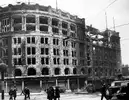
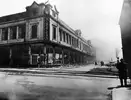
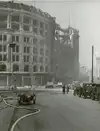
Saturday 3rd May 1941, more relentless bombardment that lasted for 7 hours, worst compared to the previous nights reduced many areas to rubble and hundreds of buildings stood burning. It was estimated that up to 500 bombers involved in some sources. {298 aircraft dropped 363 tons of high explosives and 49,706 incendiaries, included in that total were a undisclosed number of 100kg bomb mines}* Luftwaffe account. , but still doesn't diminish the fact of the devastation unleashed on Merseyside was the worst on record.
Buildings hit this night include: Bibby's Mill on Great Homer Street, Blacklers department store Charlotte Street, The Bluecoat School on School lane, Breckside Corporation depot,Central Railway Station,Cheapside oil works,Cook Street arcade,Corporation yard Smithdown Road,Corn Exchange on Brunswick Street , Cunard Building,Customs House ,Exchange Railway Station,Gas Company's works on Duke Street, GPO in Victoria Street, India Buildings on Water Street,Kirkdale Railway station, Law Society Library, Lewis's department Store on Ranelagh Street, The Magistrate's Courts, Mill Road Hospital, Old Swan Police Station,Rose Hill Police Station,Rose Lane School,Smithdown Road Cemetery,St. Athanasius Church on Fountains Road,St Mary's Church on Highfield Street,Sudley Road School,Telephone Company factory at Binns Road,Telephone Exchange at South John Street,Walton Parish Church,Walton Police Station.Walton Prison,Wapping Overhead Railway Station, Vauxhall Road Stables, The Liverpool Museum was left minus its roof, the Walker Art Gallery was damaged and the William Brown Library was hit resulting in over 150,000 books being lost. The docks were targeted and suffered huge hits along their whole length.
Streets known to have been hit in alphabetical order, but not a extensive list :
Addison Street,
Alt Street,
Anthony Street,
Bedford Street,Bootle
Bowland Avenue,
Buckland Street,
Canning Place,City Centre
Carisbrooke Road,Walton
Castle Street, City Centre
Chancel Street,
Childwall Abbey Road, Childwall
Childwall Valley Road,Childwall
Church Street,City Centre
Coltart Road,
County Road ,Walton
Dallas Grove, Warbreck Walton
Derby Lane. Bootle
Donsby Road,
Egerton Road,
Elliot Street, City Centre
Fern Grove,
Fountains Road,
Freeland Street,
Glenconner Road,
Gildarts Gardens,
Grafton Street,
Hanover Street,City Centre
Hermia Street,
Hunslet Street,
Ibbotsons Lane,
Index Street,
Linnet Lane,
London Road, Islington
Lord Street, City Centre
Kingsley Road,
Mannering Road,
Maple Grove,
Mill Lane,
Margaret Road,
Newman Street,
Paradise Street, City Centre
Park Avenue,
Park Lane,
Pemberton Road,
Pembroke Place,
Peter Road,
Pitt Street,
Ranelagh Place ,City Centre
Ranelagh Street ,City Centre
Rose Hill,
Scotland Road, Vauxhall
South Castle Street, City Centre,
South John Street, City Centre
Southport Road, Bootle
Stanley Road,Bootle
Ullet road,
Upper Huskisson Street,
Vauxhall Road,
Victoria Street, Old Haymarket
Vulcan Street,
Walton Lane,
Waverley Road,
William Brown Street

I think the list of road names brings it home more than anything. The roads around where I live now, and the road I used to live on - all receiving bomb damage. Truly horriffic- more examples of mans inhumanity to our fellow man.The night of May 3rd 1941 , May Blitz day 3
Saturday 3rd May 1941, more relentless bombardment that lasted for 7 hours, worst compared to the previous nights reduced many areas to rubble and hundreds of buildings stood burning. It was estimated that up to 500 bombers involved in some sources. {298 aircraft dropped 363 tons of high explosives and 49,706 incendiaries, included in that total were a undisclosed number of 100kg bomb mines}* Luftwaffe account. , but still doesn't diminish the fact of the devastation unleashed on Merseyside was the worst on record.
Buildings hit this night include: Bibby's Mill on Great Homer Street, Blacklers department store Charlotte Street, The Bluecoat School on School lane, Breckside Corporation depot,Central Railway Station,Cheapside oil works,Cook Street arcade,Corporation yard Smithdown Road,Corn Exchange on Brunswick Street , Cunard Building,Customs House ,Exchange Railway Station,Gas Company's works on Duke Street, GPO in Victoria Street, India Buildings on Water Street,Kirkdale Railway station, Law Society Library, Lewis's department Store on Ranelagh Street, The Magistrate's Courts, Mill Road Hospital, Old Swan Police Station,Rose Hill Police Station,Rose Lane School,Smithdown Road Cemetery,St. Athanasius Church on Fountains Road,St Mary's Church on Highfield Street,Sudley Road School,Telephone Company factory at Binns Road,Telephone Exchange at South John Street,Walton Parish Church,Walton Police Station.Walton Prison,Wapping Overhead Railway Station, Vauxhall Road Stables, The Liverpool Museum was left minus its roof, the Walker Art Gallery was damaged and the William Brown Library was hit resulting in over 150,000 books being lost. The docks were targeted and suffered huge hits along their whole length.
Streets known to have been hit in alphabetical order, but not a extensive list :
Addison Street,
Alt Street,
Anthony Street,
Bedford Street,Bootle
Bowland Avenue,
Buckland Street,
Canning Place,City Centre
Carisbrooke Road,Walton
Castle Street, City Centre
Chancel Street,
Childwall Abbey Road, Childwall
Childwall Valley Road,Childwall
Church Street,City Centre
Coltart Road,
County Road ,Walton
Dallas Grove, Warbreck Walton
Derby Lane. Bootle
Donsby Road,
Egerton Road,
Elliot Street, City Centre
Fern Grove,
Fountains Road,
Freeland Street,
Glenconner Road,
Gildarts Gardens,
Grafton Street,
Hanover Street,City Centre
Hermia Street,
Hunslet Street,
Ibbotsons Lane,
Index Street,
Linnet Lane,
London Road, Islington
Lord Street, City Centre
Kingsley Road,
Mannering Road,
Maple Grove,
Mill Lane,
Margaret Road,
Newman Street,
Paradise Street, City Centre
Park Avenue,
Park Lane,
Pemberton Road,
Pembroke Place,
Peter Road,
Pitt Street,
Ranelagh Place ,City Centre
Ranelagh Street ,City Centre
Rose Hill,
Scotland Road, Vauxhall
South Castle Street, City Centre,
South John Street, City Centre
Southport Road, Bootle
Stanley Road,Bootle
Ullet road,
Upper Huskisson Street,
Vauxhall Road,
Victoria Street, Old Haymarket
Vulcan Street,
Walton Lane,
Waverley Road,
William Brown Street
View attachment 352115
View attachment 352116
View attachment 352117
I think the list of road names brings it home more than anything. The roads around where I live now, and the road I used to live on - all receiving bomb damage. Truly horriffic- more examples of mans inhumanity to our fellow man.
….it does. Those sites are widespread across the City and I think of what my own parents went through during that Blitz. I read the bombers would drop any unused bombs indiscriminately before setting off home.
My mother-in-law is still alive at 97 and lived in the city centre during that time, she said the planes were so low going down the river you could almost see the silhouette of pilots. Kids would collect shrapnel going into school the next day.
Mill Road Infirmary , Tragic event 3,rd May 1941
On 3rd May 1941 the Mill Road Maternity Infirmary itself fell victim to the german bombing with a direct hit on the maternity unit killing many mothers and their new babies. Several Ambulance drivers were killed alongside a number of medics and nurses who were killed whilst operating on a man who miraculously survived. In all approximately 80 people died in the tragedy. The target the Luftwaffe were after was that of Everton Reservoir which was in close proximity to the Infirmary.
The ECHO reported at the time: "The assistant matron, assistant medical officer and a number of patients, nurses, students and surgeons were fatally injured.
"The operating theatre in the basement was completely wrecked. The destroyed wards were devoted to women patients, some of whom, it is feared, are still buried. One nurse was rescued after 12 hours. Untiring efforts continued to reach the trapped patients.
A staff member said ‘Everyone was heroic, nurses and patients alike. They took it remarkably coolly. The nurses were wonderfully brave’."
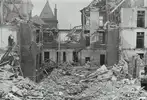
On 3rd May 1941 the Mill Road Maternity Infirmary itself fell victim to the german bombing with a direct hit on the maternity unit killing many mothers and their new babies. Several Ambulance drivers were killed alongside a number of medics and nurses who were killed whilst operating on a man who miraculously survived. In all approximately 80 people died in the tragedy. The target the Luftwaffe were after was that of Everton Reservoir which was in close proximity to the Infirmary.
The ECHO reported at the time: "The assistant matron, assistant medical officer and a number of patients, nurses, students and surgeons were fatally injured.
"The operating theatre in the basement was completely wrecked. The destroyed wards were devoted to women patients, some of whom, it is feared, are still buried. One nurse was rescued after 12 hours. Untiring efforts continued to reach the trapped patients.
A staff member said ‘Everyone was heroic, nurses and patients alike. They took it remarkably coolly. The nurses were wonderfully brave’."
Huskisson no. 2 Dock. 4th May 1941.
The SS Malakand was docked here and held 1,000 tons of bombs, when fire is believed to have spread to her from nearby dock sheds during the blitz
The order of battle states that at 044hrs on Sunday May 4th there was a huge explosion sending flames more than 500 metres into the sky.
Timings vary, particularly since the UK moved to British Double Summer Time the same night. But the blast could have been the SS Malakand, moored in Huskisson Branch Dock No. 2. It was loaded with 1,000 tons of bombs.
A cargo liner built in 1919 for the Brocklebank Line, she was named after the Malakand area of the Indian subcontinent.
It is believed that flames from nearby dock sheds spread to the ship. Four people were killed and debris from the Malakand’s hull plating was strewn for more than two miles.
Such was the force of the explosion that the Malakand’s two-ton anchor stock landed next to Bootle General Hospital on Derby Road – more than 1.5 miles away!
Fire crews struggled to contain the blaze which took more than 70 hours to burn out. Most of Huskisson Dock was destroyed and the Malakand was left a mangled wreck.
Although the greater part of the dock was rebuilt after the war, Branch Dock No. 2 was filled in and is now the site of a timber yard.
Cunard liners regularly used Huskisson Dock up to the 1960s. It also handled general bulk cargoes from Cunard cargo ships like the SS Scythia.
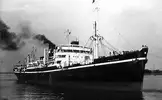
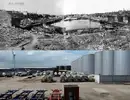
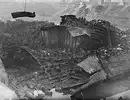
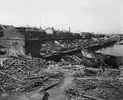
The SS Malakand was docked here and held 1,000 tons of bombs, when fire is believed to have spread to her from nearby dock sheds during the blitz
The order of battle states that at 044hrs on Sunday May 4th there was a huge explosion sending flames more than 500 metres into the sky.
Timings vary, particularly since the UK moved to British Double Summer Time the same night. But the blast could have been the SS Malakand, moored in Huskisson Branch Dock No. 2. It was loaded with 1,000 tons of bombs.
A cargo liner built in 1919 for the Brocklebank Line, she was named after the Malakand area of the Indian subcontinent.
It is believed that flames from nearby dock sheds spread to the ship. Four people were killed and debris from the Malakand’s hull plating was strewn for more than two miles.
Such was the force of the explosion that the Malakand’s two-ton anchor stock landed next to Bootle General Hospital on Derby Road – more than 1.5 miles away!
Fire crews struggled to contain the blaze which took more than 70 hours to burn out. Most of Huskisson Dock was destroyed and the Malakand was left a mangled wreck.
Although the greater part of the dock was rebuilt after the war, Branch Dock No. 2 was filled in and is now the site of a timber yard.
Cunard liners regularly used Huskisson Dock up to the 1960s. It also handled general bulk cargoes from Cunard cargo ships like the SS Scythia.

Alan Whittle
Player Valuation: £70m
May 5 2014
Crystanbul.
Crystanbul.

Tommy Chong
Player Valuation: £70m

The Memorial to the Heroes of the Marine Engine Room, Unveiled On this day, 6th May 1916.
The Memorial to Heroes of the Marine Engine Room aka, the Titanic Monument is a Grade II* listed granite monument located on St Nicholas Place, at the Pier Head, in Liverpool, England
Year build 1916
Architect Sir William Goscombe John
Official name, Memorial to Heroes of the Marine Engine Room.
The memorial was intended originally to commemorate all 32 engineers who died in the sinking of Titanic on 15 April 1912. Liverpool was the Titanic's port of registry, as well as the home of the ship's owner, White Star Line. Construction was funded by international public subscription.
Spaces were left on the monument to record the names of other engineers. However, due to the heavy loss of life throughout World War I, its dedication was broadened to include all maritime engine room fatalities incurred during the performance of duty. Shrapnel damage from bombs that fell during the Blitz in World War II can be clearly seen on the monument.
Design,
Two figures on the east face of the memorial representing stokers, one holding a shovel and the other a cleaning rag. The right figure shows damage from the Liverpool Blitz.
Standing 48 feet (14.6 m) tall, the monument was designed by Sir William Goscombe John. It is constructed in the form of a granite obelisk standing on a square chamfered pedestal. The obelisk is topped with a gilded flame. Each of its bottom corners is decorated with carved representations of the four classical elements.
The east and west side of the pedestal feature carved life-size sculptures of stokers and engineers. Pevsner describes these figures as "strikingly naturalistic" and are noted as focusing on working class heroism. When the monument was designed, the use of manual labourers and workers was an uncommon subject in British public art and their inclusion by Goscombe John was considered innovative. Historic England describe the memorial as having a considerable influence on the future design of war memorials, calling it "one of the most artistically significant memorials to the Titanic disaster on either side of the Atlantic".
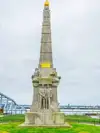
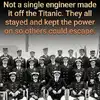
The Memorial to Heroes of the Marine Engine Room aka, the Titanic Monument is a Grade II* listed granite monument located on St Nicholas Place, at the Pier Head, in Liverpool, England
Year build 1916
Architect Sir William Goscombe John
Official name, Memorial to Heroes of the Marine Engine Room.
The memorial was intended originally to commemorate all 32 engineers who died in the sinking of Titanic on 15 April 1912. Liverpool was the Titanic's port of registry, as well as the home of the ship's owner, White Star Line. Construction was funded by international public subscription.
Spaces were left on the monument to record the names of other engineers. However, due to the heavy loss of life throughout World War I, its dedication was broadened to include all maritime engine room fatalities incurred during the performance of duty. Shrapnel damage from bombs that fell during the Blitz in World War II can be clearly seen on the monument.
Design,
Two figures on the east face of the memorial representing stokers, one holding a shovel and the other a cleaning rag. The right figure shows damage from the Liverpool Blitz.
Standing 48 feet (14.6 m) tall, the monument was designed by Sir William Goscombe John. It is constructed in the form of a granite obelisk standing on a square chamfered pedestal. The obelisk is topped with a gilded flame. Each of its bottom corners is decorated with carved representations of the four classical elements.
The east and west side of the pedestal feature carved life-size sculptures of stokers and engineers. Pevsner describes these figures as "strikingly naturalistic" and are noted as focusing on working class heroism. When the monument was designed, the use of manual labourers and workers was an uncommon subject in British public art and their inclusion by Goscombe John was considered innovative. Historic England describe the memorial as having a considerable influence on the future design of war memorials, calling it "one of the most artistically significant memorials to the Titanic disaster on either side of the Atlantic".
RMS Lusitania: 18 Minutes That Shocked The World.
RMS Lusitania was torpedoed by a German U-boat on 7 May 1915. The luxury passenger liner was crossing the Atlantic from New York to Liverpool when the German submarine U-20 fired without warning. After a second explosion – the cause of which is still debated – the ship quickly sank. It went under in 18 minutes, killing 1,200 of almost 2,000 passengers and crew on board.
On 4 February 1915, Germany declared a war zone around Britain in which any shipping – military or civilian – would be sunk on sight. During the early stages of the war, U-boats followed 'prize rules'. They would surface before attacking merchant ships, carry out formal searches of the cargo and allow time for passengers and crew to escape before the ship was sunk. Germany eventually abandoned prize rules and began its campaign of unrestricted submarine warfare, partially due to the British introduction of 'Q-Ships' – warships disguised as merchant ships.
The Lusitania was launched on 7 June 1906. It had been specially built to be easily converted to a warship and was registered with the British Admiralty as an armed auxiliary cruiser.
Following the outbreak of the First World War, it continued to operate as a passenger liner despite being used to carry British war materiel.
The sinking of RMS Lusitania caused international outrage and helped turn public opinion against Germany, particularly in the then-neutral United States. Of the 1,200 people killed, 128 were American citizens. But the incident did not immediately bring the United States into the war. Instead, the American government issued a severe protest to Germany.
Following immense pressure from the US and recognising the limited effectiveness of the policy, Germany abandoned unrestricted submarine warfare in September 1915.
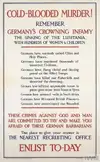
The Lusitania became a focus for British and American propaganda and was used to bolster recruitment efforts.
However, Germany claimed that the sinking was justified because munitions were being carried on board. In the days prior to the Lusitania's final voyage, the German embassy had also published warnings in American newspapers stating the dangers and risks of travelling through the war zone.
RMS Lusitania was a British passenger liner that was sunk off the coast of Ireland on 7 May 1915 by the German U-boat U-20. RMS Lusitania sank in just 18 minutes. Of the 1,960 passengers on board, just under 1,200 people lost their lives.
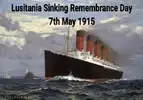


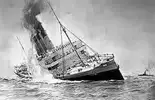
RMS Lusitania was torpedoed by a German U-boat on 7 May 1915. The luxury passenger liner was crossing the Atlantic from New York to Liverpool when the German submarine U-20 fired without warning. After a second explosion – the cause of which is still debated – the ship quickly sank. It went under in 18 minutes, killing 1,200 of almost 2,000 passengers and crew on board.
On 4 February 1915, Germany declared a war zone around Britain in which any shipping – military or civilian – would be sunk on sight. During the early stages of the war, U-boats followed 'prize rules'. They would surface before attacking merchant ships, carry out formal searches of the cargo and allow time for passengers and crew to escape before the ship was sunk. Germany eventually abandoned prize rules and began its campaign of unrestricted submarine warfare, partially due to the British introduction of 'Q-Ships' – warships disguised as merchant ships.
The Lusitania was launched on 7 June 1906. It had been specially built to be easily converted to a warship and was registered with the British Admiralty as an armed auxiliary cruiser.
Following the outbreak of the First World War, it continued to operate as a passenger liner despite being used to carry British war materiel.
The sinking of RMS Lusitania caused international outrage and helped turn public opinion against Germany, particularly in the then-neutral United States. Of the 1,200 people killed, 128 were American citizens. But the incident did not immediately bring the United States into the war. Instead, the American government issued a severe protest to Germany.
Following immense pressure from the US and recognising the limited effectiveness of the policy, Germany abandoned unrestricted submarine warfare in September 1915.
The Lusitania became a focus for British and American propaganda and was used to bolster recruitment efforts.
However, Germany claimed that the sinking was justified because munitions were being carried on board. In the days prior to the Lusitania's final voyage, the German embassy had also published warnings in American newspapers stating the dangers and risks of travelling through the war zone.
RMS Lusitania was a British passenger liner that was sunk off the coast of Ireland on 7 May 1915 by the German U-boat U-20. RMS Lusitania sank in just 18 minutes. Of the 1,960 passengers on board, just under 1,200 people lost their lives.

May 7th 2025/24/23/22/21/20 etc etc back to 94…. Me panicking as it’s my mrs birthday tomorrow and I still don’t have a present for her

There's no debate left, the munitions that didn't explode are still there in its wreck today. When the decision makers of the time made a civilian travel liner a discreet munitions transport they made it a legit target. The Germans were perfectly justified to fire on a weapons delivery, the apology is required from the admiralty to the civilians that had no idea what was hidden in the hold that so risked their lives and the ship. Unless it was on purpose and a sacrifice that was made for political reasons...RMS Lusitania: 18 Minutes That Shocked The World.
RMS Lusitania was torpedoed by a German U-boat on 7 May 1915. The luxury passenger liner was crossing the Atlantic from New York to Liverpool when the German submarine U-20 fired without warning. After a second explosion – the cause of which is still debated – the ship quickly sank. It went under in 18 minutes, killing 1,200 of almost 2,000 passengers and crew on board.

Tomorrow is the 20th anniversary of Guy Goma day.
Welcome
Join the Everton conversation today.
Fewer ads, full access, completely free.