Current Affairs German far right in the former East Germany

Status
Not open for further replies.
So called???

Well, not in terms of the AfD - they are extremists. But the left parties Die Like and SWA are not extremist. That was the point I picked up on earlier: that, for example, if the SWA are viewed as 'extremist' for their views on immigration then that is also applicable to the British 'Labour' Party, as they hold the same views.
 
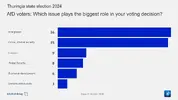
Survey of AFD voters, main reasons why they voted like that.
As expected immigration, immigration, immigration. As long European governments continue to ignore elephant in the room, far right gonna continue to rise all over the continent.

i8r9t0uvekmd1.webp
 
Well, that attitude (and how prevalent it is I dont know) is not an outcome of living in the old GDR system. The foundations of the East German state was built upon the enormous effort of the East German working class who were well used to making sacrifices to get production levels where the Party wanted them to be. They didn't exactly have it easy under that system.

There was no general culture of self-sufficiency or entrepreneurialism in the GDR because it was actively discouraged. Any innovation there was was subsumed in state projects. That's what many in the GDR were used to when the wall fell. They were sitting ducks. Some adapted, many more turned resentful. Some had genuine gripes - most did not. They liked a strongman and the state blanket. These people want a return to all that... Their "concerns" are simply the fever dreams of anti-social elements.

I think you're under-playing the still existant gaps between west and east Germany and making this sound like moaning Ossi's.

The gap between east and west has narrowed but is still significant. Salaries remain higher in the western states than in the eastern states, and unemployment is also higher in the east. Also, the young and the qualified still drift from east to west German towns and cities. Between 1990 and 2022 the east's population declined by 12%. That has to have a psychic effect on confidence. Fear then fills the vacuum and the belief that young immigrants will take up jobs in welfare especially and replace those natives who have left.

My other half is East German. There are indeed some genuine gripes and there was indeed a cultural takeover by the West to the point where positive memories and sentiments regarding aspects of life in the GDR were almost deemed un-German. But the West has spent €2tn - yes, trillion - on bringing infrastructure in the old GDR up to speed - at some cost to the existing infrastructure in the West - and on welfare, unemployment benefits, and pensions.

A declining population is an argument FOR not against immigration to keep regions alive and vibrant. But some in the East prefer to believe the talk of Nazis like the AfD and Stalinists like Wagenknecht. If she was a progressive, she would be attacking the "belief", as you put it, of young immigrants taking local jobs. There is very little immigration in the Eastern states. But let's not leave that get in the way of a good old racist scare story.

All of this has fuelled the so called 'extremism'.

There you go again, throwing a blanket of sceptical respectability over the extremists you approve of, like Wagenknecht.

She's a Stalinist, Dave, and a racist dog-whistler. By defintion an extemist. She's just polished with it, and that, apparently, is enough for the shy totalitarians to come out of their shells...
 
Last edited:
Well, not in terms of the AfD - they are extremists. But the left parties Die Like and SWA are not extremist. That was the point I picked up on earlier: that, for example, if the SWA are viewed as 'extremist' for their views on immigration then that is also applicable to the British 'Labour' Party, as they hold the same views.
Sure: if Stalinism is not extremist, she's just a cuddly socialist.
 
Last edited:
There was no general culture of self-sufficiency or entrepreneurialism in the GDR because it was actively discouraged. Any innovation there was was subsumed in state projects. That's what many in the GDR were used to when the wall fell. They were sitting ducks. Some adapted, many more turned resentful. Some had genuine gripes - most did not. They liked a strongman and the state blanket. These people want a return to all that... Their "concerns" are simply the fever dreams of anti-social elements.

This makes it sound like they were all feckless if they weren't entrepreneurs at the fall of the Wall.

They had a more than functioning industrial sector that was basically mothballed with mass unemployment resulting from it... men were employed to decommission and demolish the factories and worshops they had been employed in. No wonder they felt resentment.

The east before the Wall came down were trying to bring about a regulated consumer society by apeing production from the west of stuff like jeans and electronics. They partially succeeded though never matched the complexity or presentation of western goods. But the GDR state was not moribund in that respect and encouraged innovation as long as they could keep control over the finished product.


My other half is East German. There are indeed some genuine gripes and there was indeed a cultural takeover by the West to the point where positive memories and sentiments regarding aspects of life in the GDR were almost deemed un-German. But the West has spent €2tn - yes, trillion - on bringing infrastructure in the old GDR up to speed - at some cost to the existing infrastructure in the West - and on welfare, unemployment benefits, and pensions.

A declining population is an argument FOR not against immigration to keep regions alive and vibrant. But some in the East prefer to believe the talk of Nazis like the AfD and Stalinists like Wagenknecht. If she was a progressive, she would be attacking the "belief", as you put it, of young immigrants taking local jobs. There is very little immigration in the Eastern states. But let's not leave that get in the way of a good old racist scare story.
There was no general culture of self-sufficiency or entrepreneurialism in the GDR because it was actively discouraged. Any innovation there was was subsumed in state projects. That's what many in the GDR were used to when the wall fell. They were sitting ducks. Some adapted, many more turned resentful. Some had genuine gripes - most did not. They liked a strongman and the state blanket. These people want a return to all that... Their "concerns" are simply the fever dreams of anti-social elements.

The investment made is almost neither here nor there if at the end of it there exists no parity with states in western Germany. And that remains the case.

I offer no support for anti-immigrant policies wherever it comes from: be it the AfD, SWA or UK 'Labour' Party. So that's a straw man argument.
 
You are not going to get parity with West Germany - the biggest economy in Europe and the world's biggest exporter - in 30 years when you were a failed, communist backwater who was already dependent on West German loans to survive.

The key is to narrow the gap as quickly as possible. That has largely happened, albeit in a shock doctrine way. I know: I live here, in the old East. The East is largely rural and, in common with rural areas in the West, suffers depopulation. This is not a uniquely Eastern affliction. Leipzig and Dresden, the two biggest cities in the old East, are thriving.

The "resentments" that some people are hilariously calling "concerns" for opportunistic political reasons are simply the foot stomps of people who have always voted totalitarian: whether that was the SED, PDS, NPD or AfD.

As for Sahra Wagenknecht, she has always been a self-publicist. She was the only member of the old GDR communist party to vote AGAINST a resolution that said there was no justification for the killing of people on the Wall or its death strip. She refused to support a memorial at the Graveyard of the Socialists that was dedicated to "the victims of Stalin", simply because some fascists could also be counted among their number. She is on record as saying the GDR should not be considered a "dictatorship" as "real democracy does not exist under Capitalism" and to call it a dictatorship would "equate it with Nazism."

By simple objective definition, the GDR was a dictatorship - even if it was of a much lesser order of evil that the Third Reich characterised. But it was a dystopian dictatorship. Thing is, if you're comfortable with dictatorships, is it any wonder you might want to hark back to that and cosy up to Putin...
 
Survey of AFD voters, main reasons why they voted like that.
As expected immigration, immigration, immigration. As long European governments continue to ignore elephant in the room, far right gonna continue to rise all over the continent.

View attachment 272026

The opposite is true. The establishment never shut up about establishment, demonising migrants, lying about refugees etc. That's what legitimises the far right scum.

They all know immigrants contribute, and the far right will only be quashed when we start saying that, and start worrying about actual problems instead of scapegoating immigrants.
 
This makes it sound like they were all feckless if they weren't entrepreneurs at the fall of the Wall.

They had a more than functioning industrial sector that was basically mothballed with mass unemployment resulting from it... men were employed to decommission and demolish the factories and worshops they had been employed in. No wonder they felt resentment.

The east before the Wall came down were trying to bring about a regulated consumer society by apeing production from the west of stuff like jeans and electronics. They partially succeeded though never matched the complexity or presentation of western goods. But the GDR state was not moribund in that respect and encouraged innovation as long as they could keep control over the finished product.


The investment made is almost neither here nor there if at the end of it there exists no parity with states in western Germany. And that remains the case.

I offer no support for anti-immigrant policies wherever it comes from: be it the AfD, SWA or UK 'Labour' Party. So that's a straw man argument.

It's also worth saying, that if these wonderful entrepreneurs were the solution, why have things gone backwards from the Soviet system all over the place. Why has it not solved the issues faced in East Germany.

There are many issues with the GDR but very few of them are addressed by the simplistic view that more free market capitalism is the answer.

Effectively the East Germans didn't want that. They wanted some adaptation and modernism. But the GDR led the way on women's rights, working class people in university, a different form of development, security etc. They were effectively asset stripped by the western state, humiliated and had their achievements discarded.
 
No, I called her "Stalinist" and "totalitarian" - which she is. She exemplifies the horse-shoe theory where the extemes of left and right eventually meet. She might be "left" on economic issues and believe in "society", but she was asked to join the AfD by their fascist Thuringian leader.

She railed against the fall of the wall as a young woman and defended Stalin as it fell. A headbanging opportunist.

The horse shoe theory where the left and fascists absolutely despise each other actually somehow magically agree?
 
It's also worth saying, that if these wonderful entrepreneurs were the solution, why have things gone backwards from the Soviet system all over the place. Why has it not solved the issues faced in East Germany.

There are many issues with the GDR but very few of them are addressed by the simplistic view that more free market capitalism is the answer.

Effectively the East Germans didn't want that. They wanted some adaptation and modernism. But the GDR led the way on women's rights, working class people in university, a different form of development, security etc. They were effectively asset stripped by the western state, humiliated and had their achievements discarded.
Absolutely spot on.

The East German's were borrowing heavily off Bavaria toward the end of its existence in an effort to finance the modernisation of their factories (Bavarian President Franz-Josef Strauss pushed through deals on the basis of a liberalisation of GDR policy on coming and goings between the two Germanies).

The GDR exported a hell of a lot of their best engineering beyond the Eastern Bloc, so they were - for a Warsaw Pact country - innovative.

I think @Drico argument that they were a moribund state whose backward workers post-1989 were dumped on the heroically entrepreneurial FRG are stretching reality a bit.
 
Absolutely spot on.

The East German's were borrowing heavily off Bavaria toward the end of its existence in an effort to finance the modernisation of their factories (Bavarian President Franz-Josef Strauss pushed through deals on the basis of a liberalisation of GDR policy on coming and goings between the two Germanies).

The GDR exported a hell of a lot of their best engineering beyond the Eastern Bloc, so they were - for a Warsaw Pact country - innovative.

I think @Drico argument that they were a moribund state whose backward workers post-1989 were dumped on the heroically entrepreneurial FRG are stretching reality a bit.

They also did an incredible deal regarding coffee with Vietnam, where both sides got a lot out of it. A very different way of doing trade, but GDR never really saw the true benefits of it as they only kicked in in the 90s.

It's also worth noting for the first 10+ years East Germany massively outperformed West Germany. The issue was that West Germany had huge resources pumped in, loans written off, huge trade support, while East Germany had huge resources sucked out. Stalin wanted/needed reparations, and the function of East Germany was to provide them, for the horrors/damage that the Germans state inflicted on the Soviet Union. That burden was not equally shared at all.

So it's a total apple and pears comparison. There is a legitimate argument that if money hadn't have been sucked out, or huge investment wasn't out in to the western state, or reparation due to the Soviet Union were shared fairly from all of Germany history looks markedly different. If the huge returns had been invested back into East Germany in the first decade + there's every chance they would have outdone West Germany, which may have slowed the brain drain.

Even the brain drain stuff, which is the real reason it failed compared to West Germany is more complex. It's not inherently a flaw in the system of lack of entrepreneurs. The Eastern state has a superior education system, in developing key skills, but simply couldn't afford to keep people. And the Western state could then cherry pick the best talent, having paid 0 to educate them, where the GDR spent hugely in doing so. That not a question of entrepreneurship or ideology. And it's a bit rich saying the state who was disproportionately educated the best people is the inferior state.

 
They also did an incredible deal regarding coffee with Vietnam, where both sides got a lot out of it. A very different way of doing trade, but GDR never really saw the true benefits of it as they only kicked in in the 90s.

It's also worth noting for the first 10+ years East Germany massively outperformed West Germany. The issue was that West Germany had huge resources pumped in, loans written off, huge trade support, while East Germany had huge resources sucked out. Stalin wanted/needed reparations, and the function of East Germany was to provide them, for the horrors/damage that the Germans state inflicted on the Soviet Union. That burden was not equally shared at all.

So it's a total apple and pears comparison. There is a legitimate argument that if money hadn't have been sucked out, or huge investment wasn't out in to the western state, or reparation due to the Soviet Union were shared fairly from all of Germany history looks markedly different. If the huge returns had been invested back into East Germany in the first decade + there's every chance they would have outdone West Germany, which may have slowed the brain drain.

Even the brain drain stuff, which is the real reason it failed compared to West Germany is more complex. It's not inherently a flaw in the system of lack of entrepreneurs. The Eastern state has a superior education system, in developing key skills, but simply couldn't afford to keep people. And the Western state could then cherry pick the best talent, having paid 0 to educate them, where the GDR spent hugely in doing so. That not a question of entrepreneurship or ideology. And it's a bit rich saying the state who was disproportionately educated the best people is the inferior state.
Absolutely true every bit of that.

Just to add that in many socially progressive areas - such as women's equality, social-class mobility - the old GDR well out-performed the FRG.
 
Absolutely true every bit of that.

Just to add that in many socially progressive areas - such as women's equality, social-class mobility - the old GDR well out-performed the FRG.

Hugely. And quite honestly outperformed GDR and almost any other country still, about 60 years ago. It's astonishing.

At a time when working class kids were basically barred from universities and women were barred from universities here, they had more women doing degrees, and like 30% of working class people doing degrees.

The issue was, many left to go to the western state, who could effectively bribe them with huge financial offers. I may be biased, but to me that is not some great economic state, that's the behaviour of a parasite.
 
Hugely. And quite honestly outperformed GDR and almost any other country still, about 60 years ago. It's astonishing.

At a time when working class kids were basically barred from universities and women were barred from universities here, they had more women doing degrees, and like 30% of working class people doing degrees.

The issue was, many left to go to the western state, who could effectively bribe them with huge financial offers. I may be biased, but to me that is not some great economic state, that's the behaviour of a parasite.
Some people would reply: "well if it was that good, why did it fall and why was there a popular uprising against it". To which the answer is that the economic and social reforms set out by the East German hierarchy were not forthcoming at greater speed in the 1980s and the unstable situation with Gorbachev's USSR weakened the situation for them, making them cautious.

In truth, though, the seeds of re-unification were being laid east and west of the Wall before 1989 - although it wasn't supposed to be the capitulation it turned into as western sponsored protests - especially via civic groups like the Lutheran Church - accelerated the process beyond the GDR's control.

It'd take years though for east Germans to get over the shock of unification and the full meaning of what it meant to be 'free' on the terms of west Germany - including the freedom to be unemployed, the social dislocation resulting from the loss of their own culture, the reintroduction of class-conflict, and the steady flow of westward migration.

People looking at the political situation today in the old east Germany need to be cognisant of what was lost as well as what was gained with reunification.
 
Status
Not open for further replies.

Welcome

Join the Everton conversation today.
Fewer ads, full access, completely free.

🛒 Visit Shop

Support Grand Old Team by checking out our latest Everton gear!
Back
Top