
Current Affairs George Floyd and Minneapolis Unrest

Status
Not open for further replies.
I need to elaborate on this as it’s important.

In 2016, Trump won the presidential election because he secured the majority of electoral college votes.

He lost the popular vote by 48-45%.

In the 2016 election, African American voters represented 10% of the electorate. Of those 10%, 89% voted for Hilary Clinton.

The African American vote was underrepresented due to the electoral college format. If it hadn’t have been, and the presidential campaign had have been by popular vote, then we’d have a different president right now.

As it happens, we have a president who is outwardly racist at an individual level, having further influence on institutional and systemic racism.

And that is evidence as to why institutional racism exists, why it can’t be ignored.

(You could take it a step further and say women represent 55% of the electorate, and black women account for 6% of the electorate. They voted in favour of Hilary by 98%. They would have been the difference between Hilary winning or not. White, male privilege right there).

@Zatara

If im not wrong this system was preferred by the free states and rejected by all but one of the slave holding states?

Also, i may be wrong but isnt it up to each individual state to allocate votes (number based on senators and representatives).

Do they all allocate to the popular vote?
 
If im not wrong this system was preferred by the free states and rejected by all but one of the slave holding states?

Also, i may be wrong but isnt it up to each individual state to allocate votes (number based on senators and representatives).

Do they all allocate to the popular vote?
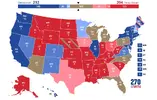
Simplified, if majority of your state votes for a Republican candidate, the states receive a certain amount of points to go towards that party.
1591360756549.webp
You must hit 270 to win
 
I'm not sure what you're trying to argue here.

That Japan is also discriminatory against different races and ethnicity?

Because if you are, then doesn't that support the wider point about black lives and discrimination?

If were talking about institutional racism you have Japanese and non-Japanese based upon processes which allow rights to japanese but not to non japanese.

Youre trying to establish whether different races are treated differently in terms of rights?

Id say its Japanese or non-japanese which defines your rights.

Im unsure what youre trying to achieve here. Youve mentioned "what youre trying to argue here"

I frankly am simply responding to your questions. Im not sure if youre looking for a view on something?

Theres plenty of information on japanese vs non japanese rights.
 
It isn’t. There’s never been a US politics A level. It’s covered in General Politics. Frankly I am shocked that a man that claims to go through women like pages on a calendar.

Were going back decades. Its a politics A level split between US / UK politics.

So yeah both.

Does it really matter?
 
But does every single state allocate electoral votes the same way?
I believe so minus the number your state brings. But the left doesn't like the electoral college and the right does. Honestly needs to be a different way besides a popular vote or a tweaking of the electoral vote because every state is different and has much different needs and wants.
 
If im not wrong this system was preferred by the free states and rejected by all but one of the slave holding states?

Also, i may be wrong but isnt it up to each individual state to allocate votes (number based on senators and representatives).

Do they all allocate to the popular vote?

The number of electoral college votes are assigned based on number of representatives in Congress and senates, yes. (Which in turn is roughly based on relative populations of each state but a little more complicated).

Within each state, who the vote goes to is based on who wins the popular vote within the state. However, votes are allocated winner takes all (and not by proportion of the vote) which is key.

Ie if one candidate gets 51% of the vote within a state, all electoral college votes are allocated to the candidate. Hence why minorities are underrepresented on a regular basis. As generally speaking, the population is 70% white.

(Is your first point trying to say the electoral college system is not racist because slave owning states were against it? It’s kind of irrelevant either way as it was designed before minorities could vote.....)
 
The number of electoral college votes are assigned based on number of representatives in Congress and senates, yes. (Which in turn is roughly based on relative populations of each state but a little more complicated).

Within each state, who the vote goes to is based on who wins the popular vote within the state. However, votes are allocated winner takes all (and not by proportion of the vote) which is key.

Ie if one candidate gets 51% of the vote within a state, all electoral college votes are allocated to the candidate. Hence why minorities are underrepresented on a regular basis. As generally speaking, the population is 70% white.

(Is your first point trying to say the electoral college system is not racist because slave owning states were against it? It’s kind of irrelevant either way as it was designed before minorities could vote.....)

Mostly true - However, Maine and Nebraska split their electoral college, with the overall winner getting a set amount, then the winner of each district also getting a set amount.
 
Mostly true - However, Maine and Nebraska split their electoral college, with the overall winner getting a set amount, then the winner of each district also getting a set amount.
Well I kind of ignored that as it complicated things slightly. 4 out of their 9 votes are allocated this way. The other 5 are as you say.
 
Status
Not open for further replies.

Welcome

Join the Everton conversation today.
Fewer ads, full access, completely free.

🛒 Visit Shop

Support Grand Old Team by checking out our latest Everton gear!
Back
Top