

peteblue
Welcome back Wayne
I am watching Newsnight just now and it seems that if Johnson decides to disobey the Benn Act then the matter will go to court and that Court will be empowered to send the letter itself.
I am watching Newsnight just now and it seems that if Johnson decides to disobey the Benn Act then the matter will go to court and that Court will be empowered to send the letter itself.
No peace treaty of the time did that though - to reform the entire nature of the defeated state if that state was still in being; they just imposed reparations on it (as the Germans had done to others) and stripped colonies and disputed off.
Your point about humiliation was what I was sort of talking about though - Versailles was by no means a savage peace treaty, nor did it humiliate the German state or people (the biggest gripe was that Germany was blamed for starting it, something that was then and is now clearly true). People were (understandably) angry about the war and the loss of so many lives, but rather than acknowledge who was to blame most of German society repeatedly told everyone else that it was a humiliation, that other people had betrayed them, delegitimizing the very real defeat they had suffered when idiot militarists had thought it would be a great idea to start a fight with most of the rest of the world. This was so successful that loads of people still believe it now.

Your view on it is flawed because you seem to think the humiliation was fabricated and solely the result of propaganda. It wasn't - it was real. By the time of the Great Depression it had been over a decade since the war and Germany, a traditional powerhouse in the Balance of Power in Europe prior to WW1, was the worst affected due to the withdrawal of the Dawes Plan, which in itself came into effect to stop hyperinflation. The reason for Hitlers' rise was social suffering and economic hardship rather than simply PR - it can be rationally explained. Democracy failed by 1933. Hitler was in the right place at the right time, whereas Oswald Mosley wasn't here.
That man is insane. Don't know if you've ever heard him actually speak, but he's Rees-Mogg on steroids. Actually insane.
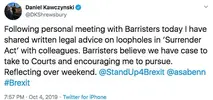
At probably north of £1000 an hour to argue something that hasn't come up yet, I am sure Barristers are encouraging him to pursue it.

I don't agree. Post 1945 Germany started to recover because it was obvious to everyone that they had lost and who had caused that war, and because large parts of society didn't go around telling everyone that someone else was to blame for it. They accepted what had happened (which was far worse than the Great War), dealt with it and moved on (mostly).
I think his intention is to determine precisely who wrote the bill, who contributed, who advised and what communication took place between various parties. I think his argument goes that if we don’t know who wrote it and under what circumstances then it may be unconstitutional. If there is any indication that a foreign power was even slightly part of the process then who knows.....

Got to get there yet mush.Brexit will be scrapped in 18 months time

I don't think there is a single tipping point you can look at and say "That's where it started to go wrong". I think there are markers along the road, though. An example of this I think is the MMR/Autism scandal which I think started in the 90's in the UK. It was probably the first occasion I can remember when the majority (and by majority I mean around 99%) of scientific opinion was routinely questioned or ignored. It also coincided with a move in the more liberal media (particularly organisations like the BBC) to have what they considered balanced debate. Their version of balanced debate was to give equal credence to both sides of any debate, irrespective of where the likelihood of truth lay. This just ended up giving air time etc. to anyone with an opinion, no matter how extreme, and without any real challenging of that opinion by the adjudicators in these debates who seemed to think that their job was to stay neutral. I don't think confidence/belief in science or other areas where experts operate has ever recovered from this and we now have a situation where a politician can say "I think we've all had enough of experts" and nobody really bats an eyelid and he doesn't get challenged at the time he says it. In fact, a large part of the population agree with him. We have allowed a situation to develop where the truth doesn't really matter any more, which is an incredibly sad state of affairs. When you get political advisors using phrases like "alternative facts" when telling outright lies you know things are on a slippery slope.
Coinciding with this, I think there has also been a dumbing down of how complex issues are reported and discussed. I get that most people like simplicity, but there are some issues that can't be simplified into a few trite phrases. Again, the BBC is a good example of this. Go onto their website and rather than seeing any real analysis of the Brexit debate all you seem to get are "Your 1 Minute Guide To Brexit", "What Is A No Deal Brexit?" If we did get another referendum you can guarantee there will be vox pops of people saying "No-one's really explained what it's about." I remember when the BBC used to employ proper journalists, particularly investigative ones but those days seem to be pretty much over now.
You then add into all of that the impact of the internet, where the echo chamber effect just confirms to people that their views must be right because everything they read says the same thing and you have an increasing polarisation of opinion with little or no middle ground or reasoned debate. Everyone becomes demonised. That polarisation then leads to hardening of views and anger/hatred/ridiculing of anyone who disagrees with you and your mob.
Regarding the internet, I think one of the most disastrously laissez faire attitudes we have allowed to take hold in the last 20 years is that internet operations such as Facebook, Twitter etc. are not viewed as publishers and can't be prosecuted for the content posted on their platforms. So we get the absurd situation of having "How to make a bomb using reagents from your kitchen" videos being posted and left up for years. Can you imagine that being sold In Waterstones? It took years to drag these companies to a point where they even started to do something about it.
A lot of these issues have come about, I think, because we chose to become too liberal. We thought that by allowing the extremists - on both sides - to have their say our logical arguments would persuade them to see the error of their ways. We gave them a platform which legitimised their views/attitudes/behaviour and society is now paying the price for that and the old middle ground around which debate used to pivot doesn't really exist anymore.
Yes, too tolerant is a better way to phrase it. It has been well reported that large chunks of western societies feel isolated and their concerns/situation ignored for a long time as you say. I mentioned the MMR/Autism debate in my earlier post, but I think there are other events that have also contributed to where we are now. The MP expenses scandal impacted in a profound way on the general UK populace's views on parliament and corruption from which it has never recovered and led to a breeding ground for the discontent that has now poisoned the Brexit issue. I think the overall lack of respect for politicians of all hues that we see now was impacted massively by this.The financial crash of 2007/2008 did the same for banks/financial corporations, particularly when said banks were bailed out with public money and it was followed by austerity measures which impacted on the people who were feeling most disaffected. When you have a Conservative party looking to go against the rule of law and a Liberal Democrat party ignoring democratic decisions you are living in a very weird place.I agree with all of this except that for "too liberal" I would say "too tolerant".
Some of the most intolerant people I have met or experienced in this and other countries are self-styled "liberals." These same people only tolerate others who have the same "right-on" views as themselves..Anyone with different views to them are ridiculed, and denied access to media or, if they are allowed on media, they are treated to hostile interviewing.
Decades of this attitude from these people who have dominated politics and society have led to what we are seeing increasingly in western countries, where a large number of people have felt ignored, and treated with contempt. This has been fertile ground for populism which feeds on and exacerbates the emotions of people who feel that their views are simply rejected by so-called intelligentsia.
The reaction has seen the likes of Trump, Johnson, and others in Hungary, Netherlands, Austria, Germany etc gaining broad support amongst the disaffected.
A truly tolerant society is one where we say to someone with a different view "I disagree with your views, but I will fight for your right to have those views" - this right of course to be limited by laws against incitement.
Ireland has lurched from one unhappy extreme of conservative domination to the other extreme where moderate Christians of all faiths are ridiculed by the establishment and the media.
I welcome that the Irish people have democratically voted to change the Constitution to permit laws that are much more tolerant of diverse sexual views. However, the large minority that have different views should not be trampled upon, and made to feel like some sort of bigots.
No major backlash of populism here as yet, but it may happen.
Yes, too tolerant is a better way to phrase it. It has been well reported that large chunks of western societies feel isolated and their concerns/situation ignored for a long time as you say. I mentioned the MMR/Autism debate in my earlier post, but I think there are other events that have also contributed to where we are now. The MP expenses scandal impacted in a profound way on the general UK populace's views on parliament and corruption from which it has never recovered and led to a breeding ground for the discontent that has now poisoned the Brexit issue. I think the overall lack of respect for politicians of all hues that we see now was impacted massively by this.The financial crash of 2007/2008 did the same for banks/financial corporations, particularly when said banks were bailed out with public money and it was followed by austerity measures which impacted on the people who were feeling most disaffected. When you have a Conservative party looking to go against the rule of law and a Liberal Democrat party ignoring democratic decisions you are living in a very weird place.
Good post but I don’t agree with that part.
The LibDems are putting forward that proposal as the central plank of this manifesto in the coming election.
So if by some miracle they were to get enough votes to form the next government then it would be incumbent on them to set the result of the Referendum aside as that is the manifesto they were elected on.
Brexit will be scrapped in 18 months time

Join the Everton conversation today.
Fewer ads, full access, completely free.