Pope goes Woke. I've briefly skimmed it, and it does seem to lay the blame on technocrats, whereas imo, it's a tool of finance. Anyway, here's the introductory text, with the Vat. link below. I'm not Catholic btw, I just think it's an interesting perspective on our immediate dangerscape:
APOSTOLIC EXHORTATION
LAUDATE DEUM
OF THE HOLY FATHER
FRANCIS
TO ALL PEOPLE OF GOOD WILL
ON THE CLIMATE CRISIS
1. “Praise God for all his creatures”. This was the message that Saint Francis of Assisi proclaimed by his life, his canticles and all his actions. In this way, he accepted the invitation of the biblical Psalms and reflected the sensitivity of Jesus before the creatures of his Father: “Consider the lilies of the field, how they grow; they neither toil nor spin, yet I tell you, even Solomon in all his glory was not clothed like one of these” (
Mt 6:28-29). “Are not five sparrows sold for two pennies? Yet not one of them is forgotten in God’s sight” (
Lk 12:6). How can we not admire this tenderness of Jesus for all the beings that accompany us along the way!
2. Eight years have passed since I published the Encyclical Letter
Laudato Si’, when I wanted to share with all of you, my brothers and sisters of our suffering planet, my heartfelt concerns about the care of our common home. Yet, with the passage of time, I have realized that our responses have not been adequate, while the world in which we live is collapsing and may be nearing the breaking point. In addition to this possibility, it is indubitable that the impact of climate change will increasingly prejudice the lives and families of many persons. We will feel its effects in the areas of healthcare, sources of employment, access to resources, housing, forced migrations, etc.
3. This is a global social issue and one intimately related to the dignity of human life. The Bishops of the United States have expressed very well this social meaning of our concern about climate change, which goes beyond a merely ecological approach, because “our care for one another and our care for the earth are intimately bound together. Climate change is one of the principal challenges facing society and the global community. The effects of climate change are borne by the most vulnerable people, whether at home or around the world”.
[1] In a few words, the Bishops assembled for the Synod for Amazonia said the same thing: “Attacks on nature have consequences for people’s lives”.
[2] And to express bluntly that this is no longer a secondary or ideological question, but a drama that harms us all, the African bishops stated that climate change makes manifest “a tragic and striking example of structural sin”.
[3]
4. The reflection and information that we can gather from these past eight years allow us to clarify and complete what we were able to state some time ago. For this reason, and because the situation is now even more pressing, I have wished to share these pages with you.
1. The Global Climate Crisis
5. Despite all attempts to deny, conceal, gloss over or relativize the issue, the signs of climate change are here and increasingly evident. No one can ignore the fact that in recent years we have witnessed extreme weather phenomena, frequent periods of unusual heat, drought and other cries of protest on the part of the earth that are only a few palpable expressions of a silent disease that affects everyone. Admittedly, not every concrete catastrophe ought to be attributed to global climate change. Nonetheless, it is verifiable that specific climate changes provoked by humanity are notably heightening the probability of extreme phenomena that are increasingly frequent and intense. For this reason, we know that every time the global temperature increases by 0.5° C, the intensity and frequency of great rains and floods increase in some areas and severe droughts in others, extreme heat waves in some places and heavy snowfall in others.
[4] If up to now we could have heat waves several times a year, what will happen if the global temperature increases by 1.5° C, which we are approaching? Those heat waves will be much more frequent and with greater intensity. If it should rise above 2 degrees, the icecaps of Greenland and a large part of Antarctica
[5] will melt completely, with immensely grave consequences for everyone.
Resistance and confusion
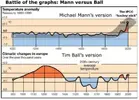
6. In recent years, some have chosen to deride these facts. They bring up allegedly solid scientific data, like the fact that the planet has always had, and will have, periods of cooling and warming. They forget to mention another relevant datum: that what we are presently experiencing is an unusual acceleration of warming, at such a speed that it will take only one generation – not centuries or millennia – in order to verify it. The rise in the sea level and the melting of glaciers can be easily perceived by an individual in his or her lifetime, and probably in a few years many populations will have to move their homes because of these facts.
7. In order to ridicule those who speak of global warming, it is pointed out that intermittent periods of extreme cold regularly occur. One fails to mention that this and other extraordinary symptoms are nothing but diverse alternative expressions of the same cause: the global imbalance that is provoking the warming of the planet. Droughts and floods, the dried-up lakes, communities swept away by seaquakes and flooding ultimately have the same origin. At the same time, if we speak of a global phenomenon, we cannot confuse this with sporadic events explained in good part by local factors.
8. Lack of information leads to confusion between large-scale climate projections that involve long periods of time – we are talking about decades at least – with weather forecasts that at most can cover a few weeks. When we speak of climate change, we are referring to a global reality – and constant local variations – that persists for several decades.
9. In an attempt to simplify reality, there are those who would place responsibility on the poor, since they have many children, and even attempt to resolve the problem by mutilating women in less developed countries. As usual, it would seem that everything is the fault of the poor. Yet the reality is that a low, richer percentage of the planet contaminates more than the poorest 50% of the total world population, and that per capita emissions of the richer countries are much greater than those of the poorer ones.
[6] How can we forget that Africa, home to more than half of the world’s poorest people, is responsible for a minimal portion of historic emissions?
10. It is often heard also that efforts to mitigate climate change by reducing the use of fossil fuels and developing cleaner energy sources will lead to a reduction in the number of jobs. What is happening is that millions of people are losing their jobs due to different effects of climate change: rising sea levels, droughts and other phenomena affecting the planet have left many people adrift. Conversely, the transition to renewable forms of energy, properly managed, as well as efforts to adapt to the damage caused by climate change, are capable of generating countless jobs in different sectors. This demands that politicians and business leaders should even now be concerning themselves with it.
[...]
Whole Text



 www.nature.com