

You are using an out of date browser. It may not display this or other websites correctly.
You should upgrade or use an alternative browser.
You should upgrade or use an alternative browser.
Current Affairs Coronavirus Thread - Serious stuff !!!
- Thread starter bullybeef
- Start date
- Status
- Not open for further replies.

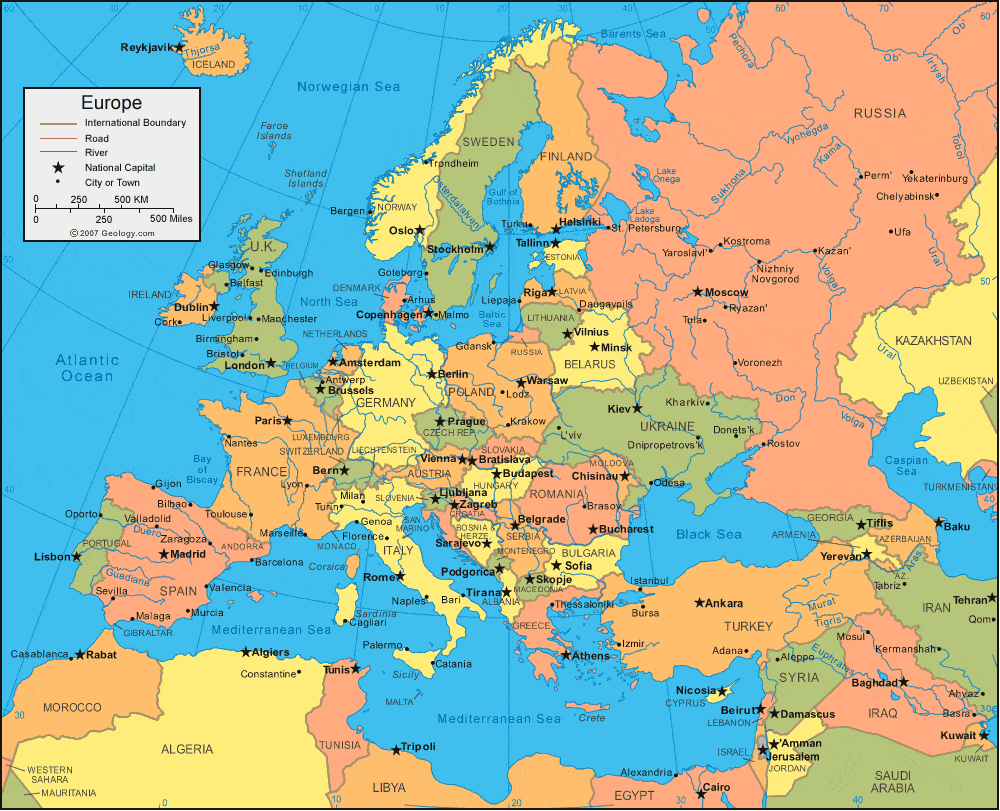
It's okay, the Czechs are opening everything up on Monday
Kroj Republic.

roydo
in memoriam - 1965-2024
It's okay, the Czechs are opening everything up on Monday
Excuse my geographic ignorance, but what colour are they?

Purple, next to the big orange Germany.Excuse my geographic ignorance, but what colour are they?
And yes, I googled.

BlueStevie35
Player Valuation: £70m
Hospital figures - 37 deaths were announced today, down 8 on yesterday and down 14 on last Friday. 33 deaths were in English hospitals, down 1 on yesterday and down 10 on last week. The 7 day rolling average falls to 32.71
All settings - for the 28 day cut off, 60 deaths were announced today, up 7 on yesterday and up 8 on last Friday. The 7 day rolling average rises to an even 32
For the 60 day cut off, 124 deaths were announced today, up 39 on yesterday and down 23 on last Friday. The 7 day rolling average falls to 64.71
All settings - for the 28 day cut off, 60 deaths were announced today, up 7 on yesterday and up 8 on last Friday. The 7 day rolling average rises to an even 32
For the 60 day cut off, 124 deaths were announced today, up 39 on yesterday and down 23 on last Friday. The 7 day rolling average falls to 64.71

Barnfred 55
Player Valuation: £80m
That's the one that was on the Sky website the other day. I thought it was really good the way they explained it so simply.Might be of interest btw - "Communicating the potential benefits and harms of the Astra-Zeneca COVID-19 vaccine" from Cambridge.

peteblue
Welcome back Wayne
Excuse my geographic ignorance, but what colour are they?
Racist.....
roydo
in memoriam - 1965-2024
Racist.....
I married a purple person, and know quite a few red and orange ones, so not really.

Going to be an important counterbalance of risks/rewards of vaccine if younger women do turn out to be the ones most at risk in vaccine related clotting events,

davek
Player Valuation: £150m
Good debate in Prospect magazine between two epidemiologists (which gets a bit heated) about the future strategy on Covid19 (in particular, the question of eliminating it).....
ByGabriel Scally&Sunetra Gupta
March 29, 2021
MAY 2021
Yes—Gabriel Scally
The destruction wrought by Covid so far is monumental. This virus has inflicted disease and death wherever it has been permitted to. So of course elimination is the safest UK policy.
That is how we deal successfully with other dangerous infectious diseases. Elimination is often confused with eradication, which means no cases occur anywhere in the world, so countries can drop all preventive measures. Eradication of the virus entirely is unfortunately not achievable in the foreseeable future. But we can and should aim to prevent cases within the UK from spreading.
As vaccination continues to deliver substantial reductions in deaths, we need to think ahead about what measures will be required to stop sporadic outbreaks or resurgence. Continued protection against new variants may necessitate the development of modified vaccines.
There will also be a continuing requirement for social and economic restrictions until cases fall to a very low level, particularly because there is no vaccine yet proved safe for under-18s. And even after they are lifted generally, there must be a willingness to reintroduce restrictions locally or nationally if needed. We must rebuild our depleted public health system in local areas across England to help rapidly suppress future outbreaks, which will also stand us in good stead for dealing with future infectious threats. It might additionally help the UK regain its standing as a country that eliminated measles, a status we lost in 2016.
The benefits of taking the elimination route are obvious. By preventing ongoing transmission, we will avoid developing a dangerous home-grown variant. The more countries we can co-operate with in taking this route, the safer the world becomes.
No—Sunetra Gupta
Those pursuing a safe public health goal must consider all the costs associated with their policy and, in the case of infectious disease, understand the natural history of the pathogen. Not all pathogens are the same; elimination is a realistic goal for measles, where vaccination confers lifelong immunity and is the only way of preventing deaths in childhood.
Covid-19 belongs to an entirely different category. Immunity is not lifelong and re-infection is common, even though subsequent reinfections rarely lead to disease. It would be foolish to expect vaccine-induced immunity to last longer than natural immunity—as many vaccinologists know from bitter experience. To achieve elimination through repeated vaccination and draconian restrictions would require investment on a scale that would dwarf anything we allocate to the many other pressing public health problems.
The good news is there is another solution. The vaccines have shown high efficacy against severe disease, and the indications are that this will hold for new variants. By using them to protect the vulnerable and letting natural immunity accumulate among those who are not especially at risk, we can avoid the unconscionable collateral damage caused by indefinite suppression, while also minimising Covid deaths.
Elimination is neither feasible nor necessary. The likelihood is that this virus will settle to the stable state characteristic of the seasonal coronaviruses currently in circulation (mainly causing common colds), where maintenance of herd immunity through natural infection keeps the risk among vulnerable populations low. To rely instead on lockdowns and border closures constitutes a profound dereliction of duty towards those most affected by such actions—the underprivileged and the young—across the world.
Yes—Gabriel Scally - You give insufficient weight to the fact that, in almost complete contrast to every other aspect of its response, the UK’s vaccination effort has been excellent. As vaccination levels rise, we can end lots of restrictions without any need for a dangerous reliance on the protection that follows infection. It is too early to say how long immunity given by the vaccine will last and whether a booster might be required. But if that is needed, so be it.
The alternative proposition, the acquisition of “natural immunity” by most of the population, will require far more people to become infected. That is a truly frightening prospect. Firstly, you can’t easily divide the population into “vulnerable” and “not vulnerable”; there will be millions of people with conditions that place them at moderate risk. If you now let the virus spread without constraint, a significant number of them will die from this preventable disease.
Secondly, higher infection rates will produce far more suffering from “long Covid,” a debilitating disorder that can affect even those who do not develop acute illness.
Thirdly, and contrary to what you suggest, natural immunity actually appears to offer limited protection against new variants. The experience in Manaus in Brazil is that a high level of infection (76 per cent by October 2020) was no protection when a second wave hit. Deaths and hospitalisation soared to higher levels than in the first wave. If that’s “natural immunity,” I’d rather have the vaccine.
I agree we have had too many “lockdowns.” That is not an argument against suppression, but for doing it more effectively. These measures could mostly have been avoided if we had kept the virus at very low levels in the first place, and avoided importing dangerous variants. Vaccines plus elimination now give us the chance to do a better job of protecting lives than we have done so far.
No—Sunetra Gupta —We agree that the UK has excelled on vaccines, but their role in preventing infection remains unclear. This is not a problem as the goal is to reduce death, not infection. We have now achieved this by protecting the most vulnerable.
To have continued with restrictions for so long already constitutes an inexcusable indifference to the collateral harm done. You claim “many millions” will die if we accelerate the opening up. The data does not support this. Some will indeed endure long-term symptoms, and must be supported, but it is hard to see how the collective danger from long Covid can justify the harms of draconian restrictions. A recent paper reports that just 2.2 per cent of Covid patients continue to experience symptoms such as loss of breath, fatigue or unusual muscle pains 12 weeks after recovery. Set this against the exacerbation of inequalities suffered by millions as a consequence of lockdowns, resulting in starvation, eviction and suicide.
Data from across the world, including the UK, now strongly suggests herd immunity has played a significant role in containing infection. It is far more plausible that the blood samples used in Manaus were unrepresentative of the population than that some monstrous new variant re-invaded an immune population. In any case, the vaccines are likely to remain effective in protecting against severe disease and death from new variants.
But because neither the vaccine nor natural immunity is likely to confer lifelong protection against infection, the virus is bound to remain in circulation. The effort and cost that would be required to drive SARS-CoV-2 off the face of this earth does not make sense. As the test and trace fiasco has shown, the road to elimination is littered with predictable failures, not to mention vast and fruitless expenditure that could have been put to better use in offering focused protection to those at high risk.
Yes—Gabriel Scally —The pandemic has seen a proliferation of novel theories about the correct response, including from academics far removed from the implementation of infectious disease control programmes. In terms of preventing infections, saving lives and preserving social and economic functioning, the most successful tactics internationally have proved to be tried-and-tested public health methods: halting spread by reducing travel, increasing social distancing, and actively finding infected people and isolating them and their close contacts, though none of these core public health responses have been implemented competently in the UK.
One thing is obvious: we still don’t know enough to foretell the long-term scenario. We do know Covid has caused almost three million deaths globally. It is also conceivable that the virus may have enduring effects, perhaps neurological, that do not manifest immediately. I have a particular concern about children, whose brains are still developing. You, on the other hand, are quoted as saying “not only is it a good thing for young people to go out there and become immune, but that is almost their duty.” Encouraging people to get the infection is shocking and unacceptable.
Yes, we have had too many lockdowns. We need to use vaccination, nationally and globally, to suppress the virus. And if the UK had a coherent strategy, which it doesn’t, elimination would be at its core. In addition to vaccination, we need an effective local health infrastructure to damp down flare-ups and keep the virus under control: with that comes the chance to understand the virus better and maintain stability into the future. We cannot afford to take a chance on theoretical musings—as the government did a year ago with its deeply flawed herd immunity approach that let the virus rip. We have been through enough. It’s time to eliminate this virus, just as we have done with many others.
No—Sunetra Gupta —You imply I lack practical experience in infectious disease control. I have worked in the field at a theoretical and practical level for decades; published in high-impact journals on controlling HIV, pneumonia, malaria and Hepatitis B among other diseases; and more recently developed and patented a novel flu vaccine.
In any case, the arguments against elimination as a strategy are neither novel nor esoteric, but based on basic epidemiology and pre-existing public health recommendations. It is the strategy of enforced lockdowns that should be regarded as unconventional and subject to scrutiny, given how ineffective lockdowns have been. Governments chose to pursue these measures rather than the focused protection of older, high-risk people—and still failed to eliminate Covid. Meanwhile they inflicted great economic, social and health damage. Elimination is, frankly, dangerous compared to the safer and better understood approach of targeted protection.
There are many respiratory pathogens where the risk of infection is kept low among the vulnerable by the acquisition of natural immunity among those who are not vulnerable. Covid-19 is no different. In my understanding of the social contract, encouraging this acquisition is a far greater “duty” than measures such as wearing masks, whose benefits remain unproven. Hence my choice of words.
We must also be careful to use our vaccine reserves to protect those around the world who are at risk of severe disease, rather than dispensing them first to those at negligible risk in an attempt to keep our own communities completely infection-free. Our domestic vaccination success story should focus on those who need protection, and then we must return to an internationally inclusive mindset.

 www.prospectmagazine.co.uk
The duel: Is eliminating Covid-19 worth it?
A public health imperative, or socially and medically backwards? Our panellists debate the propositionByGabriel Scally&Sunetra Gupta
March 29, 2021
MAY 2021
Yes—Gabriel Scally
The destruction wrought by Covid so far is monumental. This virus has inflicted disease and death wherever it has been permitted to. So of course elimination is the safest UK policy.
That is how we deal successfully with other dangerous infectious diseases. Elimination is often confused with eradication, which means no cases occur anywhere in the world, so countries can drop all preventive measures. Eradication of the virus entirely is unfortunately not achievable in the foreseeable future. But we can and should aim to prevent cases within the UK from spreading.
As vaccination continues to deliver substantial reductions in deaths, we need to think ahead about what measures will be required to stop sporadic outbreaks or resurgence. Continued protection against new variants may necessitate the development of modified vaccines.
There will also be a continuing requirement for social and economic restrictions until cases fall to a very low level, particularly because there is no vaccine yet proved safe for under-18s. And even after they are lifted generally, there must be a willingness to reintroduce restrictions locally or nationally if needed. We must rebuild our depleted public health system in local areas across England to help rapidly suppress future outbreaks, which will also stand us in good stead for dealing with future infectious threats. It might additionally help the UK regain its standing as a country that eliminated measles, a status we lost in 2016.
The benefits of taking the elimination route are obvious. By preventing ongoing transmission, we will avoid developing a dangerous home-grown variant. The more countries we can co-operate with in taking this route, the safer the world becomes.
No—Sunetra Gupta
Those pursuing a safe public health goal must consider all the costs associated with their policy and, in the case of infectious disease, understand the natural history of the pathogen. Not all pathogens are the same; elimination is a realistic goal for measles, where vaccination confers lifelong immunity and is the only way of preventing deaths in childhood.
Covid-19 belongs to an entirely different category. Immunity is not lifelong and re-infection is common, even though subsequent reinfections rarely lead to disease. It would be foolish to expect vaccine-induced immunity to last longer than natural immunity—as many vaccinologists know from bitter experience. To achieve elimination through repeated vaccination and draconian restrictions would require investment on a scale that would dwarf anything we allocate to the many other pressing public health problems.
The good news is there is another solution. The vaccines have shown high efficacy against severe disease, and the indications are that this will hold for new variants. By using them to protect the vulnerable and letting natural immunity accumulate among those who are not especially at risk, we can avoid the unconscionable collateral damage caused by indefinite suppression, while also minimising Covid deaths.
Elimination is neither feasible nor necessary. The likelihood is that this virus will settle to the stable state characteristic of the seasonal coronaviruses currently in circulation (mainly causing common colds), where maintenance of herd immunity through natural infection keeps the risk among vulnerable populations low. To rely instead on lockdowns and border closures constitutes a profound dereliction of duty towards those most affected by such actions—the underprivileged and the young—across the world.
Yes—Gabriel Scally - You give insufficient weight to the fact that, in almost complete contrast to every other aspect of its response, the UK’s vaccination effort has been excellent. As vaccination levels rise, we can end lots of restrictions without any need for a dangerous reliance on the protection that follows infection. It is too early to say how long immunity given by the vaccine will last and whether a booster might be required. But if that is needed, so be it.
The alternative proposition, the acquisition of “natural immunity” by most of the population, will require far more people to become infected. That is a truly frightening prospect. Firstly, you can’t easily divide the population into “vulnerable” and “not vulnerable”; there will be millions of people with conditions that place them at moderate risk. If you now let the virus spread without constraint, a significant number of them will die from this preventable disease.
Secondly, higher infection rates will produce far more suffering from “long Covid,” a debilitating disorder that can affect even those who do not develop acute illness.
Thirdly, and contrary to what you suggest, natural immunity actually appears to offer limited protection against new variants. The experience in Manaus in Brazil is that a high level of infection (76 per cent by October 2020) was no protection when a second wave hit. Deaths and hospitalisation soared to higher levels than in the first wave. If that’s “natural immunity,” I’d rather have the vaccine.
I agree we have had too many “lockdowns.” That is not an argument against suppression, but for doing it more effectively. These measures could mostly have been avoided if we had kept the virus at very low levels in the first place, and avoided importing dangerous variants. Vaccines plus elimination now give us the chance to do a better job of protecting lives than we have done so far.
No—Sunetra Gupta —We agree that the UK has excelled on vaccines, but their role in preventing infection remains unclear. This is not a problem as the goal is to reduce death, not infection. We have now achieved this by protecting the most vulnerable.
To have continued with restrictions for so long already constitutes an inexcusable indifference to the collateral harm done. You claim “many millions” will die if we accelerate the opening up. The data does not support this. Some will indeed endure long-term symptoms, and must be supported, but it is hard to see how the collective danger from long Covid can justify the harms of draconian restrictions. A recent paper reports that just 2.2 per cent of Covid patients continue to experience symptoms such as loss of breath, fatigue or unusual muscle pains 12 weeks after recovery. Set this against the exacerbation of inequalities suffered by millions as a consequence of lockdowns, resulting in starvation, eviction and suicide.
Data from across the world, including the UK, now strongly suggests herd immunity has played a significant role in containing infection. It is far more plausible that the blood samples used in Manaus were unrepresentative of the population than that some monstrous new variant re-invaded an immune population. In any case, the vaccines are likely to remain effective in protecting against severe disease and death from new variants.
But because neither the vaccine nor natural immunity is likely to confer lifelong protection against infection, the virus is bound to remain in circulation. The effort and cost that would be required to drive SARS-CoV-2 off the face of this earth does not make sense. As the test and trace fiasco has shown, the road to elimination is littered with predictable failures, not to mention vast and fruitless expenditure that could have been put to better use in offering focused protection to those at high risk.
Yes—Gabriel Scally —The pandemic has seen a proliferation of novel theories about the correct response, including from academics far removed from the implementation of infectious disease control programmes. In terms of preventing infections, saving lives and preserving social and economic functioning, the most successful tactics internationally have proved to be tried-and-tested public health methods: halting spread by reducing travel, increasing social distancing, and actively finding infected people and isolating them and their close contacts, though none of these core public health responses have been implemented competently in the UK.
One thing is obvious: we still don’t know enough to foretell the long-term scenario. We do know Covid has caused almost three million deaths globally. It is also conceivable that the virus may have enduring effects, perhaps neurological, that do not manifest immediately. I have a particular concern about children, whose brains are still developing. You, on the other hand, are quoted as saying “not only is it a good thing for young people to go out there and become immune, but that is almost their duty.” Encouraging people to get the infection is shocking and unacceptable.
Yes, we have had too many lockdowns. We need to use vaccination, nationally and globally, to suppress the virus. And if the UK had a coherent strategy, which it doesn’t, elimination would be at its core. In addition to vaccination, we need an effective local health infrastructure to damp down flare-ups and keep the virus under control: with that comes the chance to understand the virus better and maintain stability into the future. We cannot afford to take a chance on theoretical musings—as the government did a year ago with its deeply flawed herd immunity approach that let the virus rip. We have been through enough. It’s time to eliminate this virus, just as we have done with many others.
No—Sunetra Gupta —You imply I lack practical experience in infectious disease control. I have worked in the field at a theoretical and practical level for decades; published in high-impact journals on controlling HIV, pneumonia, malaria and Hepatitis B among other diseases; and more recently developed and patented a novel flu vaccine.
In any case, the arguments against elimination as a strategy are neither novel nor esoteric, but based on basic epidemiology and pre-existing public health recommendations. It is the strategy of enforced lockdowns that should be regarded as unconventional and subject to scrutiny, given how ineffective lockdowns have been. Governments chose to pursue these measures rather than the focused protection of older, high-risk people—and still failed to eliminate Covid. Meanwhile they inflicted great economic, social and health damage. Elimination is, frankly, dangerous compared to the safer and better understood approach of targeted protection.
There are many respiratory pathogens where the risk of infection is kept low among the vulnerable by the acquisition of natural immunity among those who are not vulnerable. Covid-19 is no different. In my understanding of the social contract, encouraging this acquisition is a far greater “duty” than measures such as wearing masks, whose benefits remain unproven. Hence my choice of words.
We must also be careful to use our vaccine reserves to protect those around the world who are at risk of severe disease, rather than dispensing them first to those at negligible risk in an attempt to keep our own communities completely infection-free. Our domestic vaccination success story should focus on those who need protection, and then we must return to an internationally inclusive mindset.
The duel: Is eliminating Covid-19 worth it? - Prospect Magazine
A public health imperative, or socially and medically backwards? Our panellists debate the proposition
www.prospectmagazine.co.uk

LEONARD
Player Valuation: £60m
Racist.....
'Racist' has slipped down the charts this week to number 5.
'Transphobic' is in at number 1 with a smash.
'Islamophobic' remains at number 2.
Has 'covid phobic' entered the lexicon yet?
roydo
in memoriam - 1965-2024
- Status
- Not open for further replies.
Welcome
Join the Everton conversation today.
Fewer ads, full access, completely free.