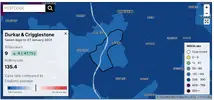
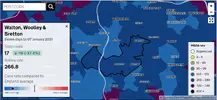
This is the rolling data for my area.
The 'rolling rate' is calculated as such: "Seven–day rates are expressed per 100,000 population and are calculated by dividing the seven day count by the area population and multiplying by 100,000."
I'm not sure if this is the modelling issue which
@Tubey was speaking of the other day?
Durkar and Crigglestone are much more densely populated than Woolley, Walton or Notton, which are small, rural villages. So I guess that it's because the case rate 'per 100,000' (based on that above calculation) is higher in those areas simply because the population of the places is lower? So if you have one outbreak, it will make the numbers look a fair bit worse?
View attachment 113914