

Alanbileysfeathercut
Player Valuation: £80m
Good adviceYou can buy special paint to seal it off so they don't pick up on it. Mind you should have done that before you had them around!
Would you buy a house with rotten skirting boards?
I wouldn't
Good adviceYou can buy special paint to seal it off so they don't pick up on it. Mind you should have done that before you had them around!


Cheers for that mate, how did you prove that it wasn't rising damp?
Miss Jones was hot

Good advice
Would you buy a house with rotten skirting boards?
I wouldn't

It's on an inside wall, living room ground floor mate
I think I read a ‘which’ report a while ago that tested a number of the top damp proof companies. Some missed the real damp, others ‘found’ damp where none was present, most suggested the wrong treatments....it’s a bloody minefield.....
Age / type of house.
Last time damp course was done.
Whether I dried clothes in the house.
Type of floor etc etc.
I never opened the windows during the Winter / when it was cold and the house was storing the damp.
I`ve never known anyone who sold a house (other than a relatively new one ), where they didn`t find some type of damp.
The surveyors do it, as it looks like they`ve done something and it justifys their fee to the client.

I mean that's still a bad problem because the condensation will come back when it's cold, unless you heat up the entire house evenly everywhere.Hi mate.
Before you start chucking money around and ripping plaster off, do a bit of research.
A surveyor comes around with a damp meter and sticks it on the wall, hey presto you`ve got a damp problem.
Wrong, damp can be caused by loads of things that are easily remedied, without having to going nuclear.
There`s load of really good builders / DIY forums that will really help you and possibly save you thousands.
They always find damp and either make a generic diagnosis of rising damp or that the damp course has failed.
It`s in the interests of the surveyor to get money knocked off for the buyer, it`s what they do.
It could well be that the problem lies with your neighbour and not you.
As I said, have a look at those forums, there`ll be loads of stuff on damp and it`s causes.
* I sold a Victorian Terrace house and they found " rising damp " and tried to knock thousands off - it was condensation and remedied by opening all the windows in the house and getting a dehumidifier.
These are good points. Obviously if the board is rotten it indicates a more serious case of damp or the above has been going on for years.
But opening up the house, hiring a dehumidifier + replacing bad skirting board may have been enough to let it pass.

I mean that's still a bad problem because the condensation will come back when it's cold, unless you heat up the entire house evenly everywhere.
But it's usually bad outside insulation (be it walls or windows), so it's not *that* hard to fix... unless it has to preserve the Victorian look I guess...
Yup. It's pretty horrible to deal with as well.Spot on, which is why I had to buy a dehumidifier.
Victorian houses where built to have an open fire in every room, which dried the house out and not central heating, hence the condensation build up in the Winter when the heating is on.

Agreed.Hi mate.
Before you start chucking money around and ripping plaster off, do a bit of research.
A surveyor comes around with a damp meter and sticks it on the wall, hey presto you`ve got a damp problem.
Wrong, damp can be caused by loads of things that are easily remedied, without having to going nuclear.
There`s load of really good builders / DIY forums that will really help you and possibly save you thousands.
They always find damp and either make a generic diagnosis of rising damp or that the damp course has failed.
It`s in the interests of the surveyor to get money knocked off for the buyer, it`s what they do.
It could well be that the problem lies with your neighbour and not you.
As I said, have a look at those forums, there`ll be loads of stuff on damp and it`s causes.
* I sold a Victorian Terrace house and they found " rising damp " and tried to knock thousands off - it was condensation and remedied by opening all the windows in the house and getting a dehumidifier.

Agreed. An industry full of Tory voting, white van men.It`s an industry based on the client believing them at face value and largely unregulated.
Anyone can go and get the kit to sort out a damp proof course and they`re in business as a " damp specialist ".

Our exclusive Everton pint glasses are a true collector’s item that pays homage to Goodison Park through iconic players who have graced the pitch over different generations.
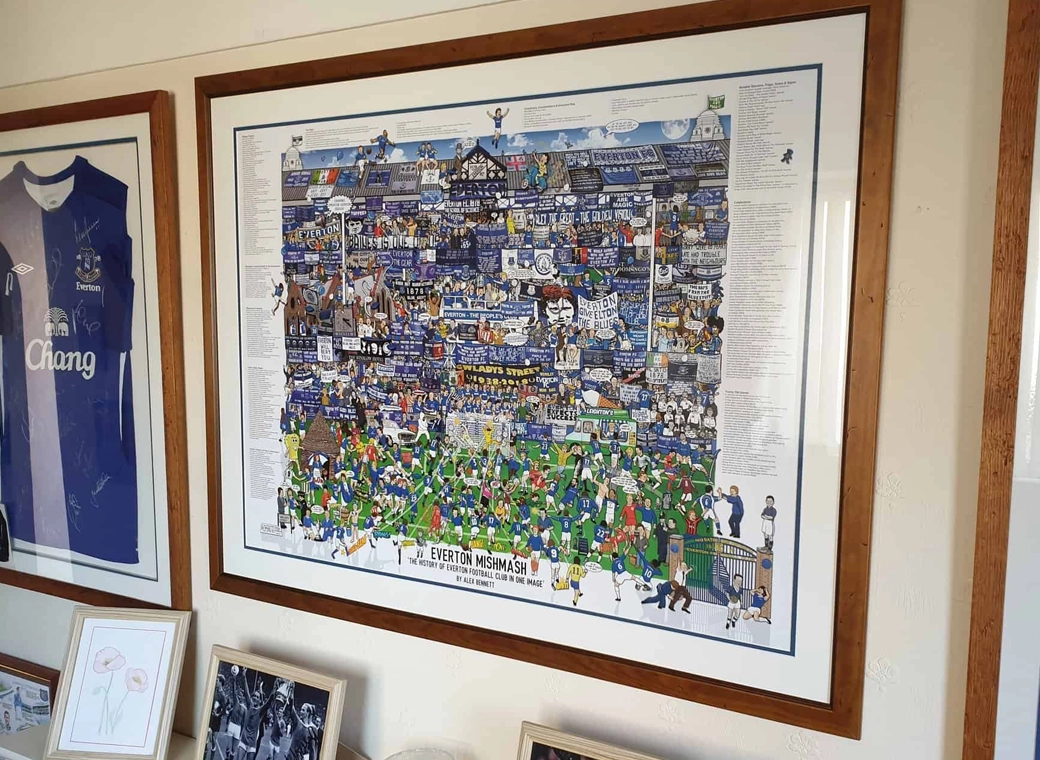
The history of Everton FC in one image! “The best Everton thing I’ve ever got!”

A truly, wonderful piece which brings memories of visits to Goodison Park alive.

This print wonderfully encapsulates the magic of the ‘Goodison Under The Lights’.

A wonderful, A3 aerial print of Goodison Park.

A special, limited edition 1,000 piece jigsaw of the popular Everton Mishmash – The History Of Everton FC In One Image!

Introducing our Goodison Gang Everton T-Shirt.

Our newest Everton T-Shirt.

Everton champions, legends, and long-time servants assembled together in one squad photo!