The 2015 Popularity Contest (aka UK General Election )

Who will you be voting for?

  • Tory

    Votes: 38 9.9%
  • Diet Tory (Labour)

    Votes: 132 34.3%
  • Tory Zero (Greens)

    Votes: 44 11.4%
  • Extra Tory with lemon (UKIP)

    Votes: 40 10.4%
  • Lib Dems

    Votes: 9 2.3%
  • Other

    Votes: 31 8.1%
  • Cheese on toast

    Votes: 91 23.6%

  • Total voters
    385
  • Poll closed .
Status
Not open for further replies.
Here's a question for you, Bruce. Why are the rich getting richer and the poor poorer?

Not answering for Bruce, just as an interested observer.

But it is kind of obvious isnt it? And I dont mean that is right, just that money makes money.

Like a rise in inflation, or bus fares, or a drop in income of £20pw will have a bigger impact on a poor person, than a rich one.

I know your concerns re inequality et al, and I dont want to reopen that, but it is an interesting theoretical discussion. And before I am jumped on, I firmly believe that the richer in society have a moral obligation to help in making life for those less fortunate better. We might disagree on how best to address that, but pretty sure you would be ok with that.

And this is from someone who has seen their income fall by about 80% from its highest to its current level.
 
Here's a question for you, Bruce. Why are the rich getting richer and the poor poorer?

Crikey, that's a complicated one. Probably a combination of a whole host of issues, including perhaps:

  • globalisation, with both larger markets to sell into (thus making more money for those with capital), and also greater competition for labour
  • technology, with an increasing number of white collar as well as blue collar jobs under threat (whilst again, making money for those who own the technology). Of course, this isn't just robots taking our jobs, but platforms emerging whereby people can do the work of professionals well enough, and they're happy to do so for free. I mean none of the Huffington Post writers get paid, yet the quality of their writing is still decent. People seem just as happy with an Uber car as they do a normal taxi. Instagram famously have a whole lot less employees than Kodak did and so on.
The general gist though is that if you manage to succeed in the modern world, then you can probably get very wealthy indeed because your markets are much larger (potentially), but there are some clear pressures on wages.

Of course, it's way more complicated than that.

What would Jesus do?

Play for Everton (and break his leg in his first match)
 
Not answering for Bruce, just as an interested observer.

But it is kind of obvious isnt it? And I dont mean that is right, just that money makes money.

Like a rise in inflation, or bus fares, or a drop in income of £20pw will have a bigger impact on a poor person, than a rich one.

I know your concerns re inequality et al, and I dont want to reopen that, but it is an interesting theoretical discussion. And before I am jumped on, I firmly believe that the richer in society have a moral obligation to help in making life for those less fortunate better. We might disagree on how best to address that, but pretty sure you would be ok with that.

And this is from someone who has seen their income fall by about 80% from its highest to its current level.
You Tory filth, Roy.
 
Interesting answers so far.

Here's another one:

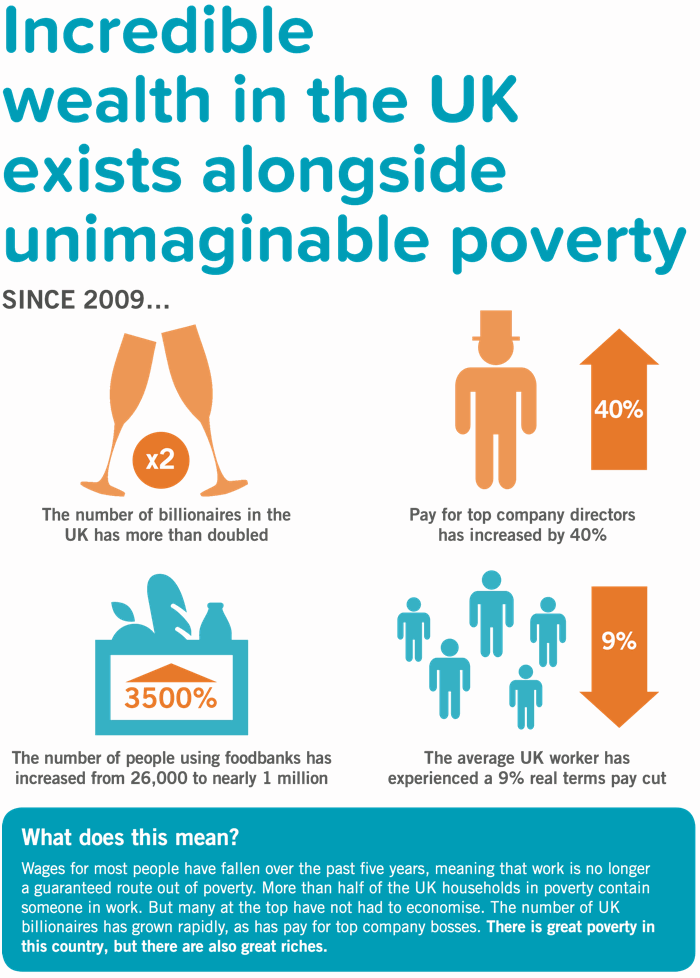
Do you see the constant and relentless redirection of wealth from the poor to the rich as a bad thing?

(Supplemental question: where does it all end?)
 
ib2015-4-700.png


Call me a rabid Marxist class warrior, but that just doesn't look right to me.
 
Firstly I don't think there is a redirection of wealth from poor to rich. By their very nature, the poor don't have much wealth to begin with. It's increasingly difficult for folks with fewer skills though I think as lowly skilled jobs are often either outsourced somewhere cheaper or mechanised.

It's easy to fall into a bubble of thinking we're not effected by what the rest of the world does, but unless world trade grinds to a halt (which isn't going to happen), it's likely that we're competing for work not just with people locally but others around the world. That places a huge emphasis on skills.
 
Interesting answers so far.

Here's another one:

Do you see the constant and relentless redirection of wealth from the poor to the rich as a bad thing?

(Supplemental question: where does it all end?)

If, and it is big if, "wealth" was finite thing, then yes. I would. Because it would mean rich people are getting richer because poor people are getting poorer.

But I dont believe the correlation is absolute.

For example, taking my example of a poor person losing £20 pw in income, say because of inflation/benefits/reduction in hours. That £20pw does not automatically head straight to the pockets of a rich person.

Or, in a ridiculous example, but extremes can often make a point well. Say I found out that the painting on my wall was worth £30m so sold it. I have become richer, but no one has become poorer. In fact one person has. The rich person who bought it, cos the £30m painting carried a £6m commission to the auction house.
 
Firstly I don't think there is a redirection of wealth from poor to rich. By their very nature, the poor don't have much wealth to begin with. It's increasingly difficult for folks with fewer skills though I think as lowly skilled jobs are often either outsourced somewhere cheaper or mechanised.

It's easy to fall into a bubble of thinking we're not effected by what the rest of the world does, but unless world trade grinds to a halt (which isn't going to happen), it's likely that we're competing for work not just with people locally but others around the world. That places a huge emphasis on skills.

Of course there is a redirection. The corporations would make their grannies work the night shift for a fraction of the minimum wage if they could get away with it.
 
To give you an example from the teaching profession. I don't think they will, but lets assume that MOOCs grow from their current base as an interesting yet largely marginal activity towards something that replaces higher education in a big way.

You'd then have a situation whereby students wouldn't need to listen to their third division standard maths teacher, they could get all their lessons from the best teacher in the world because the platform would place no limits on how many people that person could teach.

That would make the very best teachers very wealthy, and the rest much less so (or even out of work entirely).

Obviously that's a far fetched example, but it serves to illustrate a point. Barriers to trade now are very small, so the best can trade around the world, so they make a lot of money. Those who aren't as good therefore lose out because people want to use the best rather than them.

From a consumer perspective, this is great because you get access to a world class teacher and because they're serving potentially huge numbers, you're probably paying much less than before. From a societal perspective however, the 'wealth' is concentrated in fewer hands.

Whether this is an inevitable trend, and what to do about it if it is, is something that's still largely up for debate, although I posted up a couple of papers on the topic to the thread a long time ago now. Speaking with BIS today, they're putting together a report on it too, although when that's published I've no idea.
 
Status
Not open for further replies.

Welcome

Join the Everton conversation today.
Fewer ads, full access, completely free.

🛒 Visit Shop

Support Grand Old Team by checking out our latest Everton gear!
Back
Top