Some context for the current election campaign is contained in the recently published table below. The two poles of credibility are now quite familiar: nurses at the top, politicians at the bottom. Journalists are perched slightly above politicians (and advertisers), though I wonder how much further

www.perc.org.uk
Some context for the current election campaign is contained in the recently published table below. The two poles of credibility are now quite familiar: nurses at the top, politicians at the bottom. Journalists are perched slightly above politicians (and advertisers), though I wonder how much further damage the events of the last few weeks will have done to trust in the media. In any case, the
collapsing distinction between ‘the media’ and ‘politics’ that has been deliberately triggered by Boris Johnson’s team means that the interface of politics and news is now probably the most dubious of all: incredulity squared.

The Conservatives have a clear strategy for pursuing power in circumstances where trust in institutions has evaporated. Firstly, they do whatever they can to quash efforts to establish fairness, objectivity or critical distance on events, by trolling (renaming their twitter account ‘Fact check’), distraction (Michael Gove turning a climate change debate into a phoney story about how they wouldn’t allow ‘a conservative’, i.e. him, to participate) and provoking gratuitous outrage (Johnson’s ducking out of the Andrew Neil interview). To the extent that this election has been a horrible public experience, this is partly by design: the Conservative strategy is to try and alienate the public from politics even further, not least so that the Labour policy of a second referendum comes to appear unbearable. “We know you’ve had enough of all this politics – and only we can make it stop” is the Tory pitch, like torturers gently explaining to the tortured party what they need to say.
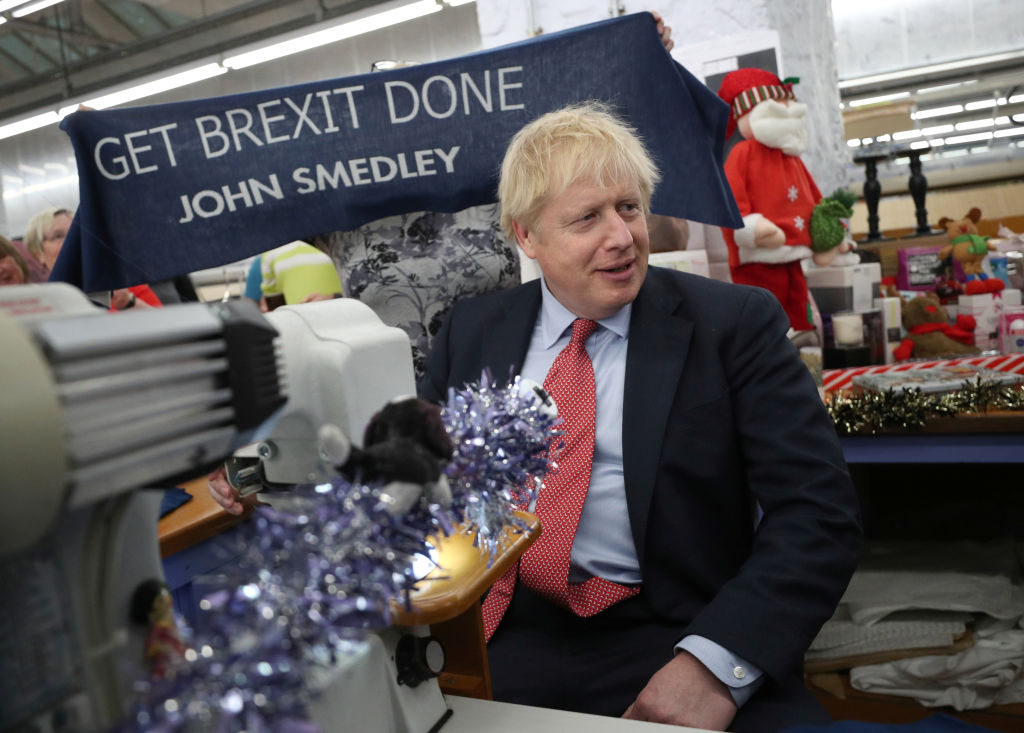
Secondly, on the assumption that all politicians are liars and frauds, and the media little better, they offer a national motto that offers a form of truth (or belief), when factual accounts have all collapsed: Get Brexit Done. This performs the same role that ‘Build A Wall’ did for Donald Trump, a slogan or destination, that people can rally around, as liberal consensus is disintegrating. Get Brexit Done, like Build A Wall, is a source of identity, precisely because half the country doesn’t share it. It’s less a policy or pledge than a folk song.
While Labour might rather have a debate about policy (as they were able to do successfully in 2017), they have now ended up doing a not dissimilar form of politics, perhaps because they simply haven’t been allowed to do it any other way. The destiny-identity for Labour is obviously the NHS, through which all other questions of economics, nationhood, leadership and history must pass, if they’re to cut through to the media or offer any kind of resistance to the Johnson-Fleet Street propaganda machine. I understand why Labour has ended up in this position, and no doubt they would rather be discussing their radical plans for a green industrial revolution (the dominant feature of their manifesto, which I wrote about
here), but it is a far from ideal scenario that the NHS is being deployed like this, and that Labour has been so squeezed into this position.
In my book,
Nervous States, I ask what politics looks like once a liberal logic of representation has ceased to function. Liberal societies depend on a wide range of representative systems, beyond just representative democracy. The media represents events in the form of reports. Statisticians represent society and economy in the form of indicators. Scientists represent nature in the form of facts. The judiciary represent the law. All manner of ‘representing professions’ are at work, in bringining a commonly credible world into being. These are destroyed by a combination of neoliberal economic analysis, which paints all public figures as self-interested (and therfore incapable of performing a public duty of any kind), and digital technologies which identify these ‘elites’ with their social networks, tastes, past indiscretions and cultural identities, rather than with their profession or office. We are therefore witnessing the partial breakdown of a worldview, born in the late 17th century, in which publicly established institutions mediate discussions of justice, truth and politics.
Various things can emerge from this, many of them ugly. But one thing that interests me in the book is that, amidst the carnage of fact-based and norm-based public life, politics and ethics becomes increasingly concerned with mortality, morbidity, violence and pain – the physiological, not the mental, aspects of the human condition. Liberalism begins with an effort to bracket these things
out of politics: to establish a legal, civic order, in which physical violence is monopolised by the state, allowing reason and discourse to determine decisions (this is at least the liberal self-understanding). However, once language and numbers are no longer trustworthy as mirrors of the world, they become more like physical instruments, either weapons of war, or sources of physical nurture and care. Used to speak honestly and factually about the world, they become suspect and liable to deliberate distortion. But used to attack enemies, or to heal friends, they are credible. Soldiers and nurses retain authority, once language is viewed as deceptive.
This is broadly the political spectrum as it now exists. Get Brexit Done: restore the military standing of this once-great nation. Save the NHS: rescue our ability to care for the sick and the dying. It’s less pronounced than in similar tables published in the United States (where the armed forces have even higher credibility), but the fact that the military and the medical professions sit in the upper echelons of trustworthiness indicates where the public turns to in search of believable political ideals, once representative democracy is no longer viewed as representative. Politics becomes experienced as something aproximating war on the one hand, and as a kind of impassioned empathy on the other, often flipping between the two (Johnson’s attempt at triangulation is to offer himself as a kind of Clement Attlee figure, who has wonderful plans for ‘peacetime’, but only once this damned conflict with Brussels has been polished off in January). In neither case is language adequate to the feelings and fears involved, and photographs (such as the single image of a four-year-old boy in a hospital), body language and imagery takes on an even greater power in public life.
Brexit may not be directly or literally concerned with the military or a desire for war, but it rests now on two beliefs that find their ultimate confirmation in war. Firstly, that Britain has become too compliant or entangled with foreign nations, and it needs some kind of sudden (if not violent) break with the rules of international cooperation, even if that involves terrible economic harm. Secondly, that British society has become ‘softened’ by an excess of compassion and femininity. The welfare state and feminism have weakened individual self-reliance and the authority of fathers and husbands over families (see
Melinda Cooper’s brilliant book on how this argument played out in the US from the 1970s onwards). There is, therefore, a surplus of compassion in society, that is weakening gender roles and individual moral strength. Brexit is a
way of recalibrating the amount of pain in society, from a culture that’s had it too good. I was very struck, reading Quinn Slobodian and Dieter Plehwe’s excellent contribution to the equally excellent
Mutant Neoliberalism collection, of the title of a conservative Eurosceptic book, published by the Social Affairs Unit in the 1990s,
This Will Hurt. In a line of conservative thinking running back through Carl Schmitt, Gustave Le Bon and Carl von Clauswitz, this suspicion of pleasure extends even to antipathy to commerce, the premise being that markets produce a pacifist spirit, in which national loyalties are gradually weakened by internationalism and hedonism.
Of course there are a wide range of Brexiteers. But we do know that support for Brexit rises with age, and is stronger amongst men than women. Support for The Brexit Party, for example, was close to zero amongst women under the age of 35. Whatever is ailing Britain, in its desire to elevate a nihilistic liar to Downing Street so as to pursue a catastrophic economic policy, it is something that emanates disproportionately (though obviously not exclusively) from ageing men. It is a feeling that young people have it too good, that poverty is exaggerated, gender roles too blurred, punishment too mild, and that only a good hard shock of some kind – if not a literal war, then some kind of proxi – will restore traditional values and fixed identities.
At the risk of analysing
en masse, it is perhaps also a deep feeling of resentment that compassion wasn’t on offer in the 1950s and ’60s, so it damn well shouldn’t be on offer today – that is, precisely a rage-filled yearning for the care and empathy that Boris Johnson is the last person in Britain to offer. Johnson stands as a guarantee that, if “my generation managed without being hugged or cared for, then this one should have to manage it too.” It is a feeling that is ably stoked by a set of declining and deteriorating newspapers, that now predominantly cater for the resentments and fears of a demographic who rarely enter large cities and haven’t been near a university campus in decades. Whether democratic politics (that is, dialogue) is remotely adequate to sort through this tangle of anger and fear, who knows? We can wait for it to gradually shuffle out of view, one year at a time, but who’s to say what damage will have been done in the meantime.
This is a kind of suicide pact, between the Conservative Party, its newspapers and their loyal followers, but one where Boris Johnson gets to have the last hurrah before everything comes crashing down. With his loose talk, his racism and sexual incontinence, Johnson offers a vicarious free-for-all for a generation of men who missed out on the 1960s (which, as we know, mainly happened in the 1970s), and now feel suffocated by ‘political correctness’. Inasmuch as it will do harm, and reduce the institutionalised sources of mutual dependency in society, it may be successful. Johnson may get his five years in office, before retreating to the dinner and talk show circuit, to tell smutty jokes about his former colleagues for money.
Yet the longer-term democratic advantage lies with a politics of care and compassion, for the simple reason that everybody, ahem, hurts, but not everybody harms. Concern for the NHS will inevitably achieve broader public support than fantasies of restored military valour and punishment. Pain has greater democratic properties than violence, which isn’t to say that violence doesn’t offer an alternative to democracy. This is why Johnson and the Conservative Party are getting increasingly boxed in, not just by Labour on the NHS, but by the likes of Gary Neville, ex-Tory grandees and the many people appalled by his response to the London Bridge attack. All he has left are his loyal newspapers, and whatever deal he has done with the hedge funds that keep his propaganda machine rolling. It’s not entirely impossible, that out of this grim winter, some new consensus might be about to emerge.